List of Authors
>>About this blog
Recent blog posts
|
[Minori]
14:00 on September 19, 2015
Hello, this is Minori.
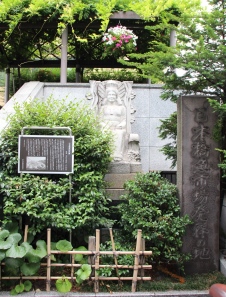
I went to the birthplace of the Nihonbashi Fish Market where the statue of Otohime is located.
On the other side, there is the Nihonbashi dock "Sou Juro Riverside". There is a sightseeing boat sailing through the Nihonbashi River.
It was a very nice day and a very hot day, but the dock was crowded.
The location is 1-8 Nihonbashi Muromachi, Chuo-ku.
Next to the statue of Otohime is a stone monument from the Nihonbashi Fish Market.
There is "Nihonbashi" over the river.
The current bridge is a two-way stone arch bridge that was completed in 1911.
The decoration was made by architect Yorinaka Tsumaki.
Fish shore
In 1590, after Ieyasu Tokugawa entered Edo, more than 30 fishermen from Tsukuda-mura, Nishinari-gun, Settsu Province (present-day Nishiyodogawa Ward, Osaka City) went to Edo to build Tsukuda-jima Island, and provided seafood to the Tokugawa family with permission to fish in the vicinity of Edo. In the sea at that time, fish and shellfish were so good that they were able to catch them so much even if they were paid up. Therefore, with the permission of the bakufu, the fishermen began to sell fish and shellfish on the board for sale, also known as board ships, on the banks of Nihonbashi, where water transport is good. This is the origin of the Nihonbashi fish shore.
The fish shore was located on the northern shore between Nihonbashi and Edobashi, and ships carrying fish were landed up the Nihonbashi River to the riverbank. It was crowded with many shoppers from the early morning, and the fish banks in the morning flourished alongside the daytime playhouses "Nakamura-za in Sakaimachi (Ningyocho), Ichimura-za in Kibiki-cho (Higashiginza) in Fukiya-cho (Ningyocho), Morita-za in Kibiki-cho (Higashiginza) in Higashiginza in Sakaimachi (Ningyocho) and Yoshiwara at night, as it is said to be "a place where thousand cars go in one day." (The majestic business of the Edo children was about to jump.)
This fish shore was decided to relocate to the current Tsukiji after the Great Kanto Earthquake of 1923 (September 1), and finally ended with the 300-year history of the Nihonbashi fish shore.
[Source] Chuo-ku Monoshiri Encyclopedia (Supervised Chuo-ku Tourism Certification Committee)
Chuo-ku Tourism Examination Past Problem Collection (Supervised Chuo-ku Tourism Examination Committee)
Official text of the Edo Cultural History Test [Beginner Edition] Oedo Mimonroku (Edo Cultural History Test Association editorial publisher Shogakukan Inc.)
[Marsha Horiuchi of Edo]
16:00 on September 16, 2015
I participated in a fun course with a time slip atmosphere to the Edo period by Makoto Takeuchi, director of the Edo Tokyo Museum.
The Edo people who lived an eco-friendly life while getting close to nature, based on the lunar calendar, even today.
There are lifestyles that have been inherited while changing the shape, but they are gradually forgotten.
It was also a time to feel lonely at the present time, when I was inferior with mental margin.
1 New Year's Day, First Sale, Inari-san, Umemi, Hinamatsuri, Cherry Blossom Viewing, Festival, Goldfish Selling, River Opening Fireworks, Mid-Autumn Moon, New Year's Eve Soba, Night Leave Bell (Not at the time)
By the way, "Kidai Shoran" in the underground concourse of Nihonbashi Mitsukoshi, from Nihonbashi to Imagawa Bridge (Kanda) in 1805
It is a picture scroll of prosperity. When I looked slowly, I noticed something interesting, please.
(Each photo will be displayed large when clicked.)
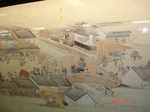 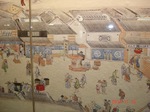 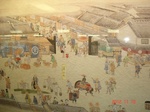
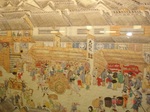 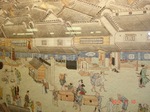 
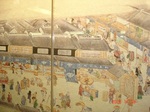 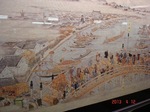 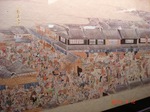
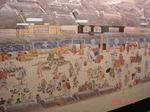 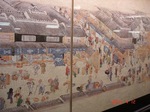 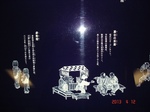
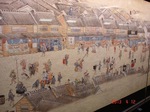 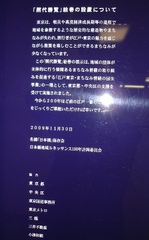
Now, I feel like Fukutoku Shrine in Muromachi 2-chome, and the "sacred shrine forest" coming next year will be saved.
gassho.
[CAM]
09:00 on September 16, 2015
Sumiyoshi-jinja Shirine, located in Tsukuda, was separated from Tamino Shrine in Tsukuda-mura, Nishinari-gun, Settsu-kuni (now Nishinari-ku, Osaka City) in 1646 (1646). It was relocated to its current location (Monoshiri Encyclopedia p.107). The fishermen who emigrated to Edo from Tsukuda Village in Settsu Province have also contributed greatly to the landfill of Tsukiji.
As a resident of Tsukuda, Chuo-ku, Tokyo, I longed for a long time to see Ta Minoru Shrine in Tsukudamura, Nishinari-gun, Settsu Province, but it has finally been realized.
The precincts of Tamino Shrine seem to be a little wider than Sumiyoshi-jinja Shirine.
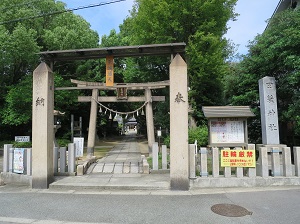
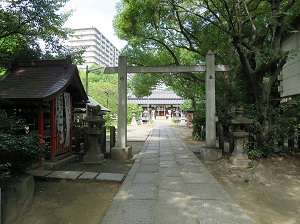
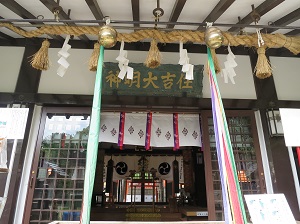
There is also a sign of donation from Mr. Fujima, Chuo-ku, Tokyo.
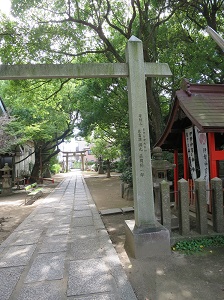
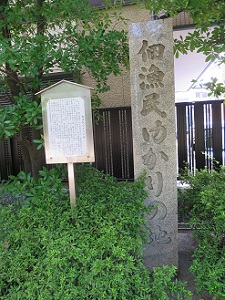
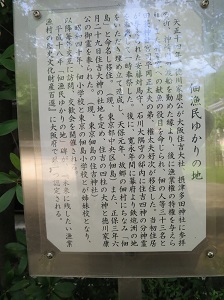
Monuments and descriptions related to Tsukudamura fishermen.
In the precincts, there is also the subsidiary shrine of Toshogu Shrine ...
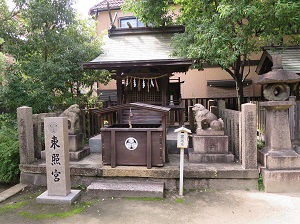
[Kra-san]
18:00 on September 13, 2015
In 1664, a vegetable sales floor was set up in the Kyobashi River, where water transport is good. After that, until the market was moved to Tsukiji in 1935, it flourished as a vegetable market that supported the kitchen of the Edo common people who handle fruits and vegetables widely called "Kyobashi radish riverbank". Just under the elevated elevated railway between Ginza and Kyobashi, there is a stone monument at the site of the Kyobashi Daikon Riverside Aomono Market. Nearby are historical sites such as the birthplace of Edo Kabuki.
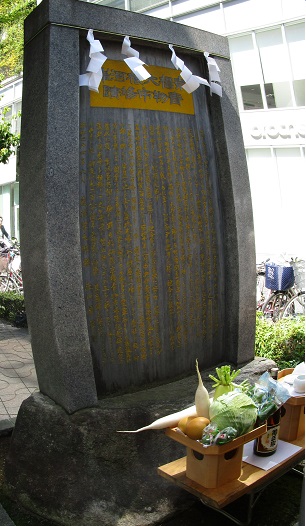 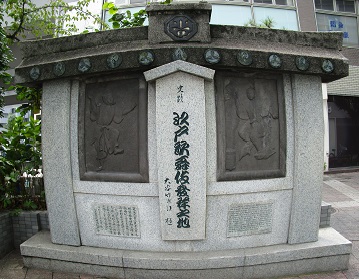
Stone monument of 'Kyobashi radish riverside green goods market ruins' Stone monument of 'the birthplace of Edo Kabuki'
 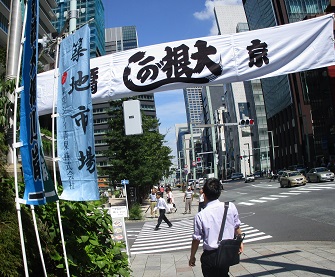
In 2014, we celebrated the 350th anniversary of the birth of "Kyobashi Daikon Bank". The Kyobashi Daikon Riverside Association celebrates its 350th anniversary, and for two years from June 2012, it is said that radish will continue to be distributed to 350 people once a month until 2016, when Tsukiji Market moves to Toyosu. This month, a free radish distribution party was held at Kyobashi Daikon Riverside Park from noon on September 11 (Fri).

This time, in addition to radish from Mount Yotei, Hokkaido, cabbage from Gunma, pears from Fukushima, and so on.
 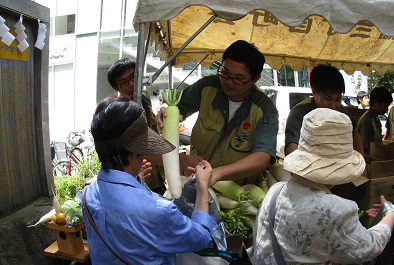
All of the vegetables distributed are very popular because they are excellent freshness directly sent directly to the market selected by Tsukiji professionals. This free distribution meeting starts at noon on the second Friday of every month. Long lines can be made every month, so if you want it, it seems that it is important to go early.
[Akira Makibuchi / Sai Sharaku]
14:00 on September 4, 2015
Matsuo Basho (1644-1694), a haiku poet in the early Edo period, explored Shofu (the urban haikai) in Edo, and flourished as an Edo school. Sanpu Sugiyama, a fish wholesaler in Nihonbashi, who was a disciple, supports both physical and mental aspects. One of the Shomon Jutetsus, Enomoto (Takarai), Sokaku set up a mansion in Kayabacho, and Hajin Hayano, who was a disciple of Buson Yosa, lived in Nihonbashi Motoishi-cho. It is a place. I would like to visit Basho stone monument in the city.
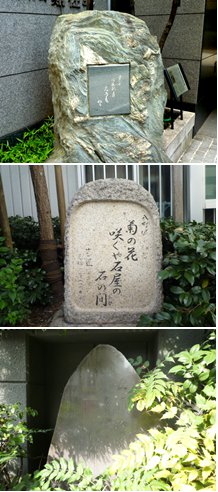 The stone monument (pictured above) is located in the store of Nihonbashi Funasa in Nihonbashimuromachi. The stone monument (pictured above) is located in the store of Nihonbashi Funasa in Nihonbashimuromachi.
'Hakuya Matsuo Momo Aojuku Spring'
In 1679, he was 36 years old Basho. The signboard on the side of the monument says, "When I was 29 years old in 1672 (1672), I left Edo from Iga Ueno and lived in a rented house of Taro Ozawa (Basho Monto, Haigo shaku) in Odawaracho for eight years until 37 years old in 1680. " His haigo at that time was Momo blue.
stone monument (center of the photo) on the south side of Kameshima Bridge Nishizume in Hatchobori,
'Chrysanthemum blooms and Ishiya no Ishinoma'
In the fall of 1693 (1693), the work of Basho 50 years old. In the adscript, "In Hatchobori", did you write the poetry of chrysanthemums blooming between the stone materials of Ishiya facing Horiwari? This phrase is also featured in the lyrics of 'Mitsuhashi' illustration of 'Edo Famous Places'.
The stone monument (pictured below) was built at Hoju-ji Temple in front of the south gate of Tsukiji Honganji Temple.
'What is the beginning of the brush of Otsu-e?'
On January 4, 1691, Basho was 48 years old. Otsu-e is a popular painting that was sold around Mii-dera Temple in Tsu, Oomi National University. It began with the abbreviation of Buddhist paintings for the common people's worship, and was greeted by the world as a souvenir on the way" (Koujien). It is said that the painter of Otsu-e took a break from work on January 3rd. Therefore, he wrote this phrase at the beginning of the book on the fourth day. Akira Makibuchi
|
Links
|