I walked around Ginza 5-8-chome, where various historical archeological sites are scattered even though it is a little quiet, with the eyes of people walking around the pedestrian paradise.
This time, we will report the location shown in bold letters. Please look forward to the next time 
< Line Hojo>
Ginza Station ... Monument of Sukiyabashi ... Tokoku Kitamura & Toson Shimazaki Monument ... Takuboku Ishikawa poetry monument ... Pedestrian Paradise ... Ruins of Commercial Law Training Center ... Ruins of Kinharu Yashiki ... Ginza Brick remain Monument ... Monument of Ginza Yanagi ... Shibakuchi Gomon Ruins ... Sanjumabori Ruins ... Former Japanese National Railways Crossing Signal ... Inspection Service Start Place ... Ginza Information Center ... Shimbashi Enbujo ... Ruins of the Tokyo Chamber of Commerce ... Shozanma Juku ... Kano
 Departing from Ginza Station,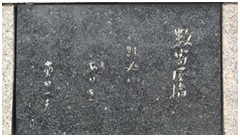
Monument of "Your Name" in Sukiyabashi Park
Sukiya-bashi Bridge was located in the outer moat of Edo Castle in the early Edo period.
A bridge built.
Removed in 1958 by landfill.
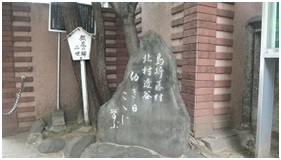
Monuments of Tokoku Kitamura and Toson Shimazaki
He was a school from Toruya and Fujimura.
This monument is located in front of Yasuaki Elementary School.
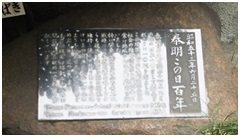
June 25, 1978
The 100th anniversary of Yasuaki Elementary School
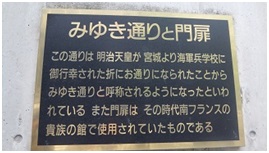
The street in front of Yasuaki Elementary School is Miyuki Street.
As we miss.
You know the Miyuki tribe~~~
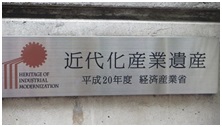
Such signs are also displayed in Ginza
I have it!
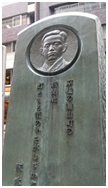
Takuboku Ishikawa Monument
Takuboku is working hard in the Asahi Shimbun.
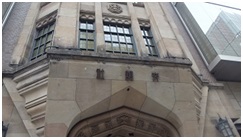
That famous Kojunsha.
By Takenaka Corporation
Even if it became a big building, it left an old impression!
Thank you!
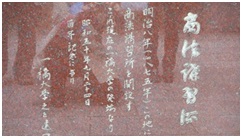
Commercial Code Training Center
Well, it's in front of Matsuzakaya on the main street!
The predecessor of Hitotsubashi University. Arinori Mori started the course.
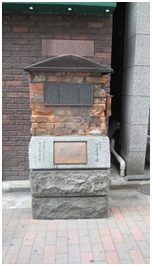
Monument of Ginza Brick remain
Well, you've left this too! Thank you!
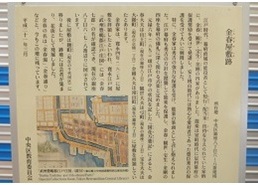
Ruins of Kinshunyashiki
He was a Noh actor under the direct control of the bakufu.
These working women form a stylish Shimbashi geisha. There is a famous Kinshunyu near here.
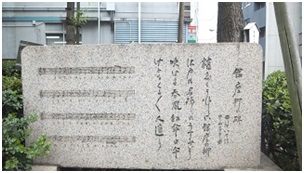
We decided to plant pine, maple, and cherry blossoms for street trees, but not all. Only willows were rooted.
Monument to the lyrics and music of the song "Ginza's willow"
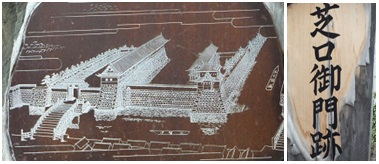 In 1710 (1710), the Masugata-mon Gate was built in Kitazume, Shimbashi, to show the dignity of Japan at the time of the Korean Communications Envoy Edo Sanfu. This gate was called Shibakuchi-gomon. At the same time, Shimbashi was temporarily renamed Shibakuchi-bashi Bridge.
However, it was burned down in 1724, and since then it has not been rebuilt and the stone walls have been removed. Shibakuchi-bashi Bridge returned to the old name of Shimbashi.
A copper plate with the design of the gate at that time. I remember the old look.
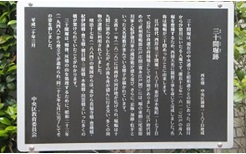
Thirty-ken excavation site
It was excavated in 1612.
This name was given because the width of the moat was thirty.
In 1828, the moat width was reduced to nineteen.
Reclaimed in 1952.
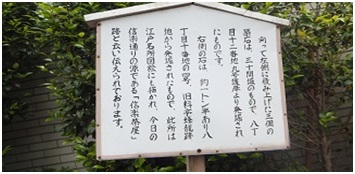
There are three large stones next to the description version above. Explanatory version of the stone group.
These are at the highway exit.
It's hard to understand.
The first paragraph is so far.