The kaempfer cicada, which tells the end of the rainy season, the "Cicada Rain" of Minminzemi and Abrazemi in the middle of summer, and the squeak of Tsukutsukuboshi and cicada in late summer make you feel the changing seasons.
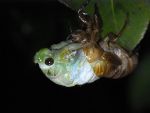
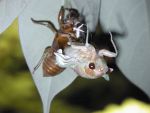
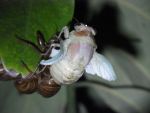
There is no age of pupae in the incomplete cicada. The appearance of the last-aged larvae coming out of the soil and molting and transmuting into an adult can be seen here at Tsukuda Park from the sunset of summer to the middle of the night.
It is beautiful, dynamic and mysterious as the center of the back breaks, pulls out the parts one after another while deflecting the body, and finally gradually stretches out the blue-white wings. (Refer to the photo below)
In the case of abrazemi, it is generally said that it is about 4 to 7 years on foot from an egg, and that emerges adults end their lives in a few weeks.
It matures within a few days after emergence, and the worm sings and calls ∞, and after mating, inserts a spawning tube into a dead branch or a raw tree ( trunk) to lay eggs. It is said that it is characterized by a zigzag-shaped spawning mark.
I hear that hatched larvae fall in the air and dive in the soil.
 ⇒
⇒ ⇒
⇒
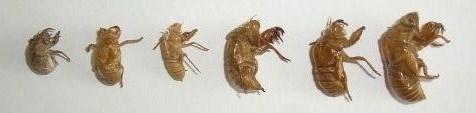
✎Cicada shell
From left to right kaempfer cicada, Higurashi, Tsukutsukuboshi, Minminzemi, Abrazemi, Bear Seminar