"Traditional performing arts" and "art entertainment appreciation" seem to have a little high threshold, but among the traditional Japanese performing arts that have continued since the Edo period, "Kouta" may be relatively familiar.
Before the bubble burst, "Three kinds of sacred treasure of Salarymen" were "go," "go (or mahjong)" and "kouta." Are there many people who have the experience of meeting the "Kouta" review party that you know has just started?
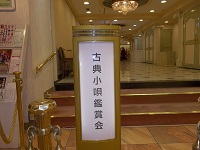
On Saturday, the 5th, when the cherry blossoms of this year are likely to be seen, I came to an appreciation party for "Kouta". The place is Mitsukoshi Theater on the 6th floor of Mitsukoshi Nihonbashi, and the "23rd Classic Kouta Appreciation Party" is being held. This association, which states that "the real pleasure of tradition-listening to the best of Edo Kouta", is divided into parts and two parts, 35 performers, and teachers of the Japan Kouta Federation. "I will return even if I stop", "Kinuginu", "Shinobu Nara", "Waiting", this is an example of the title of Kouta, a song name that makes me feel "emotion" and "smart" like a time trip to "Edo". There are also themes reminiscent of plays such as "Kawasho" and "Ochijin". Involuntarily speaking with a friend of your neighbors, saying, "This voice is comfortable for your ears" to the light and stylish verses and the shouts of your favorites, which are said to be "Nikori" and "Niyari". At the end of the day. "Oh! Is that time?" I'm getting better and better, so I'd like to immerse myself a little more. ・・
After the performance, I was able to talk a little to my friend, "Master of Hamacho", who has also appeared at the "Chuo-ku Traditional Performing Arts Appreciation Party", so I introduced it specially.
① Kouta was founded by Oyo Kiyomoto in the late Edo period. Developed as a zashiki-gei (a zashiki-gei (a zashiki-gei) where the best people gather.
② This time, I picked up "Edo Kokakyoku", so one song was short, so it was two songs, but it was not always two songs.
③ Shamisen is a "claw play" that uses fingers without using plectrum. Kouta is the only kouta that does not use plectrum among Joruri and Utamono music music that uses shamisen.
④ The names of the performers are also "Tate ...", "Spring bamboo ..." and "Tazu ...". I heard that there are more than 70 schools now.
⑤ The difference from 'Hauta' is that 'Hauta' plays the shamisen, and the tone of the tune is like 'Hauta' is 'Fad Song' and 'Kouta' is chanson.
Finally, for those who thought, "Let's start playing kouta in the future."
There is no “age limit” to start. When you start thinking, look for a teacher first. If you are contacted by the Japan Kouta Federation at such a meeting, you will be introduced to a teacher near your home. (It's good to ask Shamisenya.)
Even if you do not prepare shamisen from the beginning, there is always something for rehearsal in the training hall. It is said that there are many teachers living in Chuo-ku. Even if the "inheritor of traditional performing arts" is impossible, why not start the time to immerse yourself in "the best of Edo" a little away from the busy daily life?
(Public) Japan Kouta Federation 03-5641-0830
Although it is not Chuo-ku, a workshop for "first-time people" is also planned. Please feel free to contact us.