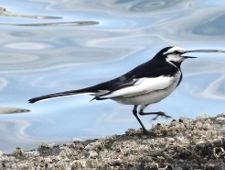

♂Summer feathers › Summer feathers
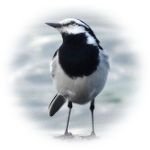 Nowadays, it is common in parks in urban areas throughout the year, and it is a hakusekirei that has become an "urban bird", but it is a feather color that tells you the season to go around.
♂The summer feathers are black from the top of the head and white with black overeyed lines. The chest is black and below the belly is white.
(Winter feathers are gray in their backs)
♀In summer feathers, the top of the head is black, the back is dark gray, and black feathers are mixed.
(The winter feathers in females have gray back from the top of the head)
Hakusekirei is widely distributed in the Eurasian Continent.
In Japan, it was used to breed on the coast of northern Japan in spring and summer, and in autumn and winter in the lower reaches of the river south of central Honshu. The number of individuals expanding their habitat has increased, the breeding area has spread nationwide, and today it is also counted as "staying bird" as today.
Non-breeding season says that it is thought that urban buildings can be applied to the environment by using urban buildings such as the gap between bridge girders, street trees and buildings at night.
Move the tail feather up and down while squeaking "Thuchun" and "Thuiley", and stop walking and often see walking again.
Wave-like flight when flying.
In addition to the smart body shape of black (dark gray), white two-tone color and long tail, it seems to be a wild bird that attracts considerable attention due to its comical work.