During the rainy season, how are blog readers going to spend? If you think that there was a sunny day like midsummer this year's rainy season, it's abnormal weather such as hail and sudden thunderstorm!
Unlike the best season when you go out in early spring, you are worried about sudden changes in the weather these days. Today, I would like to change my taste a little bit and explore Chuo-ku in literature, Ishikawajima and Tsukuda in the Edo period.
On my way back from the company on Friday, I bought two books set in Chuo-ku at a bookstore in front of Tokyo Station.
Speaking of period literature in Chuo-ku, first is Shotaro Ikenami's "Onihei Criminal Book". In the middle of the 18th century, it is a TV drama / novel that was famous as a model by Heizo Hasegawa, who managed the Ishikawajima Hitoshojo under Sadanobu Matsudaira of Kansei's reform, in the latter half of the 18th century. I would like to change the angle and introduce a novel focusing on the human footing area.
The first book is Seicho Matsumoto's "Mujukujinbetsucho" (Bunshun Bunko). This short story collection contains 10 stories, of which  "Tsunami" is a story of a person's foothold. In the novel, Shinta, who is from a fisherman in Noto and has arrived in Edo and has no lodging, is stopped by Okachiki while walking in the town, and is taken to Tsujibansho, and is kept in a temporary prison (detention center) in Temmacho. Will be From Temmacho, he is sent to Kanayama in Sado, where he is forced to work on drawing water on hell-like tunnels, and often lose his life as it is, but fortunately Shinta will be sent to Ishikawajima.
According to a textbook on Japanese history, `` As the number of indwellers who abandoned rural villages and flowed into Edo due to the famine of the Tenmei era in the latter half of the 18th century increases, the Shogunate has detained these indwellers in Ishikawajima's people's foothold. I tried to improve security ", and from such an explanation, I think that it was somewhat like a "jail", but it seems to be a little calmer. "Tsunami" also states that "what comes for a certain period of time and has good grades will be released with labor wages." It seems that Ishikawajima was given a related job for those who have a job with farmers, such as farmers, peasants.
One autumn day, a fisherman sees a new cloud weather familiar with the weather and predicts that the tsunami will come. Ishikawajima, Tsukudajima, and Tsukiji were quickly hit by the tsunami, and with the permission of Yoriba magistrate, "Escape, and if the high waves subside, gather around Eitai Bridge," swim while diving in the waves and escape to Fukagawa. It is not mentioned in the novel whether Shinta eventually returned to Eitai Bridge, but in this novel we can learn about the people's foothold at the time.
Furthermore, in the nine other stories of the Unshukujinbetsucho, the story of the prison house in Temmacho, the island flow to Hachijojima Island, and the escape from Sadogashima, 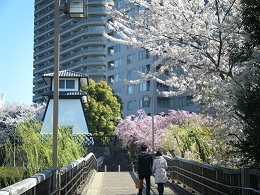 the world's hell, you can learn about various worlds in places that are very different from relatively human places such as Ishikawajima Ashoroba.
It's also a good idea to go back to Edo through novels during the rainy season.
Next time, I would like to introduce Shugoro Yamamoto's "Sabu" which I bought at another bookstore.
(The upper right photo shows Ishikawajima Lighthouse: /archive/2014/04/post-1956.html, which was introduced on April 7 of the cherry blossom season blog, "Chuo-ohashi Bridge and Tsukuda Park":