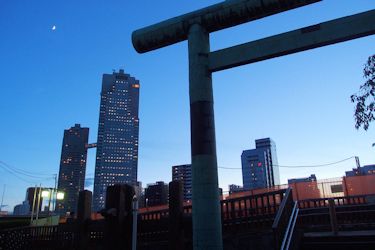
Tsukuda Island is home to Sumiyoshi-jinja Shirine, where the main festival is held once every three years.
When you look at Tsukuda digging from the top of Tsukuda Kobashi, you can see the following notes.
"In this place, there are large banners and hugs that were allowed to be built by Tokugawa shogunate in 1798, so please do not enter or dig them up. Tsukuda Sumiyoshi-ko
It is said that the "pillar" of a large banner drawn by Hiroshige, which can be set up at the main festival once every three years, and the "daki" that supports it are buried in the water like a time capsule.
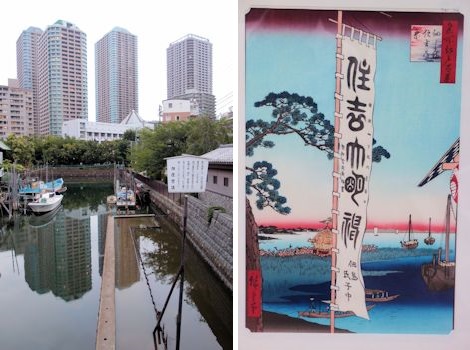
Every time I come here to Tsukuda Island and see this note
“Can’t the tree be buried in the water?”
Or
“Isn’t it okay until now, but it’s gone missing this year?”
I'm going to think about it.
That's why the work of digging this pillar and hugging tree, which are only once every three years. I was a little interested, so I watched it (Sunday, July 5).
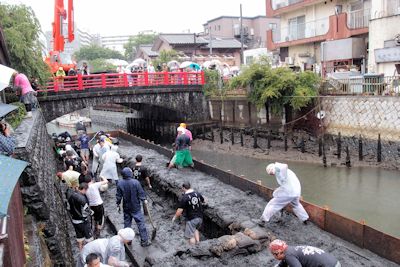
Unfortunately, it was raining on the day.
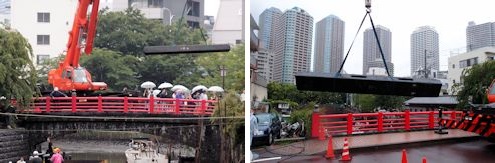
This digging starts from digging mud until the buried tree can be seen, but just looking at getting your feet off by mud can be seen, it can be seen that it is quite hard work.
Then, the buried tree begins to appear, and we move on to the task of taking it out.
Use a crane to remove the tree. Once the mud is dropped with the water of the moat, it is lifted to Hashigami.
It will be repeated many times.
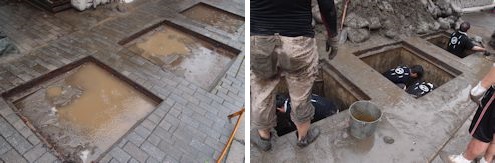
On the other hand, the work of the hole moat where the pillar is set up is performed separately. There are six large banners, which can be set up in six places, but there are places where three holes can be drilled in each place.
I'll just dig up the hole.
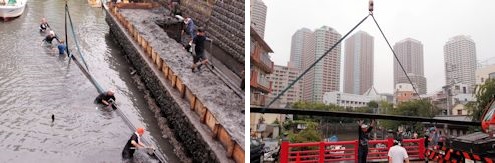
After the tree, which was a part of the holding tree, was removed, six pillars were removed. It is said that the length is close to 20 meters.
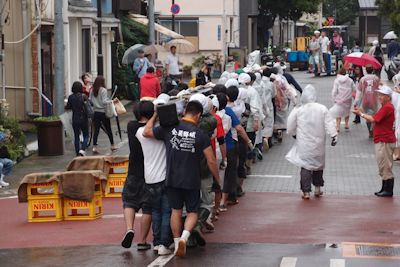
Young people will carry that pillar.
In order to take over this traditional work, the interval of once every three years may be just right.
Finally, a hugging tree was assembled to raise a large banner.
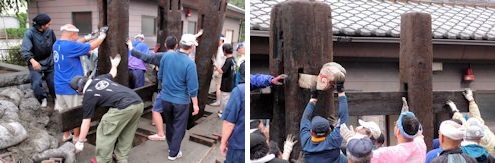 As a result, the buried tree was dug out safely this time, and we were ready to make a big banner.
According to various studies, it seems that it is the logic that oxygen is necessary for a tree to rot, and that filling a tree in the water does not let oxygen touch it.
I don't think the old people knew this logic, but it may have been a very natural knowledge from experience.
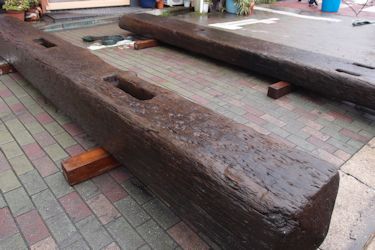
When I walked all the way to Kachidoki on Tsukishima's Nishinaka-dori, there was a bridge called Nishinaka-bashi, but this bridge was replaced last year.
Dozens of pine stakes were embedded under the previous bridge, strengthening the ground and supporting the bridge.
At the time of replacement, the pine stake was dug out without rotting, and now it is displayed beside this bridge or reused as a wooden bench.
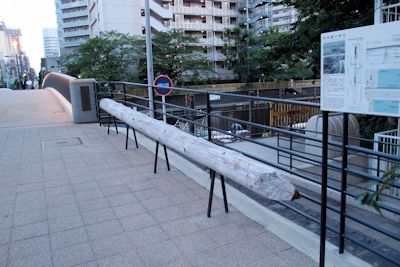 You may know that thousands of pine stakes were used under the previous Maru Building in Marunouchi, Chiyoda-ku, and more than 10,000 pine stakes were used as solid foundations under the station building of Tokyo Station. It is said that a wooden stake is also struck under the torii gate of Itsukushima-jinja Shrine.
It is called the story of this pine stake, the story of the pillars of Sumiyoshi-jinja Shirine's large banner, and the "power of wood" and "wisdom of predecessors" drop their heads.
Recently, liquefaction has become a problem in Great East Japan Earthquake, but the "power of wood" has been reviewed, and the "thinned wood" has been embedded into the ground as a stake, and it has begun to be used as a countermeasure against liquefaction.
By the way, it is the main festival of Sumiyoshi-jinja Shirine, but I think that a large banner will finally be set up on the 26th, and the festival mood will increase.
I've never seen a big banner yet, so I'm looking forward to it.