Kizo Kumoto appeared in the Nikkei Shimbun "Leader's Bookshelf" today (September 20, 2015), and lists some works by Kafu Nagai as a favorite reading book. Even if you say Mr. Kumoto, Tokyo may not have a name recognition, but it is Mayor Kambe, a former self-government bureaucrat. I had a few connections and talked a little, so I read it interestingly. It is said that Mr. Kumoto was in contact with the Kafu "Gyutei Nijo" about 20 years ago by a friend of the university, but I have been there since this year.
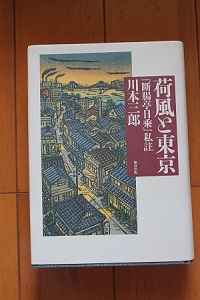
It has been half a century since I first came to Tokyo after entering university, but I did not lose my disgust with the term "Tokyo" and "Edo" and the Kanto dialect, but suddenly I began to feel interest in Edo culture. It was only after this year, and I came to the Chuo-ku sightseeing certification test. Actually, I have been living near Tsukishima Station for more than a dozen years, but when I invited a friend from my university days at the Sumiyoshi-jinja Shirine Main Festival the other day, I ate something called Monjayaki.
Then, lately, I read the works of Kafu Nagai and Junichirou Tanizaki, and finally obtained the complete collection of both individuals. The whole collection is currently trading at an alarming low price in the second-hand market, thankfully for what you buy. However, at the Nihonbashi Library in Chuo-ku, it is funny to say that the complete collection of Tanizaki is treated as valuables.
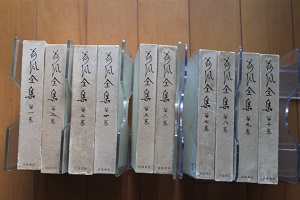
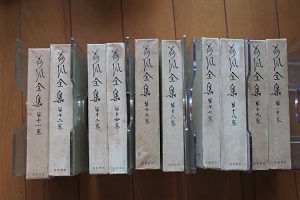
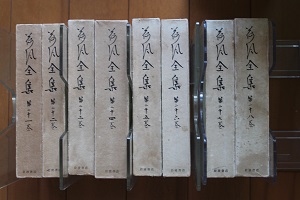
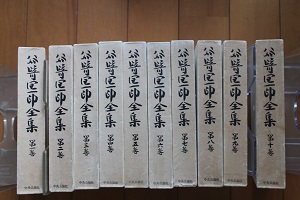
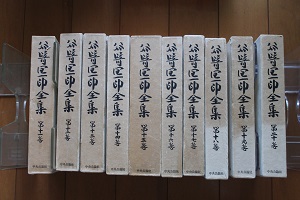
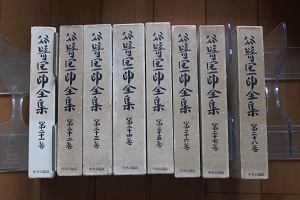
Kafu Nagai's "Gyutei Nijo" is also an abstract of the Iwanami Bunko version, and a complete collection is required to read the full text.
Finally, the heat has gone away, and it will be a great season for a walk for a while. As a poor old man, I would like to take a walk again in Chuo-ku, Tokyo with the feeling of a little wind while placing the Kafu "Gyutei Nijo", "Hyowa Geta", and Tanizaki's "Childhood" on the right. Where you are.