The other day, I stopped by the "Kachidoki Bridge Museum" beside Kachidokibashi for the first time in a long time.
This museum was built by renovating the substation used to open Kachidokibashi, but it seems that this year marks the 10th anniversary.
On my way back, I received a limited postcard for the 10th anniversary from the uncle of the museum, but I was happy and asked my uncle about the questions I always thought when walking on the Sumida River Terrace .
I asked you about "Kiyosu Bridge".
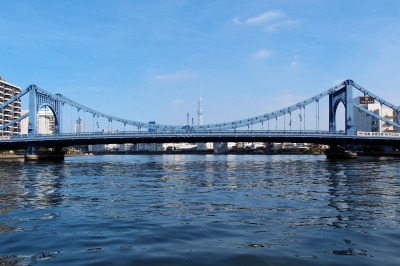 It is a suspension bridge built in a reconstruction project after the Great Kanto Earthquake and has become an important cultural property of the country.
"Eitai Bridge", which was built in the same reconstruction project, is said to be masculine, but this "Kiyosu Bridge" is said to be "feminal" because of its form, and is very popular and loved among the Sumida River bridges .
This part is where my eyes always appear when I walk on the Sumida River terrace.
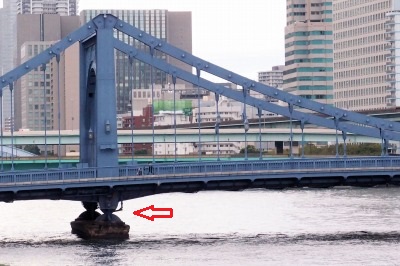
If you look at it from a distance, the lower part of the suspension bridge is constricted, and it seems to be broken somehow with a delicate feeling. The pillar of the suspension bridge had an image that it was thick and pierced into the ground, so I asked a super amateur question, "Why is this OK?"
I told you kindly, but it was a little difficult because I didn't have any prerequisite knowledge or talked about mechanics. I regretted that I should have listened after studying a little more, but I remembered the following and returned home.
・This part is a kanji character called "Kutsu" which combines "water" and "day" and is read as "shu."
・By the shoe, the direction of force due to the weight of the bridge is transmitted directly below the pier.
・The image of a bridge riding on a shoe.
A few days later, when I looked at the library, this part was called "shou", and in English it was called shoe (Shoo) and Shoo (Shoo) in shoes. In order to read "Kutsu" as "Kutsu", it seems that he uses the kanji "Kutsu" in the architectural industry term and read it as "Shu".
It is a member that conveys the weight of the bridge below, but since the bridge stretches and shrinks or distorts due to temperature changes, this bearing seems to play a role in "play" and adjusts well.
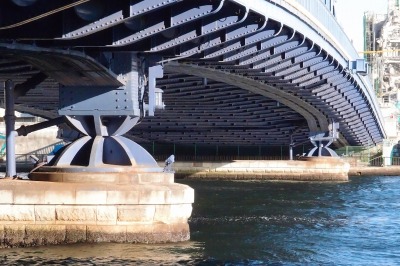 For Kiyosu Bridge, it is an image of wearing a shoe and riding a pier, so this part may be the Achilles tendon or ankle in humans.
Then, in terms of a woman's Kiyosu Bridge style, would it be like a "slim woman's ankle"? Weirdly convince me (a little excuse me?) 。
Kiyosu Bridge is a suspension bridge, but it is a suspension bridge that is rare when examined in various ways, and it is called a "automated suspension bridge".
An ordinary suspension bridge is a type called "other formal suspension bridge", and there is a weight (Ancho Reiji) for pulling the cable at both ends of the bridge.
(The photo below shows Rainbow Bridge of other fixed-type Suspension Bridge, and a huge white mass is Anka Reiji.)
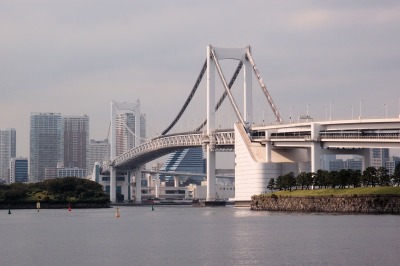
However, "autonomous suspension bridge" such as Kiyosu Bridge is a type that connects wires to both ends of the bridge girder. Since there is no weight on both ends of the bridge, it seems to be a refreshing look as a result (by the way, Kiyosu Bridge is not a wire but a steel chain, and this is also rare).
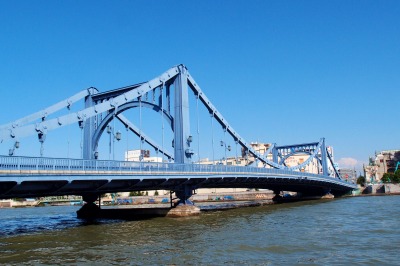
In addition, I had the image of a suspension bridge with a sturdy thick pillar piercing the ground, but in the case of a `` self-made suspension bridge '', it seems that it is related to the shape of a shoe (cloth) It seems that my way of seeing the pillars of Kiyosu Bridge was wrong.
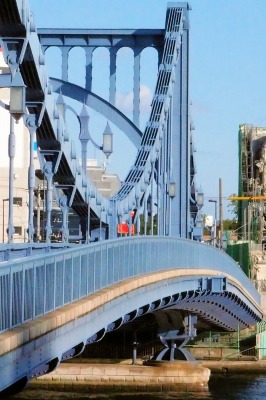 I felt that the way to make this "autonomous suspension bridge" is creating the "female charm" of Kiyosu Bridge.
I haven't learned enough yet, but I'm glad I was able to know a lot after asking my uncle. Thank you very much.
By the way, there are various types of bridges in the Sumida River, which is said to be the "bridge museum".
At the "Chuo-ku Marugoto Museum" on November 1st (Sun), you can get on the boat for free, but why not take a boat and compare various bridges?
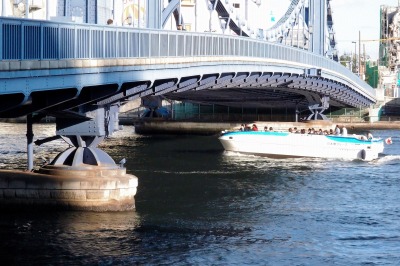
I think that there are places where Kiyosu Bridge feels feminine compared to other bridges.
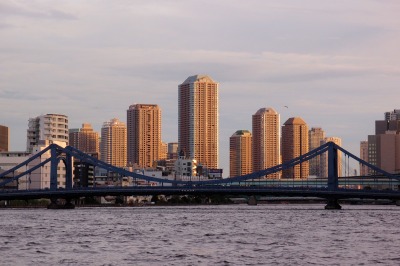 I hope you will find "female charm" by all means.