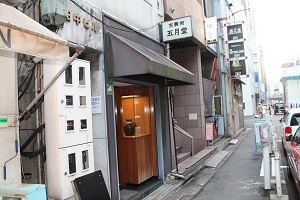
Meijiya Kyobashi Building (City Designated Tangible Cultural Property Building) 2-2-8 Kyobashi
 (Photo taken on November 24)
>The Meijiya Kyobashi Building was built in March 1933 as a head office building that doubles as an office and store of Meijiya Co., Ltd. This building is a steel reinforced concrete (8 floors above ground and 2 basement floors) office building designed by Sone Nakajo Architectural Office, which was called the largest and best design organization in Japan during the prewar period.
It is a valuable modern architecture that reflects the advanced architectural techniques of the early Showa era, along with the excellent architectural design in the Italian Renaissance style. In particular, this building is a rare surviving work created by Tatsuzo Sone, and delicate and splendid decorations are expressed everywhere while eliminating vague.
In addition, it was the first private building to be planned to connect the basement of the building with the subway station, and it is the oldest existing building integrated with the subway station, historically and culturally valuable building. It is a building.
The Meijiya Kyobashi Building, which has been preserved to this day after overcoming the Great Tokyo Air Raid and changes in the surrounding environment, is a valuable cultural property that tells the history of Showa and is an important building in the history of modern architecture.
(From the Designated Cultural Property site, Chuo-ku)
Antique Street
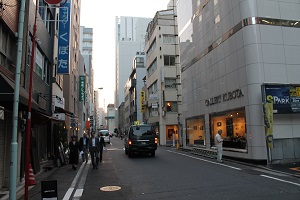
>In 1872 (Meiji 5), railways began to run between Shimbashi and Yokohama, making it easier for local people to travel to Tokyo. However, there is no major transportation from Shimbashi to Nihonbashi, and it seems that it has been a busy street since then.
Before the war, the need for antiques and antiques to decorate the reception rooms of companies etc. that entered this area increased, and many antique shops opened stores from Kyobashi 1-chome to Nihonbashi 3-chome, and now about 150 stores have been concentrated.
In particular, the streets of Kyobashi 1 and 2-chome are called "Antique Street" and attract art dealers and enthusiasts. At the Antique Festival held in spring and autumn, these shops, such as folk art, Chinese pottery, antiques, galleries, etc., will take this opportunity to make it easier for ordinary customers to enter. (From the tourist association site)
Utagawa (Ando) Hiroshige Residence Ruins (1-9 Kyobashi)
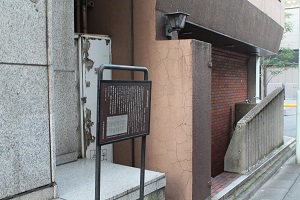
This is the site of a residence where Ukiyo-e artist Ando (Utagawa) Hiroshige (1797-1858) spent about a decade from 1849 to his death.
Hiroshige was born on the shores of Yaesu River (2-chome Marunouchi, Chiyoda-ku) as the eldest son of Genemon Yasuto, a fire extinguisher in the Shogunate, and became a disciple of Toyohiro Utagawa while working at a family job. Since "Tokaido Gojusanji", he has become famous as a landscape painter, and has also left Edo with "Toto Famous Places", "Hakkeino Maps near Edo", and "Hundred Views of Edo". In particular, "Hundred Views of Edo" is a representative work in this area.
The residence is said to have been a two-story independent house, located outside the back gate of Kano Nakabashi Yashiki, among the Oku painters of the Shogunate (Goyo painter) Kano Yotsuya.
March, 1995
Chuo-ku Board of Education
Bridgestone Museum of Art (under construction)
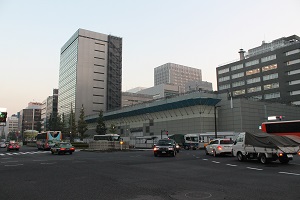
>At the Bridgestone Museum of Art, Western modern and contemporary art centered on impressionist and 20th century paintings.
It also houses Japanese Western paintings since the Meiji era.
In 1952, Shojiro Ishibashi, founder of Bridgestone Corporation, opened an art museum in the newly built Bridgestone Building and opened his own collection.
The Ishibashi Foundation was established in 1956, and in 1961, most of the artworks owned by Shojiro were donated to the Ishibashi Foundation, forming the core of the current collection.
"For the enjoyment and happiness of the people of the world," this is the motto of Shojiro Ishibashi.
This is the basic philosophy of the Bridgestone Museum of Art to date.
Since its opening, the Bridgestone Museum of Art has been enhancing its collection through continuous collection activities, holding various themes in special exhibition, holding lectures, various educational programs, and publishing books.
We will continue to provide opportunities and opportunities for people to meet, enjoy, and learn excellent works of art, and contribute to the promotion of mutual understanding among human beings in modern times and the development of art and culture.
Currently, the museum is closed for the construction of the New Museum, but we will continue to conduct research activities, collection activities, and educational dissemination activities during the museum's closed.
At the time of the opening of the New Museum, I would like to present the image of the museum suitable for the 21st century to everyone in an easy-to-understand manner. (From the museum site)