Sunday, November 1. The whole museum 2015 is held in Chuo-ku, and this year, 26 members of the Chuo-ku Tourism Association correspondents, including the second Chifuchu-Ii, board a free patrol bus. I acted as a guide to the city with a microphone in one hand. On the day, there were various events such as adjusting the number of passengers and adjusting the time of operation intervals, and heavy traffic congestion due to marches in the Ginza area, but the task of "telling customers the charm of Chuo-ku" is a great opportunity for our correspondents to show off the results of their usual study.
While on the right-clock free patrol bus, depart from the Higashinihombashi bus stop to head to the Hamacho bus stop, and turn left, one of the customers said, "Is it the name of a woman who passes Miyuki?" Is asked. 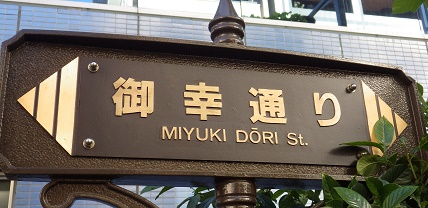 The road name information board outside the window says "Miyuki Street (MIYUKI DORI)" and the name "Miyuki" in the female name (although there are also Miyuki and Miyuki) is often heard in the female name. There was also a hero of a manga!
When you look up the kanji "Miyuki" in a dictionary, it reads "Miyuki, Goko, Gyoko" and says it has the same meaning as "Gyoko" in The Tale of Genji and history textbooks. If so, is this "Miyuki Street" also the street where His Majesty the Emperor passed? That means, if it is "Gyoko Street" that connects the Imperial Palace Plaza in Marunouchi to Tokyo Station, it may have come to pass when you get on a call train from Tokyo Station. However, when it comes to Higashinihombashi, it will be "a little far from the Imperial Palace, but why?"
The reason was at the Rinko Monument next to the bus stop in Higashinihombashi. Before the war, the site where Nihonbashi Junior High School is currently located was Chiyoda Hirojo Elementary School (founded in 1877, closed in 1945).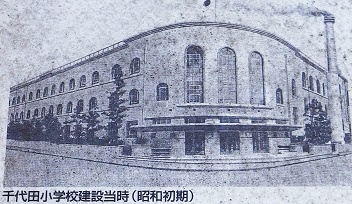
[Chiyoda Hirojo Elementary School in the early Showa era (from Chuo-ku Board of Education explanation version)]
In 1923, Tokyo was hit by the Great Kanto Earthquake, and many areas, including Chiyoda Hirojo Elementary School, became burnt fields. Chiyoda Hirojo Elementary School was completed in December 1929 with a reinforced concrete non-combustible structure as a reconstruction elementary school due to the earthquake disaster recovery project, but in March 1930 the following year, the Emperor visited the imperial palace where the Emperor revived. It is written on the monument that the car stopped near the current "Riyuki Monument" beside the school and visited the school as a rest, and apparently, "Miyuki" at this time became the name of the road.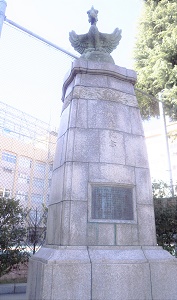
[Riyuki Monument]
By the way, Speaking of "MIYUKI DORI" in Chuo-ku, there is another famous "Miyuki Street" in Ginza. This is written in hiragana, while MIYUKI DORI in Higashinihombashi is kanji, but this street that connects Shimbashi Enbujo and Hibiya Park and runs through Ginza 5-6 chome in parallel to Harumi-dori St. It became famous as a sacred place for the Miyuki tribe. Shortly before the start of the Tokyo Olympics, in 1964, a social phenomenon in which young people with unique fashion, who had broken Aibelek, stood up and walked around Miyuki Street was called the "Miyuki tribe." Currently, as you can see, it is gaining popularity as a gorgeous street lined with brand shops. 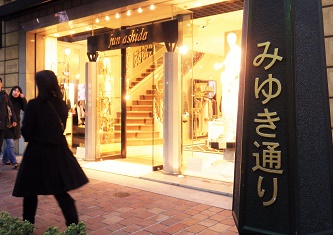 Of course, "Miyuki Street" in Ginza also comes from "Gyoko", and this is a road that was passed when Emperor Meiji went to Naval Academy, Naval College, Hamarikyu, etc. in Tsukiji.
[Miyuki Street]
Location From 2-2 Higashi Nihonbashi, Chuo-ku to 2-10 Higashi Nihonbashi.
[Riyuki Monument]
Location 1-10-1 Higashi-Nihonbashi, Chuo-ku, 103-0004 (Nihonbashi Junior High School Hamacho Riverside Street)
[Miyuki Street]
Location From 5-1 Ginza, Chuo-ku to 6-4 Ginza.