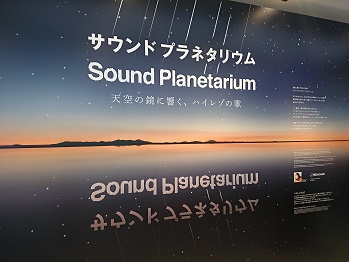
We visited
the Sound Planetarium, an event where
you can enjoy music and planetariums held at the Sony Building at Sukiyabashi intersection.

This is the third popular event.
The planetarium projector MEGASTAR-II (megastar two), which can project stars that are not normally visible to the naked eye, plays a beautiful starry sky according to the high-resolution sound source (high-resolution), which has more information on the sound than CD.
The video and graphic art projected on the projector are also beautiful, and it is a very enjoyable program.
I was very impressed by the previous sound planetarium, so I was really looking forward to it again this year.
This time, the floor of OPUS on the 8th floor of the Sony Building, which will be the venue, is affixed with mirror reflection materials.
Like Uyuni salt lake, the stars and scenery are reflected on the floor, and you can enjoy a very beautiful sight.
Three songs will be played in the 15-minute program, but in the first half of the exhibition (until 1/17) and the second half (1/18-2/14), the songs will change and you can enjoy a different atmosphere.

My recommended point is the starry sky that moves synchronously with music.
It seems that megastars are playing music on stars like musical instruments.
Please pay attention to the sea of stars flowing overhead.
In addition, it is unique to this event that you can see the projecting megastars very close.
In the permanent planetarium building, it is difficult to go near the projector.
It is a very valuable opportunity to enjoy the megastars and the starry sky at the same time around the corner.
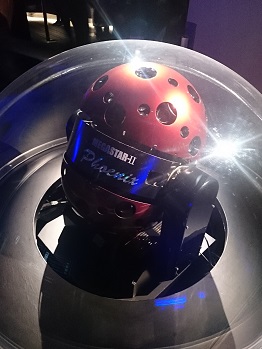
(For the sake of interview, we have taken a special photo.)
This time, the model is MEGASTAR-II Phoenix (Megastar to Phoenix).
It is a megastar with a beautiful red painting inspired by immortal birds and a rainbow-colored character.
The glittering body during the projecting is also very nice, so please take a look.
Every year, weekends and holidays are often crowded, especially the closer the end of the exhibition, the more crowded.
My recommendation is after 5 p.m. on weekdays.
At that time, when you go out after seeing the planetarium, the illuminations of Ginza look like stars on the ground.
It is a beautiful moment that you can enjoy in this place.
The sound planetarium is held every day until February 14, from 11:00 to 19:00.
Admission is free, and a 15-minute program is screened three times per hour.
For more information, please visit the website.
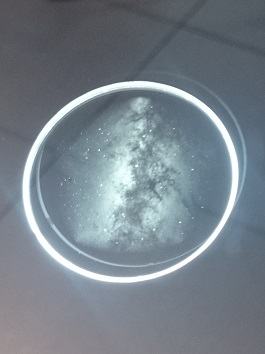
In addition, on the first floor, the ultra-precision star base plate GIGAMASK (GIGAMASK) is open to the public for the first time.
Thanks to the joint development of Giken Ohira, led by Megastar developer Takayuki Ohira, and Sony DADC Japan, the planetarium has made it possible to generate the world's largest number of star projections of 1 billion.
The world's smallest 2/10,000 mm hole in the palm of the hand.
It's so beautiful, so please take a look.
When you go to Ginza, please enjoy a trip to the star sea.