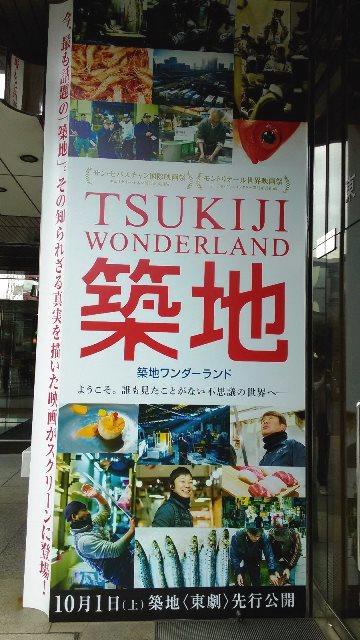
 This is Tsukiji Wonderland.
(Chuo-ku's favorite people can not miss it?)
I've seen the movie, so I'd like to report it.
This time, except for the poster photo.
I'm just writing.
It was released in the eastern drama from October 1, but from October 15 it will be released nationwide.
Also at overseas film festivals (multiple)
It is said that it will be exhibited.
○Overview
The Tokyo Metropolitan Central Wholesale Market Tsukiji Market itself consists of the Fruit and Vegetables Department and the Fisheries Department, but the movie is a documentary focusing on the Fisheries Department.
However, the images are very beautiful, and the appearance of people who come out naturally in their daily lives.
It was also like a powerful drama.
Through the movie, I was able to realize what "Tsukiji brand" or "TSUKIIJI" in the world means, and why it becomes a brand.
○Highlights of the movie
・If you dare to mention the main character, is it "the people of the wholesaler"?
The professional figure as a connoisseur is drawn vividly. Every day, a large amount of fish (seafood) from all over the world gathers in Tsukiji. Even the same fish has a different face every day.
Their role is to buy such fish from wholesale through auction, process them properly, and sell them to professional cooks and other people who come to Tsukiji to buy them.
There is also a high-quality eye-catching power to instantly identify the good and bad of fish, and a high-quality technique that processes it without losing quality.
For those who come to Tsukiji to buy foodstuffs, wholesalers are indispensable.
In the movie, such wholesales and wholesales (the side that brings ingredients to Tsukiji), or the human relationship between wholesalers and buyers is firmly depicted.
For example, culinary professionals such as Rokusaburo Michiba, a chef at famous Michelin-listed restaurants and long-established restaurants also visit Tsukiji to discuss ingredients with wholesalers.
Here, cooking professionals trust middle wholesalers, and middle wholesalers try to answer that trust, and there is a business based on Tsukiji's unique trust.
This trust business is a tradition cultivated over the 80-year history of Tsukiji, and it is portrayed as an attraction and the biggest factor that makes Tsukiji a TSUKIJI.
・In terms of food culture, architectural value, history, etc.
There are also comments from prominent people, so you can understand the Tsukiji market from various perspectives.
・Then I wrote a story that a cooking professional would consult with a wholesaler,
You can also enjoy "after buying" with beautiful images of how to cook purchased ingredients.
You can also see the shops appearing like "Oh, that's that shop."
The names of shops in Chuo-ku are limited to Rokusantei (Ginza), Koju (Ginza), and
ESQUISSE (Eskis: Ginza), Sukiyabashi Jiro (Ginza),
Kizushi (Ningyocho) comes out (they are all famous shops).
(Of course, there are famous shops other than Chuo-ku. By the way.)
○Is this going to happen from a correspondent’s point of view?
・I think this movie is very important in terms of documenting the culture of Tsukiji,
Wouldn't it be recommended for those who want to enjoy gourmet food in Tokyo (especially Chuo-ku) where delicious food is gathered?
When you eat at a restaurant, you may be worried about the production area and brand, but I feel that the word "Tsukiji brand" will be more conscious of it, and I feel that the meal will be even more enjoyable.
・"Sisters" or "After Tsukiji Wonderland" after relocation,
Personally, I will definitely see if there is something that takes up outside the venue and Tsukiji 3-chome / 6-chome / 7-chome / Akashicho (Is it called Ura Tsukiji?)
Tsukiji Wonderland=Outside + (Tsukiji 3-chome, 6-chome, 7-chome, Akashicho)