At the Chuo Ward Local Tenmonkan (Time Dome Akashi), the special exhibition "Let's See Together and Know Together-Our Treasures-Newly Registered Residents' Cultural Properties Exhibition 2017" began on April 29 (holiday / Saturday). . Two items, "Sumiyoshi Shrine Reconstruction Method Book (block)" and "Shigure Hasegawa Related Materials", which were newly registered as a ward cultural property in 2017, are displayed. The exhibition will be closed on Monday until June 25 (Sun) and free admission. Chuo-ku HP "News of Ward Chuo" here>>
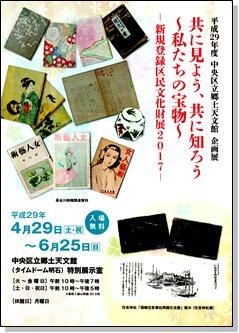 The first cultural property is a woodblock print of the "Tsukuda Island Sumiyoshi Shrine Reconstruction Method Book". Three woodblocks carved in 1835 (1835) are the original plate of a document that raises votive money for the reconstruction of Sumiyoshi-jinja Shirine, which was destroyed by fire. Sumiyoshi-jinja Shirine was hit by a great fire twice during this period, 1829 (1829) and 1834 (1834). It became difficult to rebuild on their own, and Shirakiya, a group of wholesalers, served as caretakers, and a group of wholesalers embarked on support. It is said that the woodblock reads, "We will collect Nikkesen in accordance with the holding for five years."
The second cultural property is "Shigure Hasegawa Related Materials", which covers a series of materials such as books, magazines, manuscripts, and photographs by female writer Shigure Hasegawa. Tokisame was born in 1879 in Aburamachi, Nihonbashi-dori Street (present-day 3-chome, Nihonbashi-Odenmacho). In 1905, after the screenplay "Kaichoon" became a special selection by Shoyo Tsubouchi and gained the spotlight, he established himself as the first female Kabuki writer. Fumiko Hayashi's "Wandering Records" was born from the magazine "Woman Art" which he presided over. "Old Mon Nihonbashi" has been handed down today as an essay masterpiece that vividly depicts the lives of the people living in the Nihonbashi area where they were born and raised.
This exhibition is an unprecedented exhibition focusing on newly registered inhabitants' cultural properties, and is an opportunity to experience familiar and valuable cultural properties unique to Chuo-ku. . Akira Makibuchi