"Ozu Washi" is an Australian merchant from Ise who has been involved in the history of Washi for more than 360 years since opening a paper merchant in Temmacho, Edo. On the third floor, "Ozu Historical Museum" displays the cargo of handmade Japanese paper "chogami" (for business and daily use of Machiya) sent from Echizen around the beginning of the Meiji era (48 sheets per sheet, 30 sheets, 1,152 sheets, 3.5 kg).
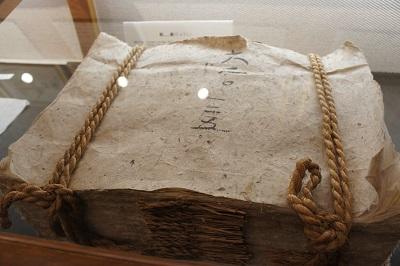
Echizen Washi has a long history of 1500 years. Shokichi Iwahara contributed to Echizen Washi no Sato, a society that loves Echizen Washi, "How was Echizen Washi in the Edo period sent to the three major consumer areas" to introduce a sentence of a paper. [The paper trade in the Edo period is said to be the second trade after rice and wood, but Echizen Washi washi was also sent in large quantities to the large consumption area of Edo. Transportation can be broadly divided into land and sea transportation. Papers from the bakufu and Edo of the Fukui Domain were carefully sent by land. After the mid-Edo period, it is sent to Edo using various boat transportation in consideration of safety and economic efficiency. In 1844, when a fire broke out from O-oku and the Edo Castle Honmaru disappeared, the Fukui clan donated 300,000 torinokoshi to the Shogunate for the fire (equivalent to 300,000 yen in terms of the current currency value). The manufactured paper was made with a guess of 7,500 sheets of horses (within 120 kg of public use), and was carried by horses across the Oi River with a large number of heads and human hands....。 Fukui is more than 500 kilometers away from Edo. I think Echizen Washi exerted various powers on industry, education, and culture formation from Edo to the middle of the Meiji era, from official papers, publications, ukiyo-e, etc. to living papers.