Junichirou Tanizaki's "Childhood" is quoted on the bulletin board of 'Armoi Bridge'. Before and after this quoted part, the surrounding scenery is well described.
The armor bridge was bridged in 1872. In 1888 (1888), it was replaced by a steel-framed truss bridge, and a tram ran over the bridge from the Taisho era to the Showa era. It was replaced with the current one in 1957 ("Monoshiri Encyclopedia"; 26). Since "Childhood" was serialized in the magazine Bungeishunju Ltd. from April 1955 (April 1955) to March of the following year, it is said that "The armor bridge has been decreed and removed." It may be before this replacement.
The Tanizaki family moved to Hamacho for a short period of time and then moved to Minami Kayabacho.
A description version of the Armor Bridge where "Kinen" is quoted
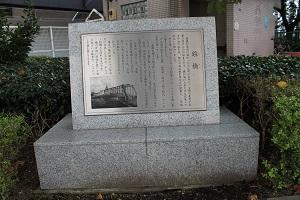
I was only a few months at the house in Hamacho, and it seems that I moved to 45 in Minami Kayabacho by the autumn of 1891. ・・・・・
・・I was told when I was a child, "Armor bridge used to be a handing of armor, and there was no bridge in tomorrow," but now there is a bridge called Kayaba Bridge downstream, and the armor bridge was old and removed, so I returned to the old days when I was not born again.
When I came from Koamicho and crossed the original armor bridge, there was a stock exchange of Kabuto-cho on the right side, but the first street on the left side was called Omote Kayabacho, and the next street parallel to it was called Ura Kayabacho. ・・・・・・・
Even after I came to Kayabacho, I was taken by my mother and grandmother and went to the main house almost every day. The distance was almost the same as that of Hamacho, and it would have been about five or six. From Ura-Kayabacho, go to Omote Kayabacho along Katsumi Yokocho, cross the armor bridge, turn left toward Koamicho, and immediately turn right and pass through Komeyacho. It was a time when there were no trains or cars on the legs of me and my grandmother, but when I crossed the armor bridge, I had to cross the humanitarian side facing wide traffic, so I was very careful not to be hit by a rickshaw. At that time, the bridge was one step higher than the road surface and had a slope, so the rickshaw running down from the bridge could not stop suddenly due to inertia, and it was unexpectedly dangerous. Armor Bridge was one of the not many railway bridges in the city at that time, and I think Shinohashi and Eitai Bridge were still old wooden bridges. I used to stop in the middle of the bridge and look at the water flow of the Nihonbashi River, but when I pressed my face on the iron balustrade and looked at the surface of the water that appeared under the bridge, it seemed that the bridge was moving instead of the water flowing. I also crossed from Kayabacho, and always looked at Shibusawa's house's fairy story-like building on the shore of Kabuto-cho upstream with a mysterious feeling. The Nissho Building is now standing here, but it was originally a Gothic Hall of Fame with Venice-style naves and pillars standing in the water right next to a stone cliff at the edge of the river. Who had the idea of building such a foreign classic hobby of mansion in the middle of Tokyo in the middle of the Meiji era? On the banks of Koamicho, on the opposite bank, there are many white walls of Tozo, and if you turn a little over the nose, it will be Edobashi and Nihonbashi immediately, but only one red-light district, like a stone-painted Western landscape painting, swept away the air from Japan. However, it was not necessarily disproportionate to the surrounding water city, and it was strange that the cargo ships, horse riding boats, and daruma boats that came and went through the previous flow were in harmony like the gondola. ("The First House of Minami Kayabacho"; 73)
We lived at the house in Hama-cho for only a few months, moving to No.45, Minami Kayaba-cho, sometime before the autumn of 1891. ・・・・・・
I remember being told as a child that there had been a ferry-crossing where Yoroibashi bridge then was; now the bridge is gone again, torn down because of dilapidation and replaced with the new Kayababashi bridge further downstream. Thus in a sense we have come full circle, back to what things were like in the old days, before I was born.
Coming from the direction of Koami-cho, at the point where the old Yoroibashi bridge crossed the river, you saw the Kabuto-cho stock exchange on the right. The first road to the left was called Kayaba-cho 'Front Street', while the next, paralleled to it, was 'Back Street'. ・・・・・
Even after the move to Minami Kayaba-cho, I still went almost daily to visit the main house with Mother and Granny. The distance was no more than it had been when we were in Hama-cho ―some five or six blocks. We passed from 'Back' to 'Front' Kayaba-cho vis the Katsumi side street; crossed Yoroibashi bridge and turned left toward Koami-cho; then turned right and passed thorough the rice dealers' district. It took only fifteen
minutes, even for Granny and me. There were as yet no streetcars or automobiles about, but Granny always warned me to be careful not to be hit by a rickshaw as I crossed the wide road beyond Yoroibashi bridge to get to the pavement on the other side.
The bridge was at that time raised somewhat higher than the surface of the road, and sloped down to meet it; and the rikishaws that sped down the slope often found it impossible to make sudden stops, so it could be quite dangerous. Yoroibashi was one of the not-so-numerous steel bridges then in Tokyo, while Shin Ohashi and Eitaibashi bridges were still made of wood. I used to stand in the middle of it and watch the flow of the Nihombashi River. As I pressed my face against the iron railings and gazed down at the surface of the water, it seemed as if it were the bridge and not the river that was moving.
Crossing the bridge from Kayaba-cho, one could see the fantastic Shibusawa mansion rising like a fairly-tale palace on the banks of Kabutocho, further upstream. There, where the Nissho Building now stands, the Gothic-style mansion with its Venetian galleries and pillars stood facing the river, its walls rising from the stony cliff of the small promontory on which it had been built. Whose idea was it, I wonder, to construct such an exotically traditional Western-style residence right in the middle of late nineteenth-century Tokyo? I never tired of gazing at its romantic outlines with a kind of rapture. Across the river on the Koami-cho embankment were lined the white walls of innumerable storehouses. Though the Edobashi and Nihombashi bridges stood just beyond the promontory, this little section of Sitamachi had a foreign air, like some scenic lithograph of Europe. Yet it did not clash with the river and surrounding buildings-in fact, the various old-fashioned barges and lighters that moved up and down the stream past the 'palace' were strangely in harmony with it, like gondolas moving on a Venetian canal・・・ (54)
An explanation version of the ruins of the armor, the ferry station survived until the armor bridge was built in 1872 (1872). ("Motoshiri Encyclopedia"; 25)
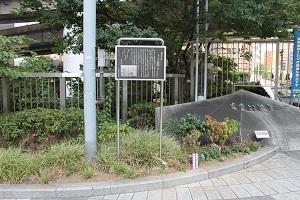
He faces Kayaba-bashi Bridge from armor Hashigami. In the past, the area around Minamizume of this bridge was called the Kayaba Riverside, and it was a storage area for cutting and stacking Kaya. Just like today's Kayabacho origin, the name of the bridge is derived from it. The current bridge was replaced in 1992 (1992) due to the aging of the old bridge ("Monoshiri Encyclopedia"; 25).
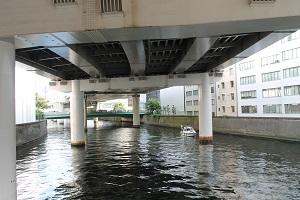
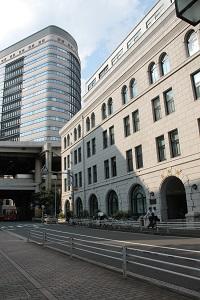
Take the stock exchange from Nihonbashikoamicho over the armor bridge
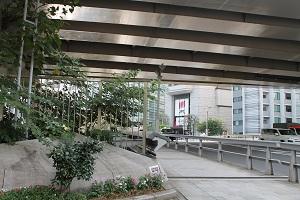
The front is the Nishokan Building, the trees ahead are Kabuto-jinja Shrine, and the high-rise building beyond is the Nihonbashi Diamond Building.