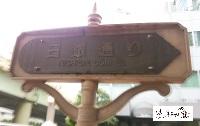
 Hello, my name is Minato-chan.
Today, I would like to walk "Bank of Japan Street" from 4-6 Nihonbashi Motoishicho to 1-1 Nihonbashi Muromachi. As the name suggests, Bank of Japan Street is the main building of the Bank of Japan. In accordance with the Bank of Japan Ordinance promulgated in 1882, the main building of the Bank of Japan began operations as a central bank in Japan.
Initially, it was the beginning of using the building of the Hokkaido Kaitakushimono Production Sales Office, located under the former Eitai Bridge.
This is a building that displays and sells special products from Hokkaido. Completed in 1881 (1881), the design was familiar at Shikanarukan, and was hired by the Ministry of Industry, Josiah Conder, an Englishman hired by the Ministry of Industry.
It is a building with a profound and beautiful appearance of the "Venetian Gothic style", and it is said that it attracted the attention of people.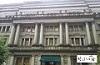 The Bank of Japan moved to its current location in 1896 (1896). Designed by Kingo Tatsuno, who studied under Condor.
"We look forward to the future and make something solid and bold," was the slogan advocated by the Bank of Japan Governor Koichiro Kawada at the time.
The masonry brick building is said to have been modeled on the central bank of Belgium and is considered to be two masterpieces of Western architecture in Meiji period. In 1974 (1974), it was designated as a national important cultural property. At present, the main building of the Bank of Japan's main building is the site of "Kinza" in the Edo period. Kinza was the place where the casting of Koban was performed, and the magistrate was in charge of the bill.
Prior to that, there was no foundry called "Temaebuki", and under the direction of Shozaburo Goto Mitsuji, Kobanshi made the original gold and passed it. It was a mechanism to hit the Goto family's mark.
Kinza, which had such a background, closed its history in 1869 (1869) with the establishment of the Mint.
Since the Meiji 20s, the Bank of Japan began to set up branches nationwide, many of which, like the head office, started operations using existing buildings. As the new store of the head office was completed and the business of each store expanded, new stores were gradually built by Kingo Tatsuno.
♪ Welcome to the sidewalk museum!
Introducing the wonderful patterns found on the sidewalk of Bank of Japan Street.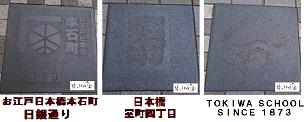
The picture on the sidewalk I found this time was astringent stone, with pride and attachment to the town. From now on, I would like to walk around Chuo-ku, cherishing the encounter with a wonderful sidewalk where you can see the face of the area.
Chuo-ku Tourism Association correspondent Minato-chan

No. 24 October 7, 2018