Hello. I'm a new correspondent, Hanes.

This time, we will take up Shintomiza in the final episode of "Chuo-ku Seen by Sidmore".
There is no Shintomiza now, but in the era before Kabukiza was established,
What was the impression of people who came from overseas?
In the first place, was Shintomiza known to such people?...
Such a thing can be read from the records left by Sidmore
■Tokyo's Great Theater, Shintomiza and its surroundings
It may be surprising, but the continuation of "Speaking of the Great Theater in Tokyo"
It is "Shintomiza [Kyobashi (center) ward Shin-Tomicho]".
Then, what was the appearance of Shintomi Theater and its surroundings, which can be said to be the "Great Theater in Tokyo" even from a foreigner's perspective?
It is a gabled building with a long frontage, and actors' paintings are lined up at the top of the entrance. The streets are lined with teahouses and restaurants, suggesting that it is not a short play where spectators go out after dinner and finish in about two hours. We organize the viewing team carefully in advance and immerse ourselves in the theater for a whole day. The play usually starts at 11 o'clock in the morning and ends around 8 or 9 o'clock in the evening. After a short period of time, when the appearance of the thousand actors and the plan of the magnificent stage equipment are known, the spectators will specify the viewing time as appropriate. For high-ranking Japanese people, the act of going to the theater entrance and paying a viewing fee is quite bad, so such audiences run at least one day in the teahouse near the theater to arrange tickets for the day, and secure seats through mediation. In other words, the teahouse is a daff shop that is paired with the ticket office! At an appropriate time, the party will gather at the teahouse, order lunch and dinner on the day, and the person in charge of the teahouse will guide the guests to the bleachers. There are several tea services a day, and you will come to order "Do you want anything" during the break time. At dinner, a large lacquered heavy box with plenty of dishes is carried, and the patron sits comfortably and eats. Each seat is equipped with a cigar tray loaded with charcoal fire in a conical shape, and everyone ignites the kissel, smokes the cigarette, and at the same time, puts out the butts. Sometimes this sound matches the stage performance and becomes Oai chanting! ?
From this point on, the theater at that time was a one-day entertainment.
There are teahouses and restaurants around the area, and you can see that we were able to have lunch and dinner.
And as you can see from Kunimasa Utagawa's "Shintomizamoto Fushin Completion First Opening Crowd of Visitors",
It depicts customers who are eating and hearings.
It is the same now and in the past that Kabuki and delicious meals cannot be separated.
■Inside Shintomiza
From the above, it was clear how the area around Shintomiza was lively and how the food was procured.
So what was the inside of Shintomiza?
The theater building is a light and thin wooden building, with matt and tatami mats spread everywhere, and they are all similar. Square seats, sloping floors, simple low corridors, and the stage are spreading throughout the hall. A low horizontal tree divides the floor space into a basin type, which serves as a connecting bridge where customers enter and exit. The audience always sits on the floor of the basin seat, and each seat is six feet [1.8 meters] square and is designed for all four people. Looking at the walkway, there is a row of Masu seats on one side and a few Masu seats toward the stage. There is an enclosure of a standing guest behind those seats, and you pay about one or two copper coins per act. This enclosure is called "Tsumbo Pier [Makumi Seat]", but the noisy of this customer is so busy that even the deaf people want to block their ears. Passengers entering the theater attach cards to their footwear. The shelf is full of hanging clogs, and it is like a decoration in the entrance lobby. Inside the building, there are shops selling fruits, tea, confectionery, cigarettes, toys, kanzashi, star photos, and even booth items, so customers in Masuseki do not need to go out for any shopping outdoors. In addition, it is a bright and airy open playhouse, so the gap winds are passing through in winter!
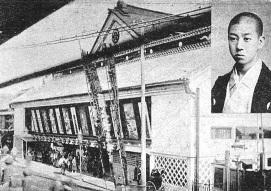
(Source: "Nihon no Meisho" edited by Mitsuyuki Segawa (History Compilation Center, 1900)
While the inside was so lively that it was said, "Noisy and terrible,"
It seems to be a comfortable space where you can shop indoors
However, from the ironically unique expression, "Because it is a bright and airy open playhouse, the gaps are passing through in winter!"
In 1878, chair seats and gas lights were introduced, and foreigners living in Tokyo were invited to the opening ceremony.
At Shintomiza, a representative atmosphere of Civilization and enlightenment, where footlights were later installed,
You can see that there were still many challenges in architecture.
■Evaluation of Foreign Residents in Tokyo
As mentioned above, not only Japanese but also foreigners had the opportunity to experience Kabuki.
What kind of impression did they have about Shintomiza and Kabuki?
And how much did you accept it?
According to the column of "Meiji-Taisho in Photographs: From the Photo Book Held by the National Diet Library-",
Even Thomas McLatch, a U.K. envoy who was assigned to Japan, worried that a ronin refers to a long sword, and if you see a foreigner, he will cut it immediately."
He was delighted to be able to see a beautiful play in a beautiful theater at the opening ceremony after the reconstruction, and wrote in detail to his mother and friend in his home country.
In July of the same year, Mr. Grant welcomed former President of the United States of America.
The costumes of the geishas who decorate the national flags of both countries on the stage, as shown in the entrance and the front, dance at the finale.
"In a kimono with red and white horizontal lines, underneath it is dressed as a juban with white stars dyed on an indigo ground.
It seems that he planned a gorgeous production that resembles a star-line flag, which can be said to be somewhat strange."
Apparently, unlike the traditional Kabuki that we imagine today,
The show seems to have been surprisingly flexible
Also, Kabuki actors are from foreign families who lived in foreign settlements.
Sidmore writes that he was sometimes invited to a tea party.
A few days later, it appeared extensively in a domestic English-language newspaper that claims to be a British daily newspaper.
Because there was also a list of attendees like a mountain,
Even foreigners at the time can see that Kabuki was accepted as entertainment and feasts.
In this way, by looking at Japan from the perspective of overseas people,
Do you have new discoveries and learnings?
It is expected that the number of tourists visiting Japan will increase further toward the Tokyo 2020 Games.
“If you were in their position....It is also important to review Japanese culture and customs from the perspective of ""!
In addition to Sidmore, there are many overseas people who recorded the state of Chuo-ku in Meiji period.
When you have time, why don't you pick up their books and discover "new Chuo-ku"?
[References and Websites]
Eliza R. Sidmore (Author) / Katsuhisa Tonosaki (Translation) "Sidmore Japan Journey" (Kodansha, 2002)
Meiji period’s Theatre and Theater (1) Shintomiza/Kanya Morita’s European heat
Japan Arts and Culture Promotion Association "Cultural Digital Library - Shintomiza"
Japan Arts and Culture Promotion Association "Cultural Digital Library - Shintomizamoto Fushin completed night theater crowd map"
[Related Articles]
"Chuo-ku seen by Sidmore (1) eel crosses the times and borders"
"What is an unexpected excavation that has nothing to do with the changes in the Chuo-ku (2) era seen by Sidmore?"