The epilogue of Kyobashi Monogatari. This is the last time.
Until the last time → 【①】【②】【③】【④】【⑤】
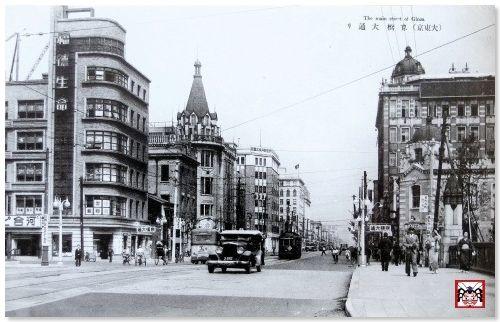
Below is the cityscape of Kyobashi seen from Ginza around Showa 37 (1962) after the war.
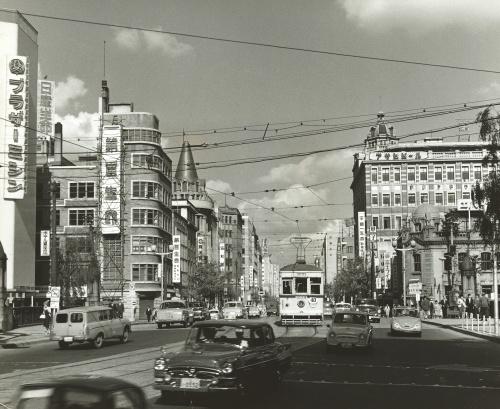
Photo courtesy of: Chuo Ward Kyobashi Library
The building standing on Kyobashi Street has hardly changed since the last post-war postcard. The remnants of the Taisho era when it was Minami Temmacho can be seen that overcame the Pacific War and continued in the Showa 30s.
However, before the Tokyo Olympics, reclaiming the Kyobashi River began in 1963, and Kyobashi disappeared, and after that, the buildings in the town of Kyobashi changed one by one.
Just 50 years ago, in May 1969, the dismantling ceremony of the first mutual building, the most famous building in Kyobashi, was held. Until now, a metropolitan inhabitant who has been watching the landmark of Kyobashi seemed to have a letter saying, "Is it possible to leave at least that red brick dome roof that rises on the roof?" Was. However, this sturdy building, which survived the Great Kanto Earthquake and the Pacific War, was difficult to dismantle.
On the other hand, on the bridge over the river, there are still things that are left at the site of Kyobashi even when the bridge is gone. This is the main pillar. There are three main pillars left, two of which are the main pillars of giboshi's design, which are said to be from Ishibashi in 1875, and the other is the main pillars of the Taisho era bridge that looks like a rocket.
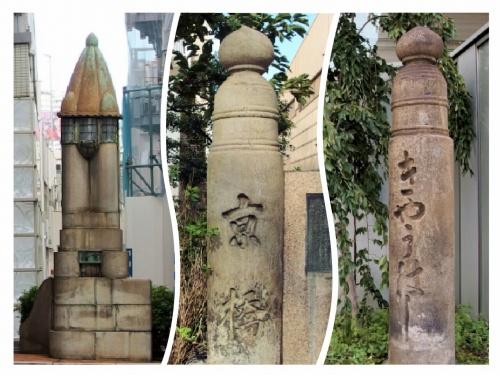
The most popular one is the main pillar of Meiji period, which retains the scent of the Edo period, and some people think that the design of the main pillar of the Taisho era is strange because it is not familiar to that era.
The main pillar was always with the city of South Temmacho. In the Taisho era, we built a cityscape with a sense of unity with Minami Temmacho, overcoming the earthquake, watching the reconstruction of Ginza, and overcoming Pacific War together. But now the companion is gone, and in a sense, I feel lonely and poor.
This is the main pillar of the Taisho era, but what is the motif of this design in the first place?
Many of you may know that there is a monument on the banks of the radish and a monument to the birthplace of Edo Kabuki in the current Kyobashi Ruins Hashizume Garden of the Kyobashi Daikon Riverside Hospitality. However, it seems that it is not well known that the "sleeve pillars" of Kyobashi, a bridge between the Taisho era, is left in this place.
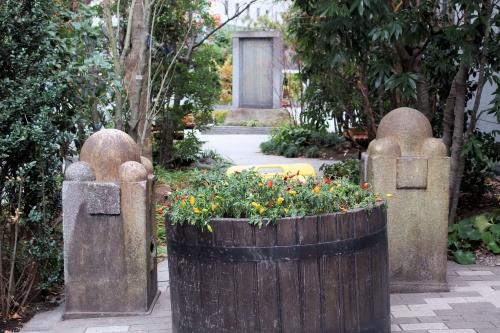
At present, this sleeve pillar is given an important role as a stopper in the park. It seems that the position has moved a little due to the recent renovation of the park, but it may be difficult to look at this and imagine that it is an old sleeve pillar.
But this design is great. Let's take a closer look. There is a large hemisphere in the middle, and there are four small ones around it, and there are mokomokomokomokomokomoko. Doesn't this look like something? 。 If you've been involved in this long story, I think there's something you can imagine.
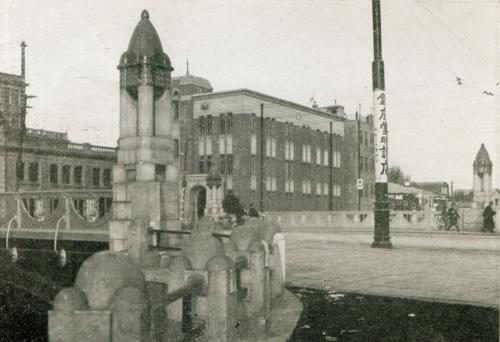
Early Showa period, Photo provided: Chuo Ward Kyobashi Library
I can only see the "three dome roofs" of a building in South Temmacho.
Then, isn't the main pillar simply using the roof of the building in Minami Temmacho as a motif? I guess I just stretched the image of the sleeve pillars on top of the guy-n. As if the dome roof of the former Daido Life Building became the Tongari roof.
It’s free and fun to imagine. History is a mystery, and it is interesting because there is room to imagine those who do not know what they are. Don't worry, I'll try to imagine a little more.
There are still friends in the main pillars of the Taisho era.
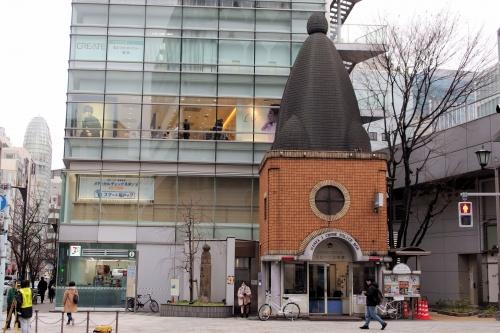
Ginza 1-chome police box located in Hashizume, the site of Kyobashi. I'm always watching the city of Ginza from the chopsticks in Ginza.
It is said that this police box building was built in the 1980s, but the design of the roof is undoubtedly the main pillar of Kyobashi on the Tongari roof of the Taisho era.
But is that all?
Looking at the design of the eaves and windows, I saw the streets of the "end of the corner" that watched the reconstruction of Ginza from the Taisho era to the early Showa era, not the brick streets of Ginza in the Meiji era. Toyokuni Bank, Daido Life Building, Daiichi Mutual Building, Hoshi Pharmaceutical, Sanjushi Bank, Chiyoda-kan ... And Kyobashi with Tongari roof.
The old bridge and the cityscape of Minami Temmacho have become one building, and now they are watching the city of Ginza as a police box. With that in mind, the design of this police box seems very wonderful.
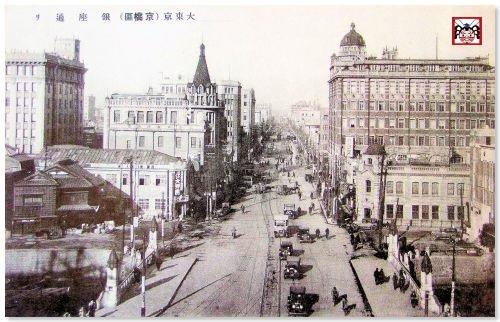
When you walk along Ginza Street, Kyobashi is a city that can be seen at the end of the corner. When I tried to find out around the Meiji and Taisho eras in the library, there were many books in Nihonbashi and Ginza, but there were few books in the town of Kyobashi in the middle, and I couldn't grasp the image of the city and the background of the times. When I thought so, I found something. This is a picture of the postcard. Postcards are first-class historical materials that can image past cityscapes, and the town of Kyobashi has postcards that are as competitive as Nihonbashi and Ginza. We collected postcards of Kyobashi, arranged them in chronological order, and spun them together in sentences.
In this story, I would be grateful if you could walk through the streets of the current "end of the corner" while imagining the streets of the Meiji, Taisho era, and early Showa eras. I’m sure there’s something wonderful ahead of you.
I'm sorry.
***
<Kyobashi Monogatari and Reference Materials>
“Do you know Antonin Raymond, the father of modern Japanese architecture?” Project Committee, Kyobunkan Co., Ltd. / 2016
"80 Years with Matsuzakaya and Ginza" Matsuzakaya Co., Ltd. / 2004
"Hundred Years of Matsuzakaya History" Matsuzakaya Co., Ltd. / 2010
"Matsuya Hundred Years History" Matsuya Co., Ltd. / 1969
"From the Townscape of the Earthquake Reconstruction <Ginza> (Shimizu Gumi Photos)" Ginza Society of Cultural History / 1995
"Meiji and Tokyo Clock Towers Revised and Revised Edition" Mitsuo Hirano and Meikeisha, 1968
"The Story of the First Mutual Pavilion," Dai-ichi Life Insurance Company, 1971
"The people are weak and the government officials are strong" Shinichi Hoshi and Shinchosha, 1967
"Chuo-ku History Zushu Kyobashi Hen" Chuo-ku Kyobashi Library / 1996
"Ginza-dori Renaikai 60 Year Historical Materials" Ginza-dori Renaikai / 1980
"Bridges in Chuo-ku, Hashizume Plaza-Chuo-ku Modern Bridge Survey-" Cultural Property Section, Social Education Division, Chuo-ku Board of Education / 1998
"Tokyo Rediscovery: Talking about Civil Engineering Heritage" Takashi Ito and Iwanami Shinsho, 1993
"Tokyo Past Walk Viewing from Painted Postcards and Old Maps" Harashima Hiroshi, Nakakei Co., Ltd. / 2008
"Chuo-ku Monoshiri Encyclopedia" Chuo-ku Tourism Association / 2018
"Kyobashi Library Image Data" Details column on the website
"Pre-war picture postcards" self-owned (collected using the expenses of correspondents)
***
*The names and company names of the buildings have changed depending on the times, but for the sake of the story, they have been unified and described.
*We tried to match the age of sentences and postcards as much as possible, but due to the sake of the story, there are some things that do not match.
*Click on some of the images to make enlarged images and explanatory images appear.
Reference: An article about the current cityscape of Kyobashi → Here












 I looked through the FY2009 budget (draft) published on the homepage of Chuo-ku.