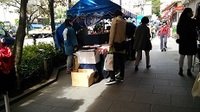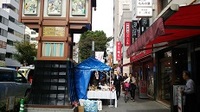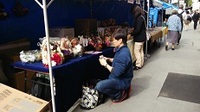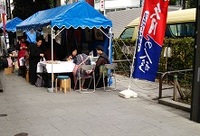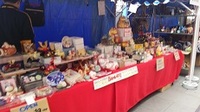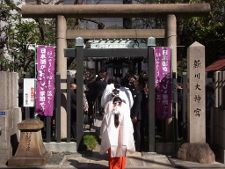
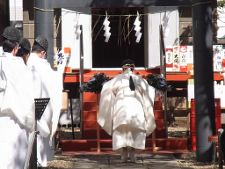
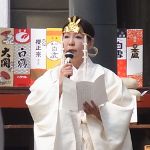
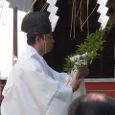
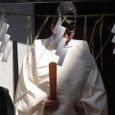
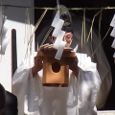
 On October 17, "Masaru Shinkawa Jingu Reisai Festival" was held by Miyaji Tomioka Hachimangu Shrine at Masaru Shinkawa Jingu Shrine at Shinkawa 1-chome.
During the Edo period, when sake was transported by boat from the upper part, Shinkawa, where water transportation was convenient, became an accumulation area, prospering as a sake wholesaler district, and continues to this day.
Masaru Shinkawa Jingu Shrine has been revered as a guardian deity of sake wholesalers in Shinkawa since the Edo period, and it is said that when young sake arrived every year, it was dedicated to the shrine as "Hatsuho" and then served for business.
Reisai Festival continues to pray for the development of the liquor industry, such as local liquor wholesalers.
After the festival, a direct meeting (Naorai) moved to the adjacent Sake Foods Health Insurance Association Hall, which has been handed down since the Edo period, is held to celebrate the establishment of business negotiations and pray for the prosperity of both sellers and buyers. "A unique hand tightening "Shinkawa tightening" will be unfolded.
Participants drink one after another a large cup filled with Naminami and alcohol in accordance with the shouts and clapping of "Prosperity-", and hear that there is a penalty called "Punishment Cup" if the drink is bad.

✎Shinkawa tightening procedure
1. "Yes!"
(In the first voice, the signal is that the sake has been poured into the cup. It is also the meaning of confirming the establishment of a business.)
2. "Borrow your hand" (a signal to ask everyone to clap)
3. "Wow!" (A signal to finally start tightening)
⑦ Yoi Yoi Yoi (Colla) Yoi Yoi Yoi Yoi Yoi (Colla) Yoi Yoi Yoi Yoi Yoi
⑤ Chongohan
③ Jou
The underlined part of katakana is vocalization + clapping. The underlined part of Hiragana is only clapping. (Katakana) The part is only vocal.
It is also called "7.5.3 closing" because it is handmade with the rhythm of 7.5.3.