List of Authors
>>About this blog
Recent blog posts
|
[The Minnie Cricket]
12:00 on October 17, 2015
On the 7th floor Japanese stage of Matsuya Ginza, Ginza 3-chome, an exhibition of a slightly retro car made of wood is being held entitled "Koji Kobayashi Exhibition-Nostalgic Cars Made of Trees-" .
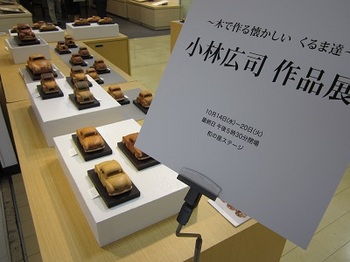
Citroen 2CV, Alfa Romeo 1300 GTA, jaguar, Lotus Development Corporation Europe, Lotus Development Corporation Super 7, Lancia Stratos, Beatle, BMW 2002 and Porsche 356A.
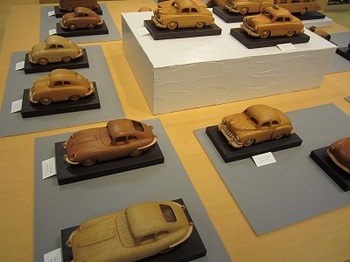
There are also candy cars in nostalgic memories.
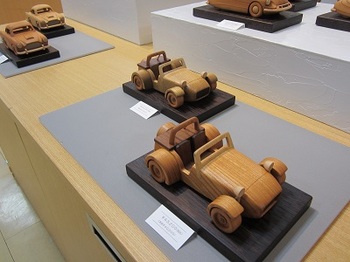
There was Koji Kobayashi at the venue, and I was able to talk directly.
In the first place, the building of this car was completely self-taught. The materials used are many zelkova, and it is said that colors and grain materials that match the parts, such as oak, shidan, and Kojiro Tamo (buried trees of peaches that have been buried in the soil for more than 1,000 years). In addition to cars, propeller airplanes, submarines, etc. will be made.
When asked why it’s a retro car, it’s because the headlights are integrated with the curves of the body.
Mr. Kobayashi responded politely to my poor questions with a smile all the time.
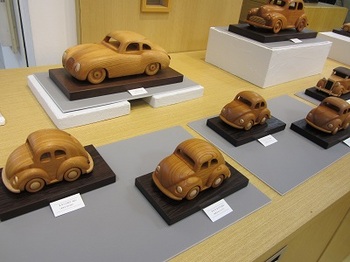
All the cars lined up at the venue were carefully made by hand, carving, shaving, polishing, and they were very warm, nostalgic, and kind to grain.
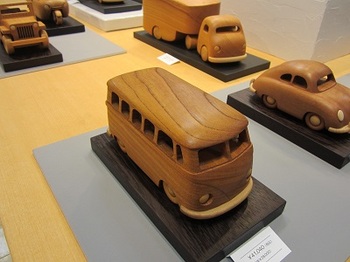
The event period is from Wednesday, October 14 to October 20 (Tuesday).
In addition, the photographing at the venue was approved by the person himself. at the venue was approved by the person himself.
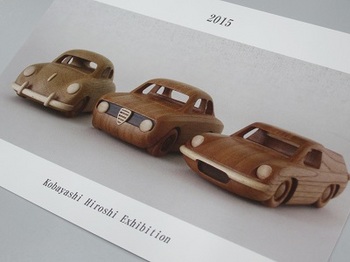
Click here for the website of Matsuya Ginza Gallery ⇒
http://www.matsuya.com/m_ginza/exhib_gal/details/index.html#gallery02
 
[The Minnie Cricket]
09:00 on October 17, 2015
Autumn of art
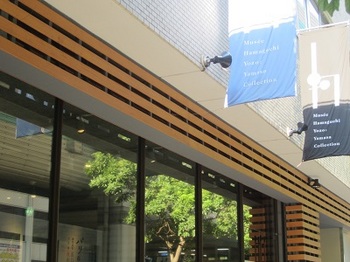
From October 10 (Saturday), at the "Muse Yozo Hamaguchi Yamasa Collection" at 1-chome Kakigaracho, Nihonbashi, photographer Shotaro Akiyama and copperplate painter Yozo Hamaguchi, entitled "Four Months in Paris" An exhibition of works by photographer Yozo Hamaguchi is being held.
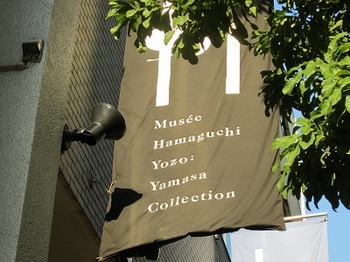
In this exhibition, photographs of Paris and Venice taken by Shotaro Akiyama during a trip to Europe were released, and about 30 copperplate prints by Yozo Hamaguchi, mainly works exhibited at the Venice Biennale, are exhibited.

Shotaro Akiyama is one of Japan's leading photographers, and photographs of women and flowers remain impressive, but the photos of Paris and Venice exhibited in this exhibition are like a "refresh vacation" It seems that he took during his stay in Paris. For that reason, I thought there were many very easy-to-understand works.
Yozo Hamaguchi is a copperplate painter known worldwide for pioneering the technique of color mesotint. In the work, small fruits and shells are arranged in a screen composition that takes a wide space, expressing a quiet world with a three-dimensional sense. The subtle shade of black, which is characteristic of mesotint, is also wonderful.
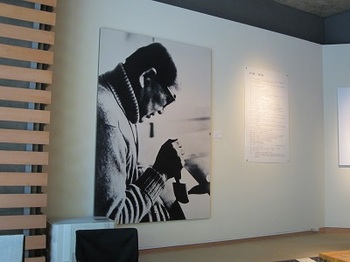
In addition, the “Muse Yozo Hamaguchi Yamasa Collection” was opened by Yamasa Soyoy Co., Ltd. in November 1998 as an art museum that stores and displays the works of Yozo Hamaguchi.
This is due to the fact that Mr. Yozo Hamaguchi was born as the third son of the 10th president of Yamasa soy sauce.
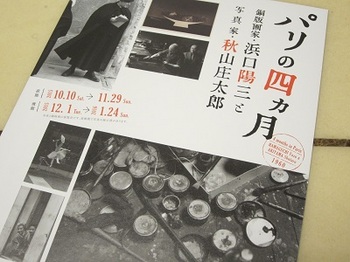
The period is until January 24, 2016 (Sun).
Click here for the website of "Muse Yozo Hamaguchi Yamasa Collection" ⇒
http://www.yamasa.com/musee/info/
 
[CAM]
18:00 on October 16, 2015
In the Monoshiri Encyclopedia, Ginza has regained its liveliness through the earthquake disaster recovery project.
In 1910, the first cafe in Tokyo, "Maison Konosu" opened in Koamicho, Nihonbashi-ku. In March of the following year, Ginza's first cafe "Cafe Plantin" opened, and in August of the same year, a three-story "Cafe Lion" opened on the corner of present Ginza 5-chome. ・・ ・ ・ ・ ・ ・ In the Taisho era, the success of "Cafe Lion" became a buzzword, and cafes opened one after another in Ginza Brick Street. Ginza will enter a gorgeous era with the scent of Taisho romance.
It is said. (page 122)
Kafu is also actively entering the cafe, and at Nijo on November 20, 1926, he detailed the state of the cafe at that time, saying, "Taga opened around the spring of the year following the earthquake, and in contrast to the lionkaku in Owaricho, it is now much better than its prosperity. On Ginza-dori Street, there are also sake shikoshi that can be called Syogetsu or Ginmura.'
As Kafu also stated, "Cafe Lion" (Shishikaku) opened its doors early in 1911, and was managed by Tsukiji Seiyoken. Tiger followed it in 1924.
Kafu often travels around the end of the Taisho era to the beginning of the Showa era, especially to this "Cafe Tiger" (though fangs). On September 28, 1927, a fee of 130 yen for a female salary of Cafe Tiger? I'm paying for it.
Tiger is a large store with a salary of 200 people at one time. Kan Kikuchi brought a lot of friends and Bungeishunju Ltd. employees, and he actively drank beer. In "Ginza March" (1928), there is a statement that "I like Tiger Woman Bunshi, and I like Lion Waitress Lady".
"Cafe Tiger" (copy from Wikipedia)
![Cafe_Tiger[1]. jpg](https://en.tokuhain.chuo-kanko.or.jp/archive/Cafe_Tiger%5B1%5D.jpg)
Café was originally supposed to be a coffee shop, but the character of the cafe at that time was a pure bar.
[The Minnie Cricket]
16:00 on October 16, 2015
An exhibition is being held at Gallery Ginza in Ginza 2-chome, where visitors can experience the charms of Mino Washi and Mino Paper cloth.
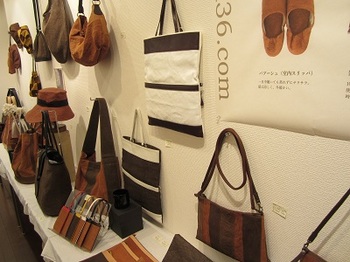
Speaking of Japanese paper in Chuo-ku, "Ozu Washi" (3-6-2, Nihonbashi Honcho), but at this exhibition, Mino Washi, registered with UNESCO Intangible Cultural Property in 2014, and his handmade Japanese paper are twisted. Clothes, hats, cushions, bags, cushions, pillows, umbrellas, etc.
A modern Japanese space is created.
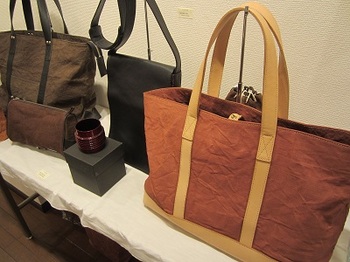
The paper cloth dyed with persimmon astringent has a unique expression, and it seems that it will have a leather-like texture over time
In addition, persimmon astringency has the effect of antibacterial, deodorizing, and detoxification of formaldehyde, and it is especially recommended for the interior of health-conscious homes.
I think you can see the charm of Mino Washi, Mino paper cloth, not leather like cloth like leather, not cloth like cloth, if you actually see it at the venue.
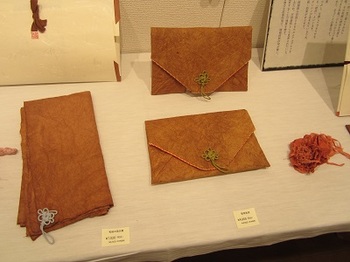
The period is from October 12 (Mon / holiday) to 18 (Sun), and the time is from 11:00 am to 7:30 pm.
The last day is until 4 p.m.
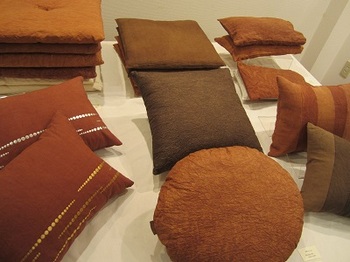
Gallery Ginza (Ginza 2-13-12)
[Sam]
12:00 on October 16, 2015
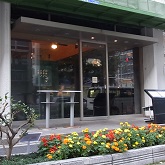 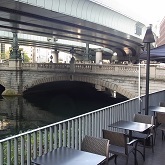 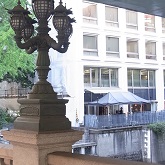
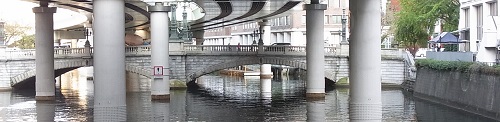
  In front of you is the Nihonbashi River. In front of you is the Nihonbashi River.
You can enjoy "Nihonbashi Beer" on the open terrace on the banks of the river.
In the old days, the starting point of the Gokaido, the center of Japan, the symbol of prosperity of Edo, and the edge of Nihonbashi, which has been over 100 years of bridge, was opened in June 2008, and is a Japanese dining & bar with its location as it is.
It has a stylish interior and consists of a dining, bar, and terrace area, and can be used for various scenes.
Business hours
Lunch from 11:00 to 14:00
Dinner from 17:00 to 23:30
From 16:00 to 19:00 (Saturdays and Sundays from 15:00 to 19:00), Happy Hour: Offered for Drink ALL ¥300
(However, Nihonbashi Beer is excluded)
The brewery of "Nihonbashi Beer" is Hoppe Beverage.
Fermented underside beer with live yeast, fragrant sweetness of wheat, refreshing bitterness of hops.
It has a mild and refreshing taste.
Originally, I heard that it was born as a PB product of Kokubun, a long-established food and liquor wholesaler in Nihonbashi, to borrow the name of the head office and grow it into a beer that represents Tokyo, but it is attracting attention in the recent gourmet scene There is also a movement of craft beer, which seems to increase the level of attention.
The evening time spent blowing in the refreshing breeze is exceptional, but you can't miss the glittering view of Nihonbashi lit up at night.
[Tachibana]
09:00 on October 16, 2015
As usual, Bettara City will be held on Monday, October 19 and 20 (Tue). In the vicinity of Nihonbashiodenmacho
Preparations for the city are steadily underway.
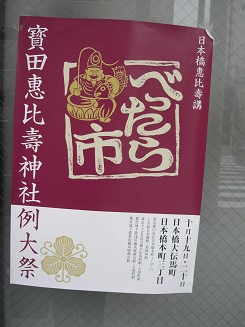 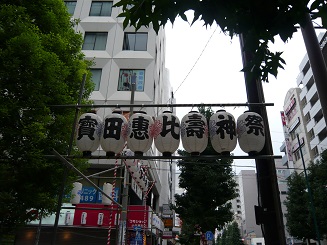
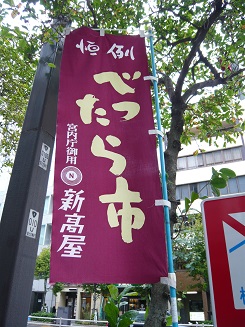 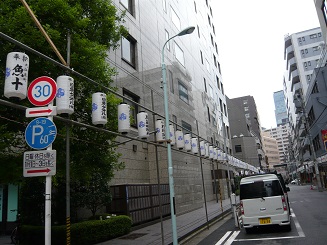
Speaking of Bettara City, it's "Kiri Sansho".
"Kiri Sansho" has a feeling like "Gyuhi" and is just an adult taste like "Suma" with Sansho.
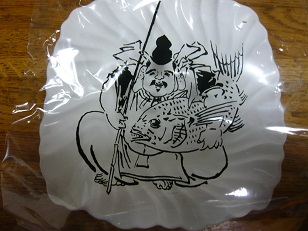
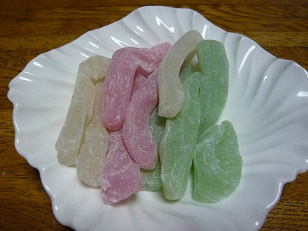
"Kiri Sansho" will be sold at "Mekatei" Kodemmacho store only during the period of Bettara City (also at the head office of Rei Iwao Island).
You can buy it.) 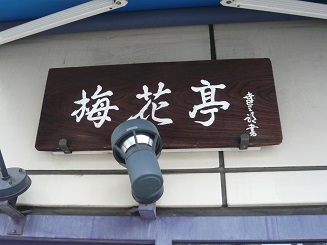 In addition, "Mekatei" will also sell "Kiri Goji" (Kurimushiyokan) only during this period. In addition, "Mekatei" will also sell "Kiri Goji" (Kurimushiyokan) only during this period.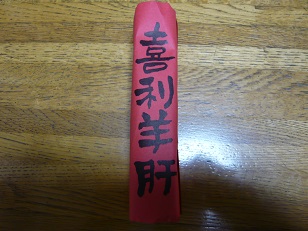
If you go to Bettara City, it is not just pickled, but it is a delicious "Kiri sheep liver" by all means.
Try "Kiri Sansho" from lucky items.
"Mekatei" Kodemmacho Store
Address: 12-5, Nihonbashikodenmacho, Chuo-ku
TEL: 03-3661-7604
*It is right next to Exit 1 of Kodemmacho Station on the Hibiya Line, but since it is a small shop with a frontage of about 1.
Please be careful not to miss it.
**The photos of "Kiri Sansho" and "Kiri Sheep liver" are previous ones.
|
Links
|