List of Authors
>>About this blog
Recent blog posts
|
[CAM]
18:00 on October 22, 2015
In "Monoshiri Encyclopedia", the following "Ginza Yanagi Monument" (8-9 Ginza) is described (page 47) for the monument of willow in Ginza.
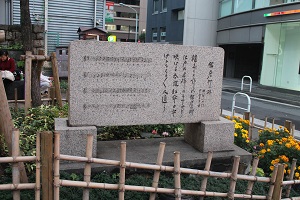
poetry monument of "Ginza Yanagi" composed by Yaso Saijo and Shinpei Nakayama. Willows planted in the city of Ginza as street trees around 1887 became a specialty of Ginza along with the development of the city. This song, which sang the willow, dominated the whole country. To commemorate this, on April 1, 1954, the Ginza-dori Association erected this monument.
However, there are two other monuments related to willow in Ginza, one of which is "Yanagi Namiki Monument" is located in Sukiyabashi Park.
![IMG_1851[1]. jpg](https://en.tokuhain.chuo-kanko.or.jp/archive/IMG_1851%5B1%5D.jpg)
"Symbol of Ginza Yanagi Namiki
The willow in Ginza was planted around 1877 and became a symbol of Ginza, but after three changes, it disappeared with the renovation of Ginza Street in 1968.
This time, Nishi-Ginza Street became a symbol road in Tokyo, with granite paved along with the expansion of the sidewalk as a symbol road in Tokyo, and the resurrected the symbol of Ginza by replacing a row of trees with willows.
Nishi-Ginza-dorikai hopes that this willow will will continue to be loved and loved by people for a long time and will build a monument here in Sukiyabashi Park.
November 1999: Seiichi Yanagisawa, Chairman of Nishi Ginza Street Association
And another "Diction from Ginza Yanagi" is located in Ginza 1-chome.
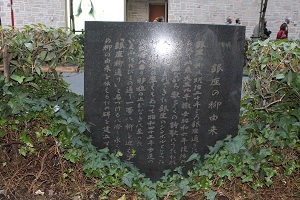
"From willow in Ginza
The willows of Ginza were planted on Ginza Street around 1887, removed in 1920, and in 1931, the willows, which became a symbol of Ginza, which was sung by many poems and became popular among people, due to the decline of the vigor, due to the major renovation of the sidewalk in 1968, the transplant was stopped.
Once again we welcome willows around this street and call them "Ginza Yanagi-dori St.", we will build a monument to convey the origin of the willows in Ginza for a long time. Ginza-dori Union Association'
Regarding this "Resurrection in 1931", Kafu writes as follows:
March 25, 1932 "... On the way back, I see a notice such as "Ginza's Willow Resurrection Memorial Festival" at the entrance of Sukiyabashi Asahi Shimbun. I use the resurrection and Ifu religious language, but I look at this and I am suspicious and laughing. The disturbance of words proves the disturbance of the human mind. ・・・・」
[CAM]
16:00 on October 22, 2015
"Sanjikenbori" is described on page 47 of Monoshiri Encyclopedia.
At present, the following explanatory version is installed as 'Sanjumabori Ruins' (some Chinese numerals are converted to arithmetic numerals).
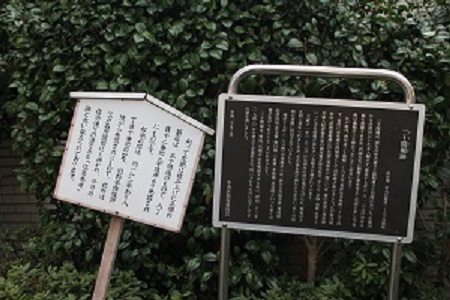 The ruins of Sanjumabori The ruins of Sanjumabori
Location 1 to 8-chome Ginza, Chuo-ku
Sanjumabori is a moat between the current Chuo-dori and Showa-dori, from the Kyobashi River to the Shiodome River. In 1612 (1612), in order to maintain the Funairi moat in Edo, it was completed by ordering the Nishikuni Daimyo to dig it. The name is derived from the fact that there were 30 moat widths. In the Edo period, the west bank was 1 to 8-chome, and the east bank was 1 to 7-chome, and there was a river bank on the coast as a loading place for boat transportation. In the early Edo period, the Edo Shozu, Bushu Toshima-gun (Kanei era Edo map) shows the Owari Tokugawa and Kii Tokugawa families' warehouses on the east side of the moat, and daimyo residences such as Kyogoku, Kato, and Matsudaira are lined up. It is depicted. In 1828 (1828), the shores of both banks were widened, and the moat width was narrowed to 19, but after that, boats came and went actively and used to transport many luggage. From the map of 1884 (1884), many bridges were built in the north, such as Shinpukuji Temple Bridge, Toyozo Bridge, Kii Kuni Bridge, Toyotama Bridge, Asahi Bridge, Mihara Bridge, Kibiki Bridge, Izumo Bridge, etc. You. Sanjumabori was reclaimed in 1948 (1948) to treat ashes after the war, and disappeared after completion in July 20155. March 2008 Chuo-ku Board of Education"
Kafu depicts the scenery of the digging seen from Izumo Bridge in one book "Shimbashi Night Story" (1910) as follows.
"I came to the front of Izumo Bridge, thinking of turning Yokomachi, where I was walking with Masaji, toward Kibiki-cho. The view of the deep ditch seemed more and more silence, and on the surface of the sinking water, with the shadows of the roofs of the houses on both sides of the slept, seemed to be seen in his own appearance, so he stood on the bridge and laid himself on the balustrade” (5-250).
[Dye]
12:00 on October 22, 2015
I received such a flyer in the garden where my little boy goes to.
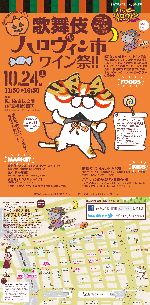
"Kabuki de Halloween City Wine Festival! 」
It seems to be held this weekend from 11:30 to 16:30 on October 24 (Sat).
Click here for more information↓
http://info-shintomi.com/
Niantomi-kun is cute.
It's a new wealthy city cat.
It was written that it was a wine festival, so I thought it was for adults,
There is an event to make Halloween wear,
Take a quiz to get sweets,
We sell children's books and seasonal vegetables,
Both adults and children can enjoy it with the whole family.
Even those who like Kabuki may enjoy the atmosphere.
I think I'll go to Shin-Tomicho this weekend too (^ ^)/
[Tom downtown]
09:00 on October 22, 2015
Tsukiji's out-of-town market is always crowded with many people. Not only shoppers, but also tourists who want to enjoy this atmosphere at a glance are coming from Japan and abroad every day.
I think that there are various purposes for visitors, such as "I want to eat delicious sushi", "I want to buy souvenirs", and "I want to walk around". Lunchtime is always very crowded. However, it seems that there are many cases where seafood menus are selected for lunch, probably because of the strong image of "fish market".
However, there are a number of delicious restaurants in Tsukiji besides sushi restaurants. There are highly acclaimed shops such as Italian and Chinese cuisine, Western food, tempura, and coffee shops, so I think you should visit such shops occasionally.
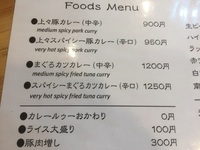
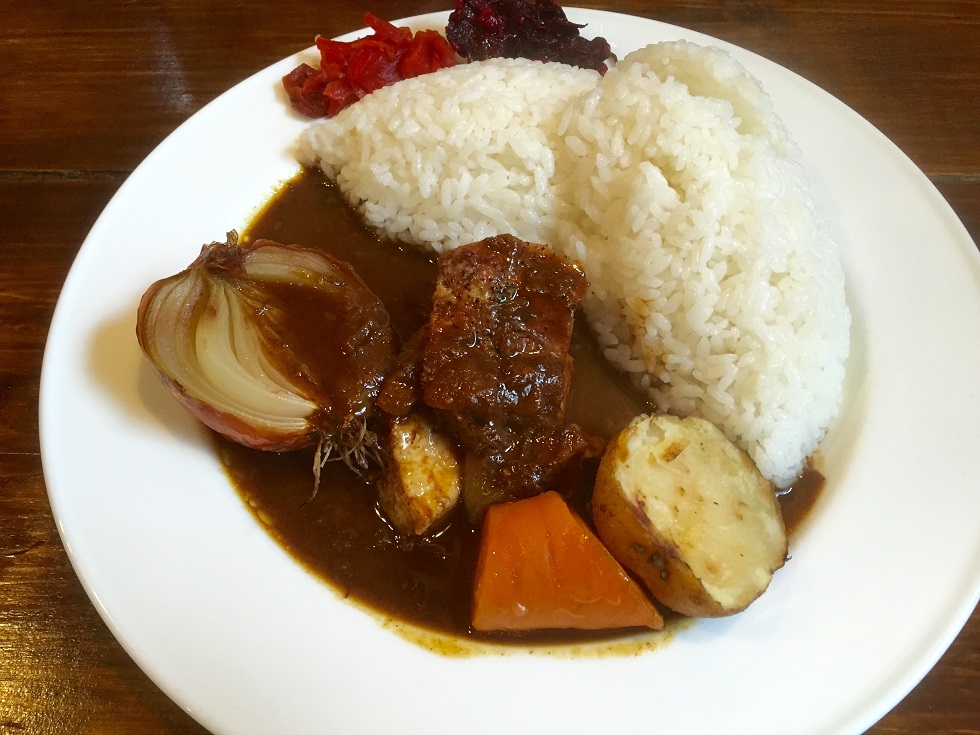
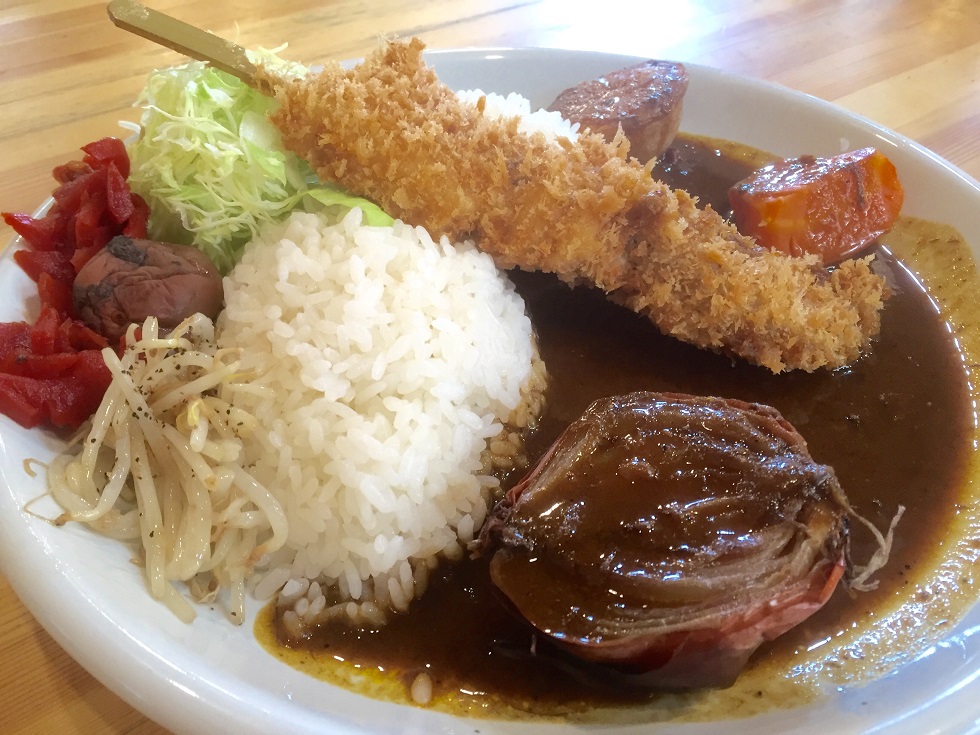
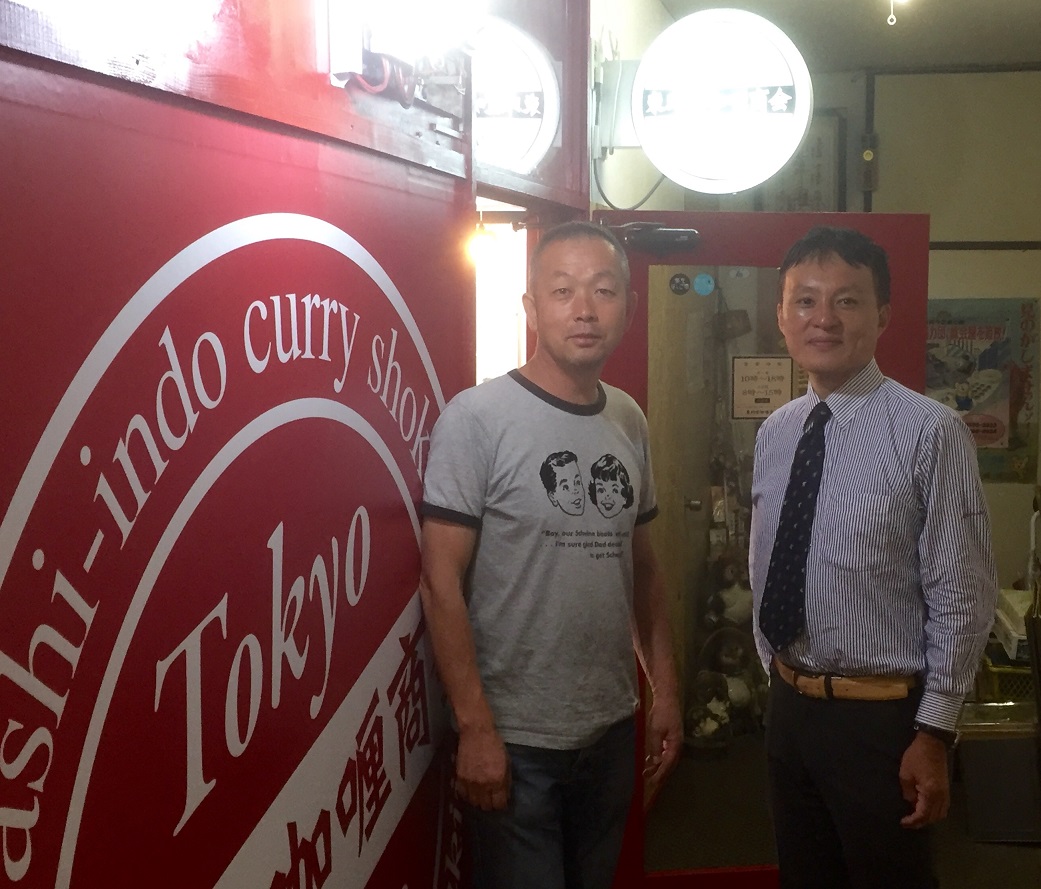
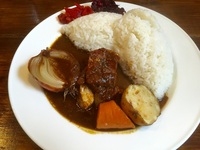
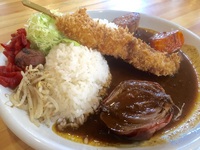
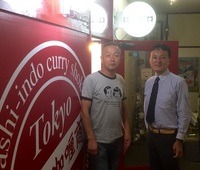
Among them, the curry shop has been attracting attention recently. In the middle of the out-of-the-box market, the yellow signboard is displayed and it is the Higashi India Kalu Shokai. As you go up the stairs beside the bean shop, you will find it on the second floor. The big red trademark is a landmark.
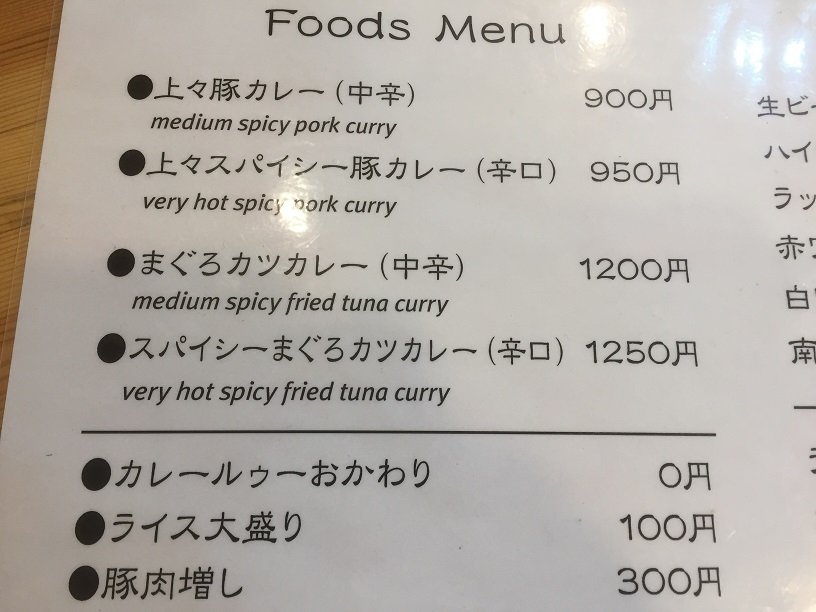
The curry of this restaurant is deep, carefully stewed with a unique flavor, and it has the charm that you will want to eat again once you eat it. As for the spicy, you can choose not only regular but also spicy. This is so painful, so be careful of those who are not good at it, but there is an irresistible depth for those who like it.
 There are two types of curry: "Kamikami pork curry" and "Tuna cutlet curry". The former allows you to taste the sweetness and soft meat quality of pork carefully with the flavor of curry. The latter is a Tsukiji-like high-quality tuna that dares to be cutlet and incorporates it into ingredients, and it is perfectly harmonized with curry. Both are hard to throw away, so please visit and try it multiple times. There are two types of curry: "Kamikami pork curry" and "Tuna cutlet curry". The former allows you to taste the sweetness and soft meat quality of pork carefully with the flavor of curry. The latter is a Tsukiji-like high-quality tuna that dares to be cutlet and incorporates it into ingredients, and it is perfectly harmonized with curry. Both are hard to throw away, so please visit and try it multiple times.
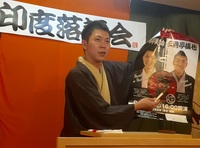
The owner of this shop is very frank. We warmly welcome those who work in the market, local residents and tourists. In addition, people who have a playful spirit and sometimes hold rakugokai in the store. This year, it will be held on December 1st, so please visit us if you like. Enjoy walking around the town of Tsukiji, enjoying curry, and relaxing with rakugo is a luxurious way of spending time in the city. 
<Rakugokai Information: http://shousuke.net/1606>
This time, we introduced a curry shop that has a strong presence in the Tsukiji Outer Market. Please try the real taste.
[CAM]
19:00 on October 21, 2015
The movie "Tokyo March 31, 1929" was released on May 31, 1929, and the theme song was released by Victor Records. The best thing that sang Ginza
Willow of Ginza that I miss in the past
Who knows the age?
Dancing in jazz and recuring.
At dawn, the dancer's tears rain
Seidensticker's "Tokyo March" translation into English for reference ("TOKYO RISING")
The Ginza willows bring thoughts of the past.
Who will know the aging, fickle woman?
Dancing to jazz, liqueur into the small hours.
And in the dawn a flood of tears for the dancer.
![Tokyo_koshin-kyoku_poster[1]. jpg](https://en.tokuhain.chuo-kanko.or.jp/archive/Tokyo_koshin-kyoku_poster%5B1%5D.jpg) (Copy from wikipedia, public domain confirmed) (Copy from wikipedia, public domain confirmed)
Kafu also touched a little "Tokyo Marching" in "Nichijo" on June 25, 1929.
"I walk around Ginza with a song at night. There is a store that sells phonographs at the corner of Sanchome. Listen to the popular song played by the phonograph in a group of walking people. Tojiro Kutsukake and Yaraifu's popular song. Around this time, this song is very popular, including the caffee in the capital (everywhere) and the color town Izukoto on the mountainside. Other Habu no Minato Kimi Koishi Tokyo March kyoku and other Ifu folk songs have become popular since this spring and have reached the present day. The poor lyrics of the lyrics are not comparable to the words, and only the broad Tokyo Koimeite and Ifu are the same.'
The song can be seen and heard on "You Tube" along with the scenery of Tokyo at the time.
[CAM]
15:00 on October 21, 2015
In 1911, following Plantin (March), which is considered to be the first cafe in Japan, a series of shops bearing lions (August), Paulista (December) and "Cafe" opened in Ginza one after another. Paulista was a coffee center, but lions were mainly cooking and alcohol.
Lion was managed by Tsukiji Seiyoken, and it was large and easy for ordinary customers to enter. He was known for serving a beautiful woman's salary with a matching costume (Japanese clothes and aprons).
Appearance of “Cafe Lion” and the inside of the store (copy from Sapporo Lion Co., Ltd.)
![1911_gaikan[1]. jpg](https://en.tokuhain.chuo-kanko.or.jp/archive/1911_gaikan%5B1%5D.jpg)
![1911_tennai[1]. jpg](https://en.tokuhain.chuo-kanko.or.jp/archive/1911_tennai%5B1%5D.jpg)
In "Sapporo Lion Co., Ltd."'s "Origin and Birth of Ginza Lion" store name, it is stated as follows:
>On August 10, 1911, "Cafe Lion" was born at the corner of Ginza 4-chome. (Management of Tsukiji Seiyoken)
Behind the opening of this store was a recommendation from painters returning to study in France who could not forget the taste of the cafe he knew in Paris at that time.
The name of "Cafe Lion" is said to have been named after the restaurant "Lion (LYON)" (owned by Joe Lions Shokai), who was operating at the corner of Piccadilly Circus when Mr. Uhei Kitamura, the owner of Tsukiji Seiyoken (the predecessor of Seiyoken) at the time visited U.K. London. This "Lion" was taken from the name of its founder, Joe Lion, but it was also used in honor of the dignity and dignity of the Lion King of the Beasts. The lion is also the coat of arms of the British Royal Family and is an animal that symbolizes the U.K.
This name was given to a restaurant that could be said to be the originator of Western restaurants at the time, and "Cafe Lion" is a full-fledged restaurant with a dining room as well as a bar and banquet hall, which was loved by many cultural figures, and its popularity flourished.
After that, in 1931, the management moved to Dainippon Beer Sake Co., Ltd., and changed the name of the store as "Lion Yebisu Beer Hall" and was reborn as a Beer Hall.
Even after it changed to a bear hall, many visitors were nicknamed "Ginza Lion" and "Ginza Lion". This nickname, "Ginza Lion was officially named in 1949 after the war.
The store name of "Ginza Lion", which is now popular as the core brand of Sapporo Lion, was born in the middle of Ginza, the corner of Ginza 4-chome, and has become a name familiar to many customers.
|
Links
|