List of Authors
>>About this blog
Recent blog posts
|
[Sam]
12:00 on October 24, 2015
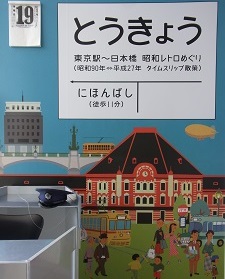 
From October 10 (Sat) to November 3 (Tuesday / holiday), "Tokyo Station-Nihonbashi" Showa Retro Tour "is being held in the Tokyo Station-Nihonbashi area.
Tokyo Station City Management Council, Daimaru Tokyo Store, Nihonbashi Takashimaya, Nihonbashi Mitsukoshi Main Store, Mitsui Fudosan, and Yaesu Underground Shopping Center.
Last year, we celebrated the 100th anniversary of the opening of Tokyo Station. Tokyo Station-Nihonbashi "100-year walk" was held, but in 2015, when the era of Showa was changed to the "90-year" milestone, the neighborhood is full of history and there are many spots related to "Showa". Therefore, under the theme of "Showa", we took a stroll through the Tokyo Station-Nihonbashi area where the past and present intersect, and rediscover the charm of the city.
If you go around each point while looking at the "walking map"* in the same area where each episode is attached, such as architecture built in Showa, you can get a commemorative replica hard ticket* of the cardboard ticket that was once widely used as a railway ticket.
*Place of distribution of "walking map" and "memorial replica hard ticket"
Tokyo Station Yaesu Exit Grand Roof 2F Special Venue, Daimaru Tokyo Store 1F Information Center,
Nihonbashi Takashimaya 1F Front Information Center, Nihonbashi Mitsukoshi Main Store 1F Lion Entrance Information Center,
Coredo Muromachi 1 B1F Nihonbashi Information Center, Yaesu Underground Shopping Center Information Center
The event will also be held for a limited time.
A special Showa retro venue appears on the second floor deck on the Yaesu Exit Grand Roof, Tokyo Station.
An old-fashioned candy store, a fukudai is set up on tatami mats, and an original mount that can store 6 types of hard tickets is available here. A photo spot is also set up, and you can take a picture with a nostalgic ticket gate.
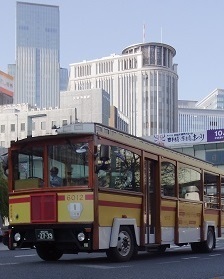
During the period, during the limited time (October 10, 12, 17, 18, 24, 31, November 1 and 3, 11:00 to 19:00), Toden's heyday, Showa 30's "Yellow red band" form 6000 and "Toden wrapping bus" with a design motif based on the car number 6012 patrol the area.
A nostalgic scenery will be revived on Chuo-dori where Toden was actually running.
Comparing it with the photos from the time of Showa published on the "Walking Map", thinking about the changing landscape of the city, and immerse yourself in "Showa Retro" for a while.


[Marsha Horiuchi of Edo]
09:00 on October 24, 2015
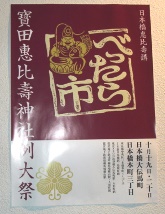
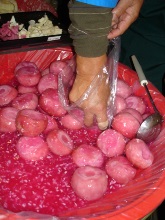
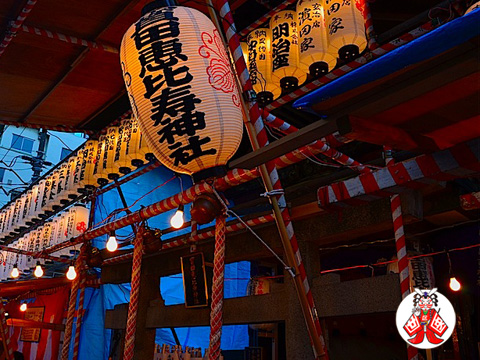
On the evening of Tuesday, October 20 on weekdays, we enjoyed "Bettara City" together with the guidance at the Jushi Cafe held by the collaboration station Chuo.
Takarada Ebisu Shrine in the Great Temmacho is the center of Edo development.
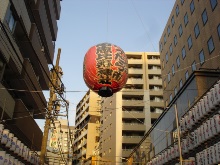
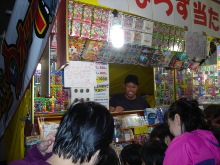
"Bettara City" continues as a city lined with offering such as fish and vegetables for "Ebisu-ko", and now it is a traditional downtown festival with nearly 500 stalls.
There was a new movement, and at the Bettara City Regional Promotion Association, curry watermelon and eel skewers were very delicious.
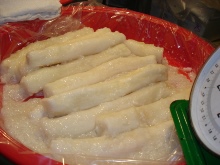
The name of "Bettara City" is used by young people to use the congestion of Asatsuzuke radish (Bettara), and to the pilgrimage women, while wearing it on the sleeve of kimono while calling it "Bettarada, Bettarada" It is reported that it became the name of Bettara because it made fun of the women.
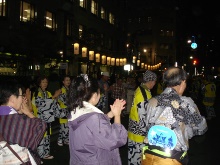
Here, long-established and large and small trading companies line up, praying for thriving business and safety at home, and working hard. From 5 o'clock in the evening, the nostalgic Bon Odori song and the dance circle of local people were expanding.
1) At first, the main deity of Takarada Ebisu Shrine, who had moved to Otemmacho, where he had been evacuated due to the construction of Edo Castle.
I worshiped in front of me (this Ebisu was worshiped by Ieyasu Tokugawa, and it was restored once by Unkei).
2) Thank you for the "Bettara-" circle of Atomi Women's University and the cooking recipe.
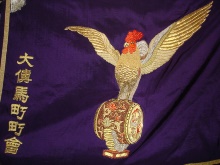
3) As the first float at the Odenmacho 1-chome Neighborhood Association drop-off place, Kanda Festival, and Sanno Festival, the flag of Isamudori in Otemmacho is here.
It was displayed at the entrance. Thank you very much for taking a break in tidbits/Bettara pickles.
In the hot air mumun, I bought a red turnip "Bettarazuke" and arrived home. May next year be a good year.
Onchuchishin
[CAM]
18:00 on October 23, 2015
"Shintomiza Ruins" is described on page 61 of Monoshiri Encyclopedia.
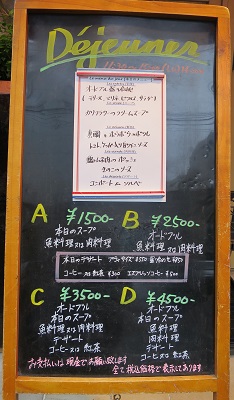
Shintomiza was a Kabuki theater that took over the Morita-za, which was founded in 1660 at 5-chome Kibikicho (currently Ginza 6-chome, west of Showa-dori).
Morita-za was based on Kanya Morita for generations, moved to Asakusa Saruwaka-cho (currently Asakusa, Taito-ku) in 1843 (1843), and changed to "Morita-za" in 1858 (1858). In 1872 (1872), Kanya Moritaza 12th generation moved to Shin-Tomicho, and in 1875, it was renamed "Shintomiza".
Shintomiza held an active performance by gathering famous actors such as Danjuro Ichikawa, Kikugoro Onoe, and Sadanji Ichikawa. The theater is a large-scale building that incorporates a modern style, and was called "Tokyo's No. 1 Theater". There were many Kabuki actors in the surrounding area, and the area was a play town.
Until the opening of Kabukiza Theater in 1889 (1889), it was a central player in theater performances, but it was destroyed by fire in the Great Kanto Earthquake of 1923 (1923).
In the Nishiki-e of the Meiji era, you can see the state of a large theater with picture signs on the sea rat wall, indicating the prosperity of the past.
![1024px-Dai-ichi_no_Gekijō_Shintomi-za_from_Tōkyō_Meisho_by_Hiroshige_Utagawa_III[2]. jpg](https://en.tokuhain.chuo-kanko.or.jp/archive/1024px-Dai-ichi_no_Gekij%C5%8D_Shintomi-za_from_T%C5%8Dky%C5%8D_Meisho_by_Hiroshige_Utagawa_III%5B2%5D.jpg) 
(Copy from wikipedia, the photo below is around Meiji 15-16. All confirmed public domain)
I often visit Kafu, whose mother was a great play lover. For example,
On October 9, 1918, 'We had lunch at Sanjumabori Kasuga and visited Shintomiza backstage in the evening.'
On October 13, 1918, 'I see Shintomiza with three geisha in Shin-Tomicho'
July 7, 1919: 'I go to Shintomiza at night and watch the song of Kido Okamoto-kun's rainy night.'
On March 23, 1920, "Seeing Shintomiza and returning home"
In addition, in the essay "Back of the Prison Station" (1909), it is written as follows.
"(My mother) is born in Edo and loves the play ... I will never forget. He was taken by his mother, and was held by his nanny, and at the bars such as Hisamatsu-za, Shintomi-za, Chitose-za, etc., unusually ate a heavy meal of eel rice ..." (4-54)
Hisamatsu-za and Chitose-za were former names of Meijiza, and were renamed Meijiza in 1893 (Monoshiri Encyclopedia; page 91).
[Ginzo]
18:00 on October 23, 2015
Halloween parties in Japan have also become familiar and are held in various places.
In Chuo-ku, Halloween events on Tsukishima Nishinaka-dori are thriving.
As I was walking along the Nishinaka-dori shopping street today, I noticed a banner of news.
It seems that there is an event where children get a snack called "Trick or treaty" and go around the shop.
The date and time is October 25, from 13:00 to 16:00.
Reservation required. It's a charge of ¥300. The telephone for your application is 03-3532-1990.
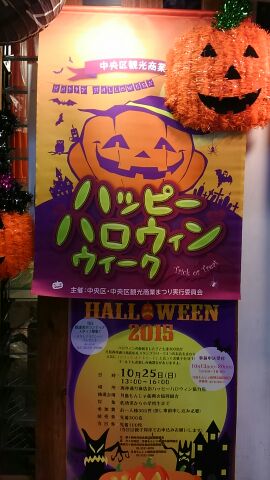
The first time I went to Halloween was in 2009.
Here is an article that reported the pattern at that time, but the photos of beautiful Tsukishima have disappeared, but you can see pictures of cute children and feel the atmosphere of a fun event.
/archive/2009/10/post-189.html
There is  also a delicious also a delicious  monja-yakimo monja-yakimo . Please go out. Posts: One of the 63rd Chuo-ku Tourism and Commerce Festival, . Please go out. Posts: One of the 63rd Chuo-ku Tourism and Commerce Festival,
"Happy Halloween Week" starts on October 23.
In the flyer obtained at Tokyo Metro Shintomicho Station this morning, there are many events at shopping streets in each town, Nihonbashi Takashimaya, Nihonbashi Mitsukoshi Main Store, Ginza Mitsukoshi, Harumi Triton, etc.
[CAM]
14:00 on October 23, 2015
Junichirou Tanizaki wrote in his "Crazy Old Man Diary" as a passage in the diary of Kusuke Uki, as follows. (Transform the original katakana into Kana)
・・Who did it to make Tokyo so shallow and turbulent city, everyone who called it a rural person, a peasant climb, a politician who did not know the taste of old Tokyo? The beautiful rivers of Nihonbashi, Armor Bridge, Tsukijibashi, and Yanagibashi, are all the people who sucked away with the tooth black groove. Isn't it a species of people who don't know that there was a time when white fish swam in the Sumida River? It doesn't matter where you're buried once you die, but I don't like being buried in a land that has lost any connection to yourself, which is unpleasant in Tokyo today. ・No matter what, Kyoto is the safest. ・... If you get a rabbit buried in the corner Kyoto, people from Tokyo will come to play all the time. "Oh, that old man's grave is here," he stood by the street and turned his hand on one of incense stick. (19-139)
Needless to say, Tanizaki died at the age of 79 on July 30, 1965, and was buried in Honen-in, Kagaya, Sakyo Ward, Kyoto City.
Since the "Crazy Elder Diary" was published in Chuo Koron magazine from the issue of 1962 to the issue of May 1962, Nihonbashi should not have been covered by expressways yet. Although the above lamented the water pollution of the river, it does not describe the destruction of the landscape.
Nihonbashi in 1933 (Chuo-ku Tourism Association, a moving town)
![04_03[1]. jpg](https://en.tokuhain.chuo-kanko.or.jp/archive/04_03%5B1%5D.jpg)
From Edogawa to Nihonbashi in 1957 (Chuo-ku Tourism Association, a moving town)
![01_03[1]. jpg](https://en.tokuhain.chuo-kanko.or.jp/archive/01_03%5B1%5D.jpg)
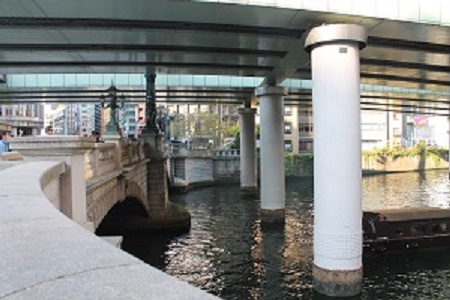
Current Nihonbashi and Nihonbashi River (photographed on October 18, 2015)
[De Niro]
09:00 on October 23, 2015
I'm not good at radish and can't eat takuans, but this time it's my first challenge to pickle.
While various stalls are crowded, one bite of bettara pickles for tasting
I feel like jumping off the stage of Shimizu
I put it in my mouth (>_<)
What? Personally, I would like to refrain from commenting concretely, but Kamogawa may be said to be a representative specialty of Tokyo. At least it doesn't taste like takuan, so it's okay.
My purpose is of course not to pickle pickles, but to enjoy the atmosphere of the festival that takes place in front of the gate of Takarada Ebisu Shrine and its surroundings. The hidden feature of this festival is a group of stalls in Nihonbashi where long-established famous stores serve limited menus and products only at this time. In the lineup of stalls that are famous as Zurari, sampling samples stabbed in toothpicks, such as Castella's "Bunmeido", Ningyocho's "Koharuken", a long-established eel restaurant "Isada", and a famous sukiyaki restaurant "Imahan". You can taste today's dinner with a top-class gourmet that can make its name nationwide by picking up and eating.
Even so, this traditional bustle that has been around since the Edo period. Is it okay to be registered as a World Memory Heritage? It is so nostalgic that I think. The simple original scenery that can be seen in any country originated here in Nihonbashiodenmacho ...
Many festivals are held in Tokyo during this season, but this year I remember the summer festival in Hokkaido, probably because it is somewhat chilly (I am Dosanko)
Many tourists from overseas visited along with the local people, and the peaceful smiles of the stalls, which entertained even outsiders like me, were impressive.
After buying a toothbrush at a well-established Edoya from the Edo period, take a break at "Itamae Bar" just before it.
It seems that this was originally a sushi restaurant, and Itamae, a creative dish, opened in a shop as it is. It looks a little high threshold, but it is recommended with a common and reasonable price setting.
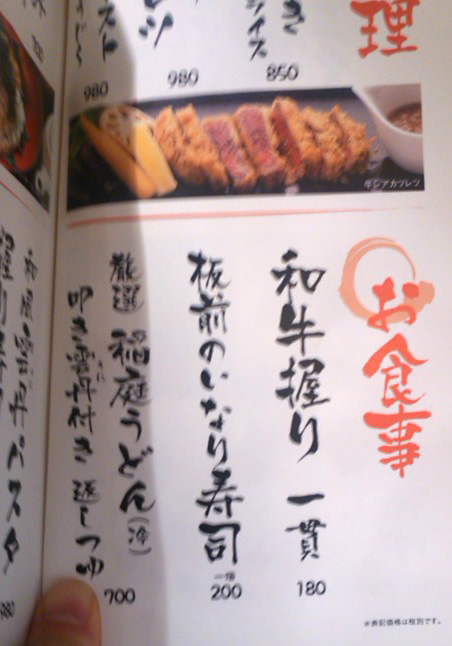
There are plenty of wine and sake menus, and you can enjoy unique dishes such as Untan pasta, a little stateless style of Untan, and Japanese beef nigiri sushi (¥180).
I went to Bettara city, but I turned away for Bettara pickles and became a casual grenabi, and I was sorry (>_<)
In fact, next month, I will be in charge of the guide on a mini tour from Nihonbashi to Kanda at the Oedo Tokyo Manman Festival, and it was a stroll that also served as a preview.
On this tour, you will step not only in Chuo-ku but also in Chiyoda-ku, and you will be guided to the downtown atmosphere of the Kanda area.
A different world is not expanding even if it crosses the border. The current 23 wards of Tokyo have increased or decreased several times since the Meiji period (it seems that there were 35 wards in 1932!) Each area partition has been changed repeatedly due to integration and other factors. We hope that you will enjoy a global town walk while keeping an eye on such history.
Previous article list by this blog correspondent
Photo Gallery of Urban Landscape in Ginza
Sightseeing Test Quiz Tournament in Hamacho Park
To walk around the city comfortably
Leader Guide Training (Participation Report)
En Liao-kan, a hospitality facility for the new era
|
Links
|