List of Authors
>>About this blog
Recent blog posts
|
[CAM]
18:00 on October 25, 2015
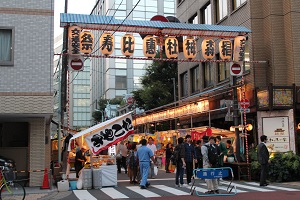
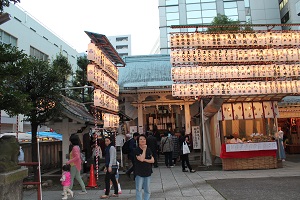
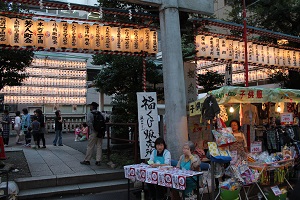
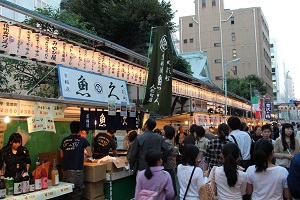
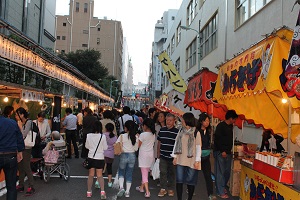
On October 19, we looked at "Bettara City".
On page 168 of Monoshiri Encyclopedia, there was a custom that Ebisu-ko was held on October 20 at the gate of Takarada Ebisu-jinja Shrine in O Temmacho during the Edo period. ・・ ・On the 19th of the day before, a city that sold offering stood. ・・・・Sometimes, pickled radish began to be sold in the city. ・・ ・ ・ ・ The store also explained that the city on the day before Ebisu-ko came to be called "Bettara City" because the customers were invited with a lively shout, "Bettara, Betara" .
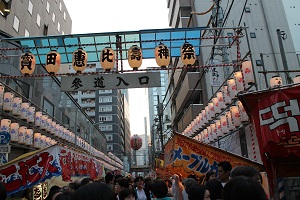

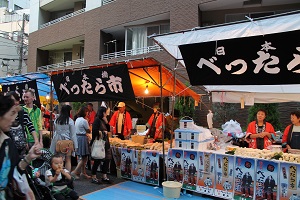
portable shrine was also out.
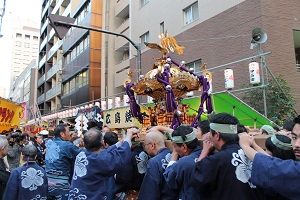
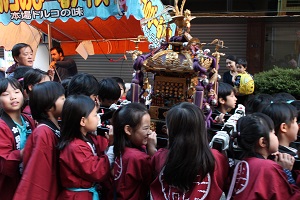
[CAM]
18:00 on October 25, 2015
On page 168 of the Monoshiri Encyclopedia, the date of the event is as usual for two days on October 19 and 20, and hundreds of stalls, including stalls selling betta pickles, were lined up in the area from Takarada Ebiju Shrine to Sugimori Shrine. He explained that there were many stalls, but exactly, from Takarada Ebiju Shrine to Sugimori Shrine, there was no interruption, and the row of stalls continued.
[Tellers I want to see]
14:00 on October 25, 2015
 Currently, this pamphlet is Currently, this pamphlet is
"Edo power from here! Nihonbashi Hundred Views" are installed at the Securities Hall (Tokyo Securities Credit Union) in Kayabacho on the Tozai Line, post offices near Kayabacho on the Hibiya Line, nationwide small and medium-sized enterprises  halls and smile hotels halls and smile hotels . .
Kenta Ueno's gentle and familiar watercolor postcards, etc., which can be healed just by looking at, are Taisei Printing Co., Ltd. (Nihonbashi Marching Committee), Anzai stationery store, Hotel Villa Fontaine Tokyo Hatchobori, Sotetsu Fresain It was said that it was handled.
The "Nihonbashi Marching Committee" was formed by volunteers from a local printing company, and "Marching" is a coined word for "town ing".
Town +ing = We aim to create a vibrant city that is, that is, the progress of the city, that is, to rejuvenate the city. And it was written in the brochure.
Unfortunately, the watercolor exhibition in the bank lobby has ended for a limited time, but it can be seen on the left side, one step from the automatic door of the Securities Hall.
If you are interested, please.
[Oldrose]
09:00 on October 25, 2015
Even in October , it was still hot, and I passed in front of the Moroi Konjac store in Tsukiji. , it was still hot, and I passed in front of the Moroi Konjac store in Tsukiji.
A man was buying a stick-shaped agar in a bag.
It seems that you will arrange it yourself and make an anmitsu.
I also bought a stick-shaped agar and ate it with canned oranges, pineapples, tsubuan, and black honey.
I was impressed by the freshness of the agar.
In the past, there were several shops of the same industry, but now it seems that only Moroi Konjac stores are now available.
Next week I bought black konjac!
This is delicious again
If you think it was made in Tsukiji, it feels even more delicious.
[Moroi Foods Co., Ltd.]
3-8-2, Tsukiji, Chuo-ku, Tokyo
[CAM]
16:00 on October 24, 2015
In "Monshiri Encyclopedia", there are explanations on pages 109 and 146. The bulletin board in the photo on page 147 was new (with English and painting).
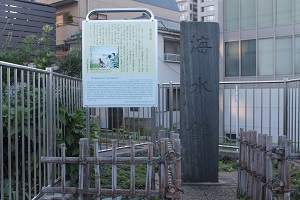
This is part of the Shin-Tsukuda Island Reclaimed Land completed in 1896, and at that time it was a quiet scenic spot where the mountains of Boso could be seen in the cloud.
The Shimojuku Ryokan "Saikaikan" built by Hanzo Tsuboi here was housed by many cultural figures, including writers, poets, and painters.
In 1907, Toson Shimazaki wrote "Spring" and in the following year, with Fujimura's introduction, Kaoru Osanai wrote "Okawabata", and around 2-3 years Sonosuke Sato, Kimura Genji, Takehisa Yumeji, Rofu Miki, Nisatsunosuke, Tenmin Matsuzaki, Kendo Yokoyama, etc. boarded here, and it is said that literary gatherings were often held.
This monument was built in 1968 by the Fujimura Research Department of Meiji Gakuin University, the alma mater of Fujimura, and on the back a note from the writing of "Spring" is written.
Fujimura seems to have spent about a year since September 1907 (September 1907) from the preparation of writing "Spring" to the end of the series. This "spring" was published 135 times in the Asahi Shimbun from April 7, 1908 after Soseki Natsume's "mineer".
During writing, Fujimura told an acquaintance about the state of the seawater hall, etc., `` More than half this year-I need to write about two-thirds if possible ... I thought to put myself in a quiet state ... I moved to an inn on this beach yesterday. This inn has not been told to my friends ... Even writing by the Asahi Shimbun has not yet been published in the world. In a room in the west corner of the second floor, it is also a quiet place like a temple and a convenience of the dormitory. "
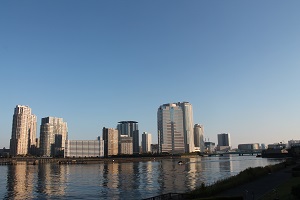
From the area near the site of the current Kaikaikan (photographed on October 18, 2015)
[CAM]
14:00 on October 24, 2015
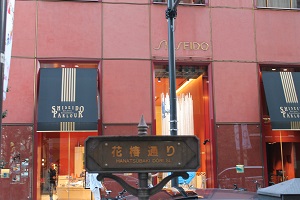
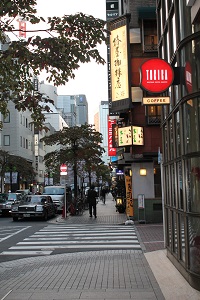
"Hanatsubaki-dori" is a street that intersects around 7-chome to 8-chome on Chuo-dori, the main street of Ginza. Izumo camellia donated by Izumo City was planted as a street tree, so it seems that the current name was given.
In the "Ginza Hanatsubaki-dori Official Web", "(at the time of the founding of Edo shogunate) reclaimed the sea called "Hibiya Irie" and the maintenance aimed at expanding the castle town was completed 30 years later. Edo residences of feudal lords of various clans began to be built. The house of the Matsue clan was built around this area. Since the Matsue clan owned one country in Izumo, it was named "Izumo-cho", and the street was called "Izumo-dori" as well as the town name, and "In 1934, the name of the street camellia was contributed. "
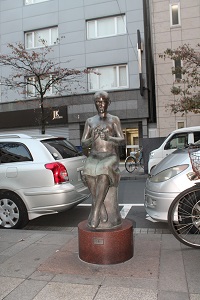
At present, granite is laid neatly, and a statue of a ponytail girl "Hana" with camellia flowers is placed in commemoration of its maintenance. The eight camellias contributed from Izumo are still alive, and you can see beautiful red flowers from March to April. dogwood, USA is also planted as a street tree. Throughout the year, it continues to be loved as a vibrant street that attracts tourists from all over the country, regardless of men and women of all ages.
The back building is Ginza Shiseido Building
Tsubakiya Coffee Shop Main Store
 A statue of the girl "Hana" A statue of the girl "Hana"
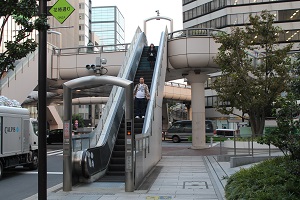
 Showa-dori Pedestrian Bridge has an escalator Showa-dori Pedestrian Bridge has an escalator
In the past, the symbol mark of "Shiseido" has been called "Hanatsubaki", and the name "Tsubaki" has been often used for activities related to Shiseido. However, this symbol was discontinued in advertising in 1987, and since 1989, external use was discontinued, such as removing it from the product, and the range of use was limited to a very narrow range such as stock certificates, but since then the policy has been changed and revived since 2004. As a "Tsubaki" fan, I'm happy to return to the tradition of Shiseido's policy.
According to the Shiseido Group website, "Shiseido's symbol "Hanatsubaki" was designed and created by the first president Shinzo Fukuhara in 1915. Even after that, we have made some fine adjustments, but we have continued to this day as Shiseido's unwavering identity."
As a private matter, my blog name "CAM" is an acronym for "Camellia".
|
Links
|