 Official
[12th Excursion Series] Perfect for the coming season!
Fujikawaguchiko Town Enjoying Superb Views and History
Hello. Although the frequency of updates is lower than last year, it is Hanes, an active correspondent who is expanding the range of activities.
In January 2019, I went to Higashine City, Yamagata Prefecture, a friendship city of Chuo-ku, and in March, I went to Fujikawaguchiko Town, Yamanashi Prefecture, an exchange city!
This time, I would like to introduce the charm of Fujikawaguchiko-cho, which I discovered from my perspective, in relation to Chuo-ku.
About Fujikawaguchiko-cho
![With Fujikawaguchiko Town [Excursion Series 12th] Perfect for the coming season! Fujikawaguchiko Town Enjoying Superb Views and History](https://en.tokuhain.chuo-kanko.or.jp/img_data/CBLOGIMG189_1_1.jpg?20190506114140)
Chuo-ku and Fujikawaguchiko-cho started exchanges with the construction of the inhabitant's health village "Villa Motosu" in 1990.
On November 4, 2014, we concluded a mutual assistance agreement in the event of a disaster, and are currently working to interact through opening stores at the Oedo Festival Bon Odori Tournament.
When I hear Fujikawaguchiko-cho, I literally associate "Mount Fuji" and "Lake Kawaguchi", but when I look at the website of Chuo-ku (1, 2, 3), the following charms are introduced. Is being
・Located on the north side of Mount Fuji and in the southern part of Yamanashi Prefecture, Japan's leading scenic spot with four lakes and a sea of trees
・90 minutes from central Tokyo
・Villa Motosu (recreation facility owned by Chuo-ku)
・Traditional craft "Oishi Tsumugi"
・Lake Shoji-ko Footpath
・Summer festival held by the lake
![[12th Excursion Series] Perfect for the coming season! Fujikawaguchiko Town Enjoying Superb Views and History](https://en.tokuhain.chuo-kanko.or.jp/img_data/CBLOGIMG189_2_1.jpg?20190506114140)
And as you can see at a glance at the sign at the border of the town, you can enjoy upside down Fuji on the lake of this town.♪
I often see signs with municipal emblems, but I think that signs that depict the characteristics of such a town are rare, and when I checked the sign of Fujiyoshida City next door, a person climbing the mountain was drawn. Was
Does it represent the Yoshidaguchi mountain trail used for climbing Mt. Fuji?
It is one of the pleasures of traveling to expand your imagination from such casual things ^ ^
Lake Kawaguchi
![Lake Kawaguchi [Excursion Series 12] Perfect for the coming season! Fujikawaguchiko Town Enjoying Superb Views and History](https://en.tokuhain.chuo-kanko.or.jp/img_data/CBLOGIMG189_3_1.JPG?20190506114140)
If you say that it is a spot that you can't miss in this town, it's Lake Kawaguchi!
It is one of Japan's leading scenic spot, including Mount Fuji, so there were many tourists from overseas.♪
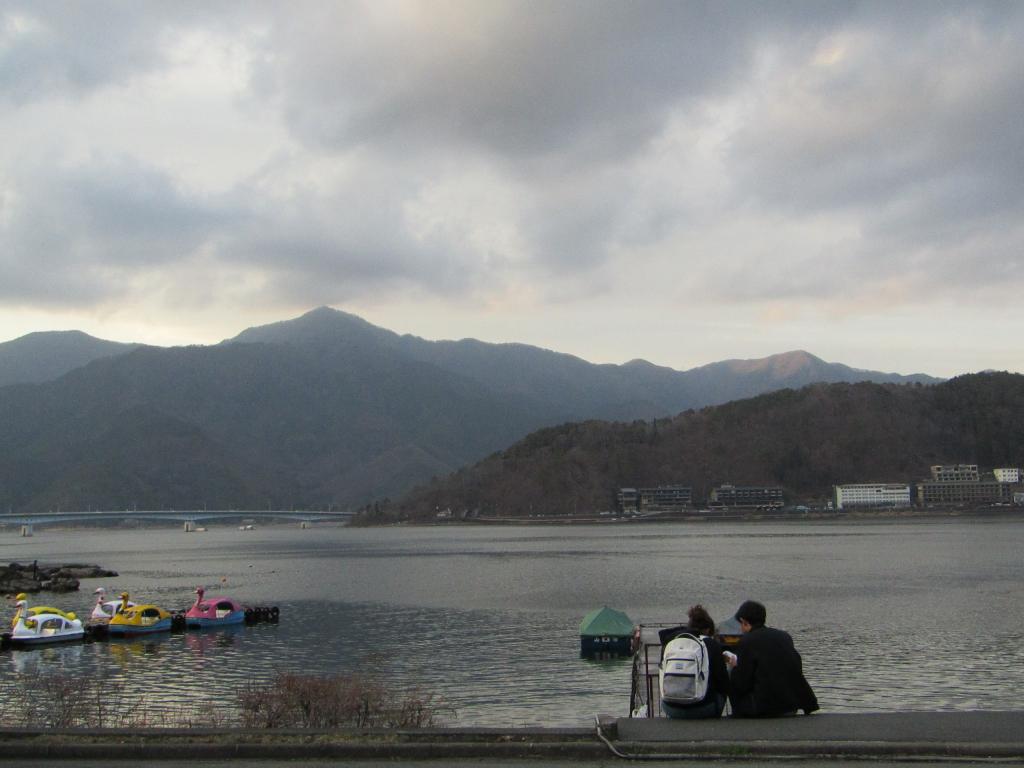
Unfortunately, at the time of the visit, we could not worship upside down Fuji, but instead we could see a wonderful sunset.
No matter what time you go, it seems that you can enjoy the scenery that is surrounded by nature and is washed somewhere.
Among them, this bronze statue, Lake Kawaguchi "Goddess on Lake".
This work, which adds a dynamic "move" to the mountains of the background, is based on the lovely apprenticeship of the Japanese sculpture world Seibo Kitamura (No.: Ryo Nawatake).
![[12th Excursion Series] Perfect for the coming season! Fujikawaguchiko Town Enjoying Superb Views and History](https://en.tokuhain.chuo-kanko.or.jp/img_data/CBLOGIMG189_7_1.JPG?20190506114140)
His work is known for his statue of Michio Ota in front of Nippori Station, but his work "Todai" by master Seibo Kitamura can be seen at Sukiyabashi Park.
Seibo Kitamura is involved in this "Goddess on Lake", and Asama Myojin Kihana Kaiya Himemei (This Hanasakuya Hime) and Iwanaga Himemei (Iwanaga Hime) dance on the lake. Expresses the appearance of dancing.
These Sisters 2 God seems to be revered by the inhabitants of the neighborhood as a patron saint who transcends wealth and beauty after many hardships, helps the birth of all things with a noble heart, and brings eternal love, peace and prosperity.
For me living and working in modern Tokyo, it was a work that made me think again about what is important as a human being.
Lake Shoji-ko
![Lake Shoji-ko [Excursion Series 12th] Perfect for the coming season! Fujikawaguchiko Town Enjoying Superb Views and History](https://en.tokuhain.chuo-kanko.or.jp/img_data/CBLOGIMG189_4_1.JPG?20190506114140)
Next, I visited Lake Shoji-ko, which was also introduced on the website of Chuo-ku.
Since I visited in the evening, I gave up walking on the footpath, but there was an unexpected event here.
It is an encounter with Harry Stewart Whitworth (Yoshiharu Hoshino), a naturalized British native to Japan.
He came to Japan in 1895 and is said to have reached this lake as a result of continuing to search for places where Mount Fuji looks the most beautiful.
![[12th Excursion Series] Perfect for the coming season! Fujikawaguchiko Town Enjoying Superb Views and History](https://en.tokuhain.chuo-kanko.or.jp/img_data/CBLOGIMG189_10_1.JPG?20190506114140)
On the northern shore of the lake, there are old Nakamichi departures and village settlements.
According to "Kai no Kuni Shi," the old Nakamichi departure was called "Nakamichi" because it was a highway that runs through the middle of the three highways connecting Kai and Suruga.
It is surprising that this highway, which has been open since ancient times, was used as a military road that Takeda Shingen, Nobunaga Oda, Ieyasu Tokugawa, etc. came and went during the Warring States period!
It is said that since the village was formed in the Edo period, he made a living with crafts (clogs, balance sticks, hoe patterns, square chopsticks, etc.).
If you go a little further along such historically interesting streets, you will see shrines and temples lined side by side, unusually.
The main hall of Suwa-jinja Shrine in Designated Cultural Property, Fujikawaguchiko Town, was rebuilt in 1843 with Ichima-sha style shingle roofing.
It is characterized by excessive decorative decorations in temples and shrines at the end of the Edo period, and here you can see a really rich design from flora and fauna to Chinese events.
In addition, there is a large cedar, a nationally designated natural monument, and the male figure, which is said to be about 1200 years old, has a presence even from afar!
![[12th Excursion Series] Perfect for the coming season! Fujikawaguchiko Town Enjoying Superb Views and History](https://en.tokuhain.chuo-kanko.or.jp/img_data/CBLOGIMG189_11_1.jpg?20190506114140)
In the neighboring Ryusenji Temple, there is a sleeping tomb of Whit Wars mentioned above, and on the tombstone you can see his Japanese name, Yoshiharu Hoshino.
![[12th Excursion Series] Perfect for the coming season! Fujikawaguchiko Town Enjoying Superb Views and History](https://en.tokuhain.chuo-kanko.or.jp/img_data/CBLOGIMG189_5_1.jpg?20190506114140)
Whit Wars, who decided to live permanently in this area, built the Lake Shoji-ko Hotel, which became recognized as a classic hotel for wealthy and foreigners in the country.
In addition, as a result of his dissemination of information overseas, Lake Shoji has become one of Japan's leading summer resorts, attracting many foreign tourists!
Interestingly, there is an episode in which Emperor Showa, who visited U.K. during his time as Crown Prince, was questioned by an Englishman about Lake Shoji-ko, and the superb view of Mount Fuji from this area, which was called "Switzerland of the East", is still entertaining visitors even today.
This time, when I visited Fujikawaguchiko-cho, I actually saw the scenery of the image I had before the visit, the fact that there were historically important highways, and that there were British people who were fascinated by this area. I was able to know.
I was particularly impressed by the fact that there were hotels on the shores of Lake Shoji-ko, such as the Tsukiji Hotel Museum, which was once located in the Tsukiji Reservation, which was used by many foreigners.♪
And since historical sites with interesting history are scattered, I would like to walk the footpath "D Aokigahara jukai forest & Stone Base Course - Walking on the Takeda Sengoku Historic Site in the Tree Sea to Lake Motosuko" and enjoy the visible (nature) and invisible (history that does not exist physically).
It is also famous as a summer resort, so it is perfect for visiting the coming season ^ ^ ^
<Asiden> Scenery from Fujikawaguchiko Town seen on paper money
On April 9, Finance Minister Taro Aso announced that he would renew the design of banknotes in 2024.
What attracts everyone's attention, except for counterfeit measures, materials, and manufacturing methods, is a new portrait!
The 10,000 yen bill depicts Eiichi Shibusawa, who has a connection to Chuo-ku and laid the foundation of Japanese capitalism.
As interest in new banknotes increases in this way, why don't you take a closer look at the current banknotes?
What I would like to see this time is the back of the 1,000 yen bill.
Here is a picture of upside down Fuji, which can be said to be a representative landscape of Japan, but in fact, this was taken by photographer Koyo Okada from Lake Motosuko in Fujikawaguchiko Town!
Click here for more information. It is also depicted on the old 5,000 yen bill. )
My hobby is collecting commemorative coins, I have visited places drawn on overseas coins and banknotes and traveled to take pictures from the same angle, and the upside down Fuji from Lake Motosuko I introduced this time also wants to go shooting before the new banknote comes out.♥
It's a little maniac proposal, but when you visit Fujikawaguchiko town, you may be able to enjoy the scenery from the same position as the reverse Fuji of the current banknote.
In the future, it would be a good memory to be able to say nostalgicly, "I went to the place where the upside down Fuji was photographed before it became a new banknote." ^ ^
■Eiichi Shibusawa Related Articles
[7th Excursion Series] The story of bricks
[8th Excursion Series] Follow the footsteps of Eiichi Shibusawa...