 Official
The process of intercultural acceptance is interesting! Japan's First Christmas
Hello. I'm an active correspondent, Hanes.
The passage of time is fast, and Christmas is approaching again this year.
The city is illuminated with illuminations, and the expression of those who enjoy shopping seems to be fun somewhere.
Now it is a Christmas that has become completely established in Japan, but did you know that Japan's first Christmas was celebrated in Chuo-ku?
This time, I’m going to look at the reality of Christmas!
About Japan's first Christmas, Masao Shimizu's "100 episodes of Tokyo Tsukiji Reservation" (Winter Seisha, 2007) has the following description.
In December 1874, Japan's first Christmas celebration was held at Tsukiji Reservation No. 6 by a member of the Karozas family. According to Taneaki Hara's recollection, on October 10 of the same year, Hara, who was baptized at the First Presbyterian Church in Tokyo, came up with a Christmas celebration as a sign of gratitude. Under the guidance of Karozas, young people in Shintomiza put on lanterns and set up a Christmas tree to make entertainment, and Hara himself also served as Santa Claus in a palace style with a hakama on kimono. The visitors were Takaaki Kuritsu, Masanao Nakamura, Ginka Kishida, Falls, Sen Tsuda, Fulbecchi, Tamson, Davidson, Green, etc., and it seems that it was a very Japanese original Christmas. (Reference: "Masahisa Uemura and His Era 2")
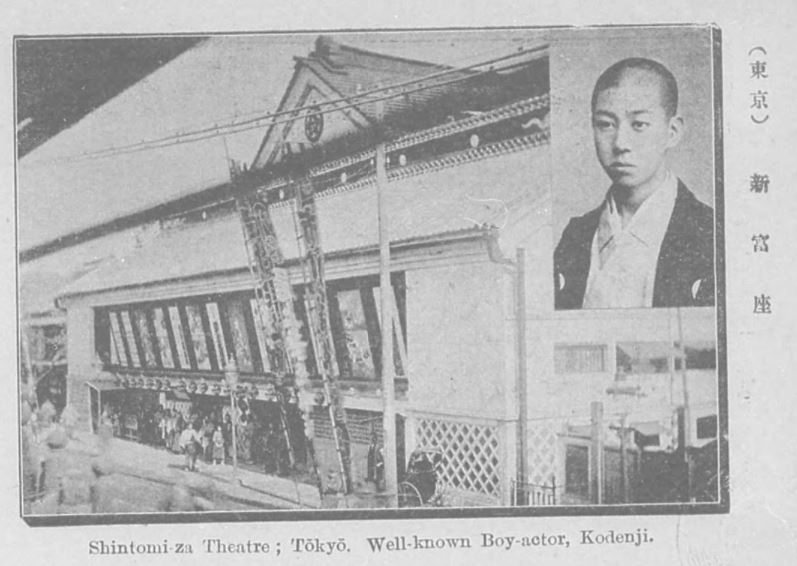
Image : Shintomiza in 1900 (Source: National Diet Library "Meiji and Taisho eras in Photographs from the Photo Book Collection of the National Diet Library-", expiration of the period of protection)
Just reading this short sentence wouldn't there be a number of highlights, such as the fact that the young people in Shintomiza helped prepare for Christmas, and that Hara served Santa Claus in the palace style?
As mentioned above, Japan's first Christmas had a stronger Japanese-Western eclectic element than modern times, but since it was a Christmas celebration held under the guidance of American missionary Karozas, I think it's remarkable that the Christmas tree and Santa Claus were incorporated first.
However, there is no description of what kind of food or drink it was celebrated.
Wine bottles and beef bones have been excavated from the remain of Tsukiji Reservation, so did the Japanese who are familiar with Western culture enjoy some Western cuisine?
In Koji Nomura's "Cooking Recipe 126 of Tsukiji Reservation Chef Madame Perry's Cooking Recipe 126" (Seifudo Shoten, 2017), which I have referred to several times so far, minsmeet (cows fat, apples, dried grapes, and fragrances are finely chopped. Contains mince pie etc.) and mince pie.
Mince pies are typical sweets that can be eaten at Christmas, and even today, they are lined up in stores during the Christmas season.
(Last year, we confirmed that mince meats imported from U.K. were sold at Meijiya Kyobashi Store.)
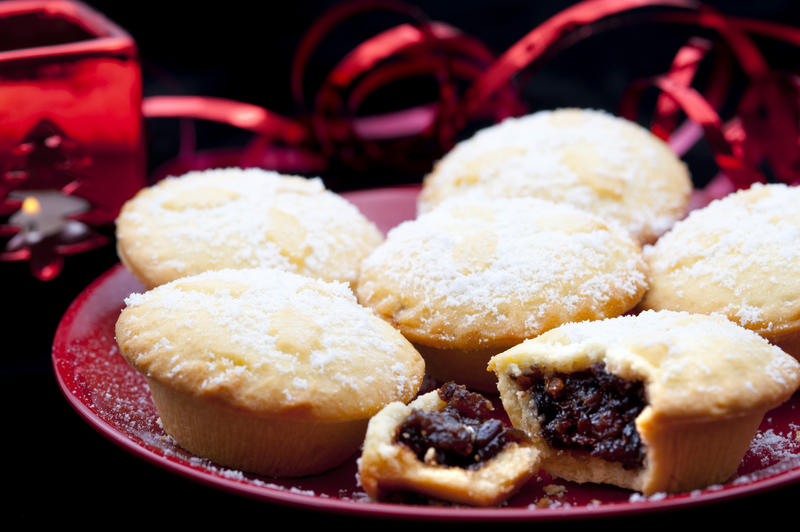
It is not clear whether it was eaten at the first Christmas in Japan, but it confirms the possibility that mince pie was made at the Tsukiji Reservation at that time.
At Christmas this year when self-restraint is shouted, you may try making mince pie with reference to this recipe.♪
As an aside, in 1900, "Santakurou" by Nobuyoshi Shindo (Kaede), who is said to be the first novel in Japan with Santa Claus, was published by Kyobunkan in Ginza.
The valuable literature is published in the Digital Collection of the National Diet Library, and on page 3, there is an incomprehensible Blending of Japanese and Western elements Takuro (Santakuro) who can read novels.
How much has Santa Claus evolved from a palace style in Japan?... Please take a look at it!
And you can see how sophisticated Santa Claus has been over the past 100 years.
In the Meiji era, how did you explain Santa Claus to ordinary people who do not have much opportunity to come into contact with Western and Christianity culture, when and how did department stores start promoting Christmas, etc. I am also worried about the process of acceptance since the first Christmas.