 Official
The Disappearing Meiji Stone Wall - Now in the Canal Renaissance Asashio District -
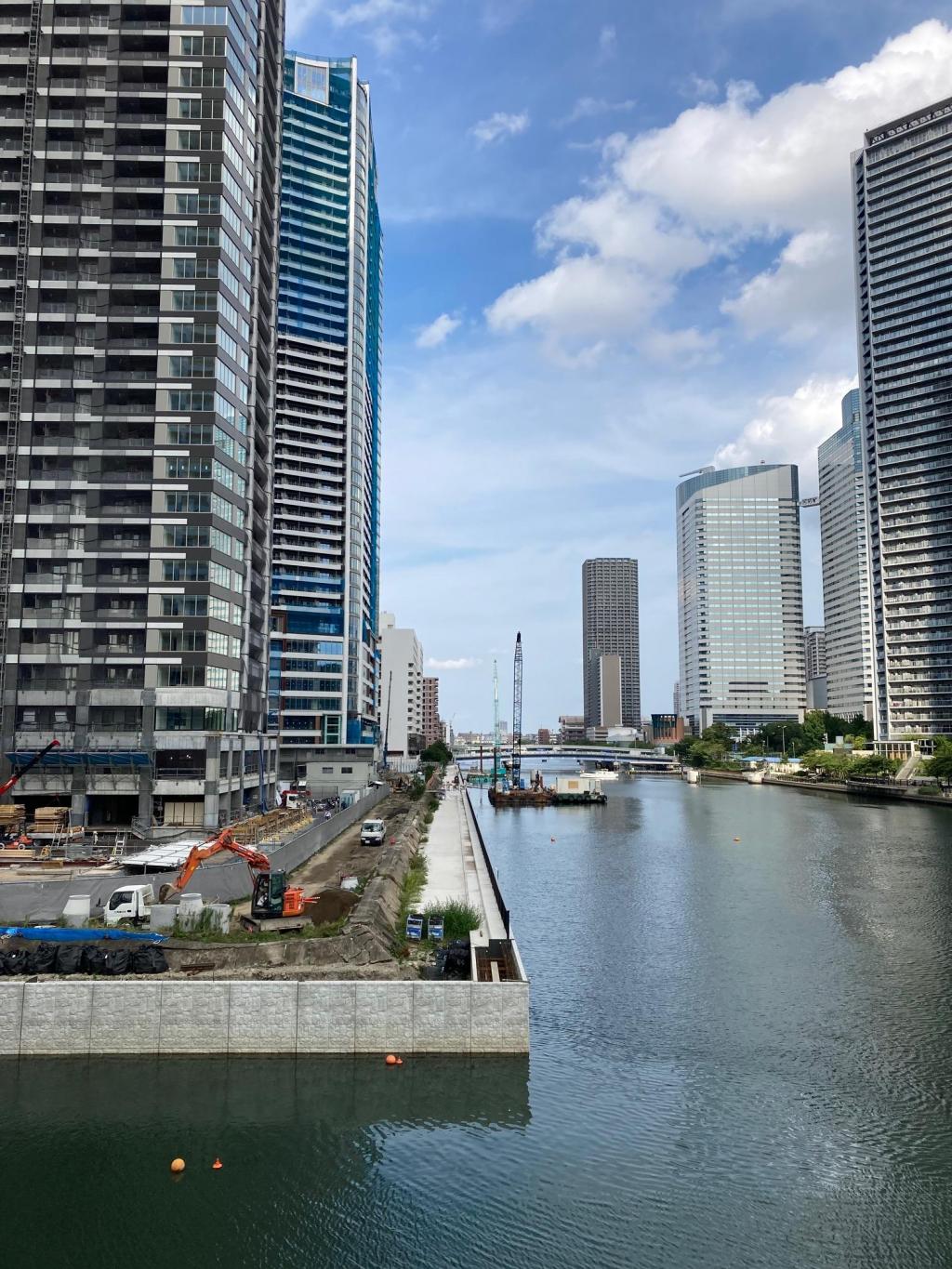
Hello. This is my favorite RIEdel in the city.
One of Tokyo's efforts to improve the attractiveness of the waterside and promote tourism is the Canal Renaissance.
In Chuo-ku, the Asashio Canal area was designated as a Canal Renaissance Promotion Area in 2006.
Recently, the development of promenade has progressed rapidly along with the redevelopment of land along the canal, and the stone walls on the west bank of the Asashio Canal (Tsukishima 2-chome to Kachidoki 6-chome) piled up in the Meiji and Taisho eras are gradually disappearing.
This report reports on the current west bank of the Asashio Canal with the aim of keeping a record of the historical scenery of the Tsukishima area, a landfill.
Canal Renaissance Asashio Canal Area
The area designated as the promotion area is the part surrounded by red dashed lines on the map.
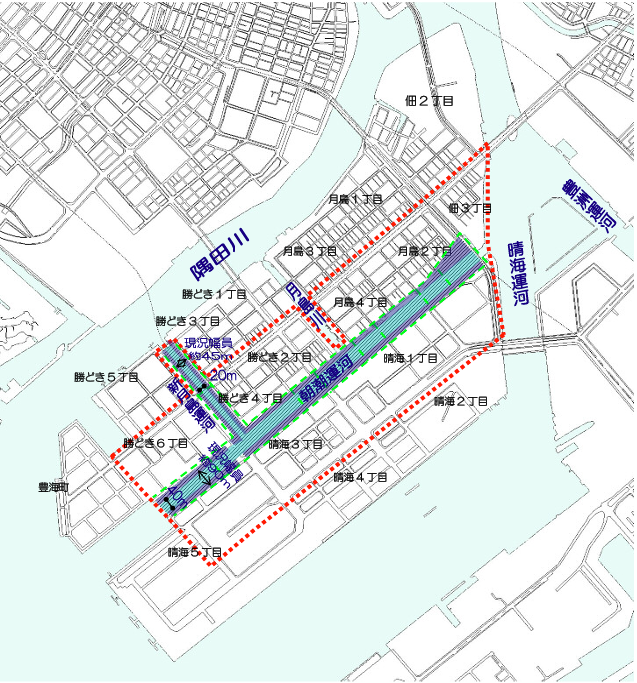
Area of the Canal Renaissance Asashio Canal District (reprinted from Tokyo Port and Harbor Bureau data)
While walking along the Asashio Canal in order from the north, I photographed the state of the stone wall on the Tsukishima side, which was reclaimed during the Meiji and Taisho eras.
The numbers on the map are linked to the places that appear in later articles.
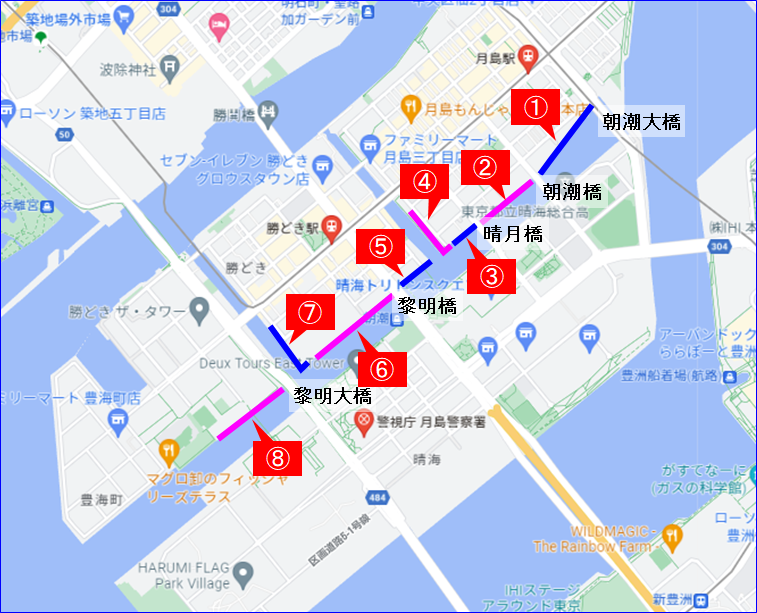
①Asashio Ohashi - Asashiobashi (Asashio Canal Water Park)
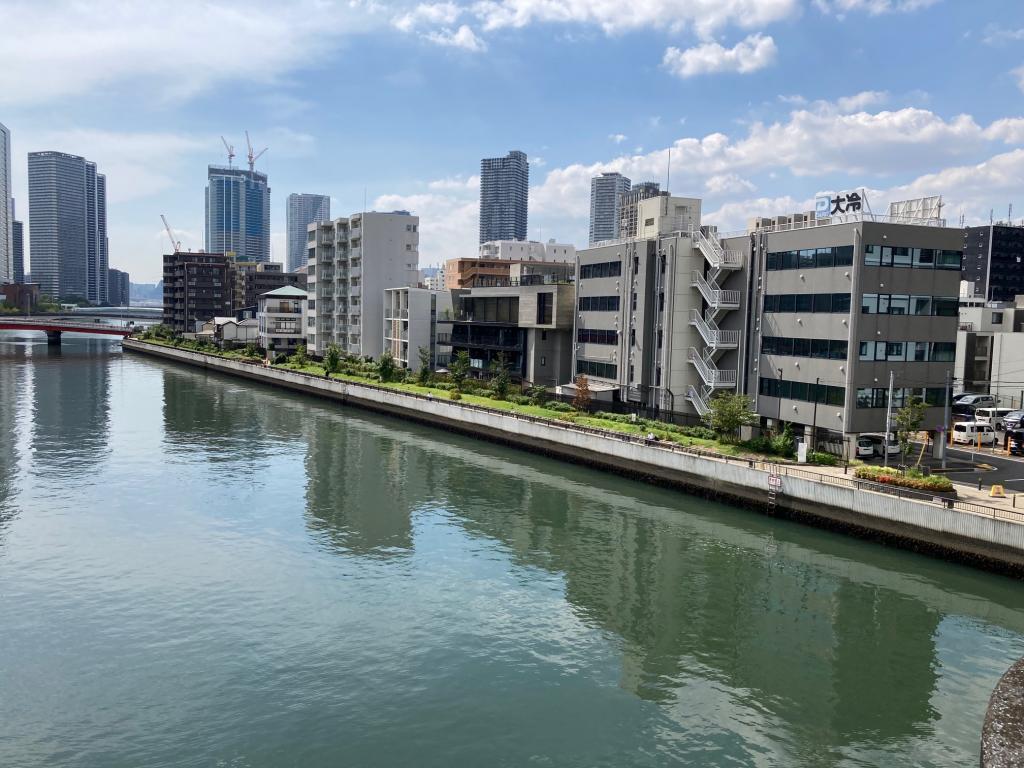
The northernmost side of the morning tide canal is now the morning tide canal Shinsui-Koen Park, and a wonderful promenade is completed.
Looking from the top of Asashio Ohashi, as shown in the photo, the revetment is clean concrete and fences, and there is no remnants of the Meiji era. 。 。
But if you look closely at the flower bed in promenade, there is something like a stone wall there!
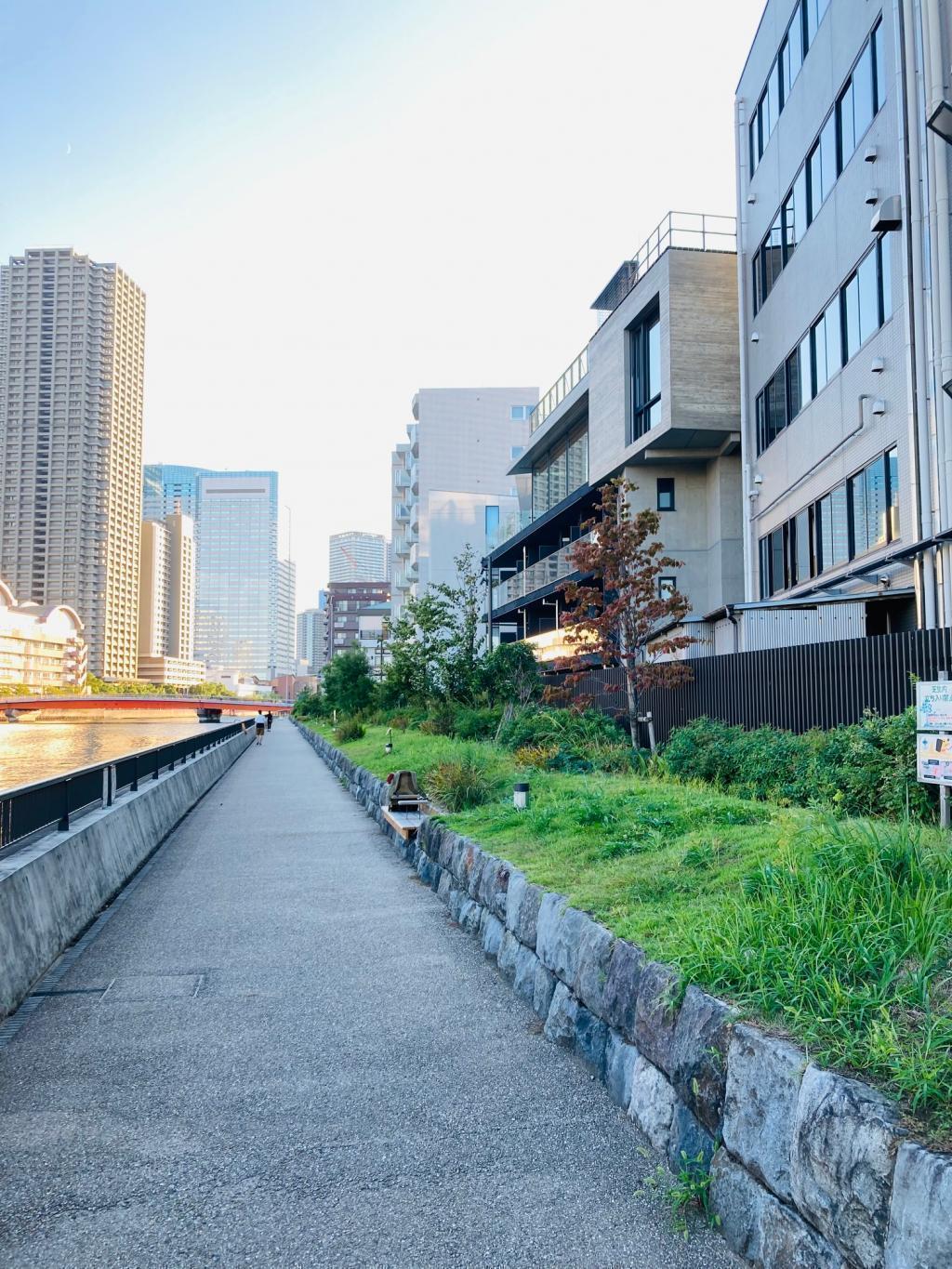
Photograph of Asashio Canal Water Park at Tsukishima 2-chome from the north side
Looking at it, it seems that this was a re-used stone piled up during the Meiji era when Tsukishima No. 1 (currently Tsukishima 1-chome to 4-chome) was reclaimed during park maintenance. I'm glad that the masonry of the historical seawall has been reused, even if it is not originally piled up, in this way.
②Asashiobashi - Harutsuki-bashi Bridge
On the west bank from Asashiobashi to Harutsukibashi, landfill work to create promenade has begun.
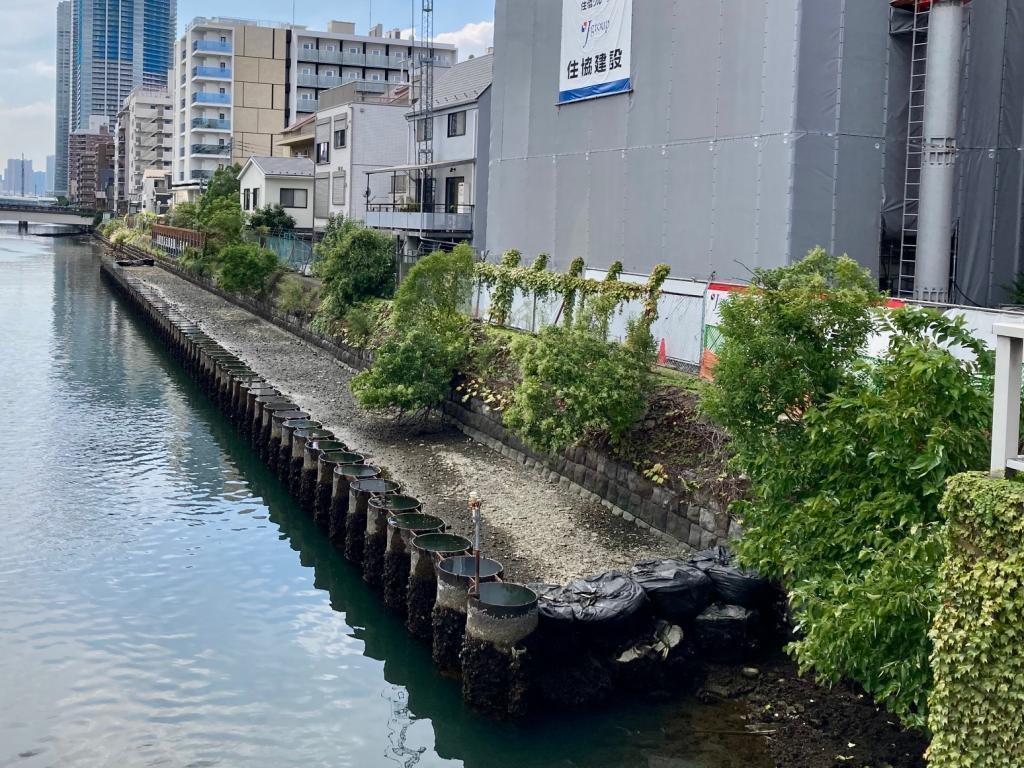
Photographed from Asashiobashi (north side)
At present, the two steps above the masonry of Meiji period are slightly visible, but if concrete is poured on it, the stones will be invisible. Like Shinsui-Koen Park on the north side, will some of the stone walls be reused in the form we see?
I'd like to look forward to it.
③Harutsuki-bashi Bridge - Tsukishima-gawa River
The west bank from Haruzuki Bridge to Tsukishima River, that is, the opposite bank of Harumi Triton Square, has not yet been reclaimed, and you can see the old masonry as it is.
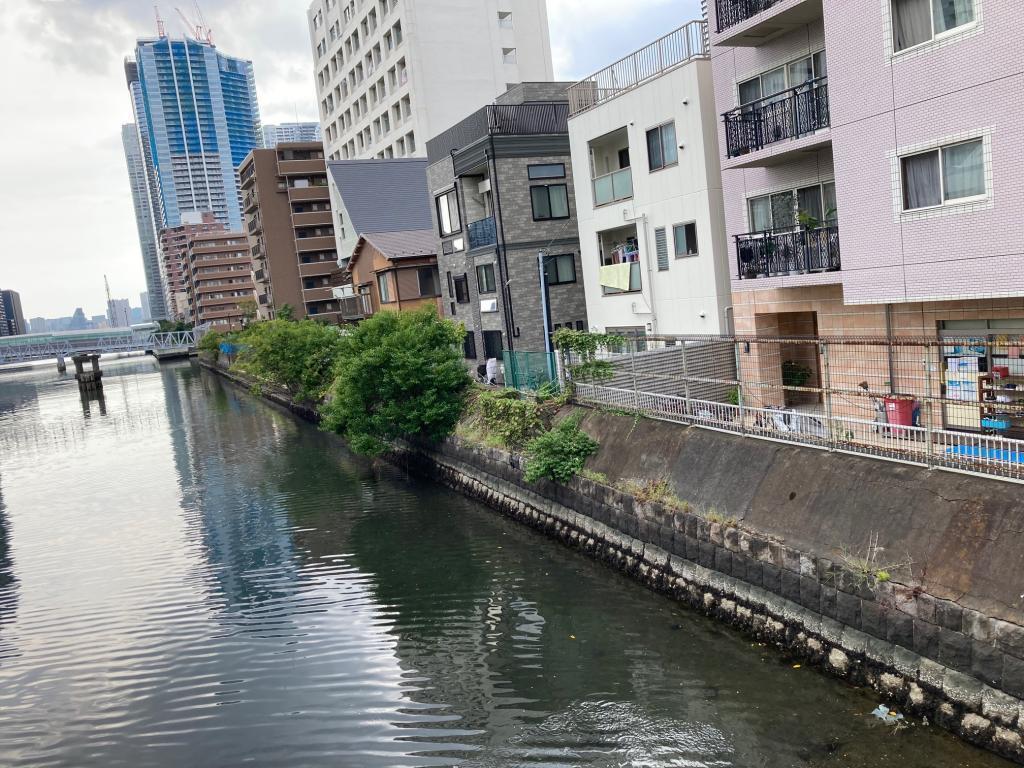
Photographed from Harutsuki-bashi Bridge (north side)
From the stone below where the shells are tight and the original shape is not clear, to the upper stone that shows that the stones are piled up neatly without gaps with the neighboring stone, four steps on this day I was able to confirm.
④Tsukishima Kawakita shore
Along the morning tide canal, you can see the stone walls of Meiji period on the surface of the water.
On the other hand, the northern quay of the Tsukishima River is completely covered with concrete, and the stone walls of Meiji period are not found anywhere.
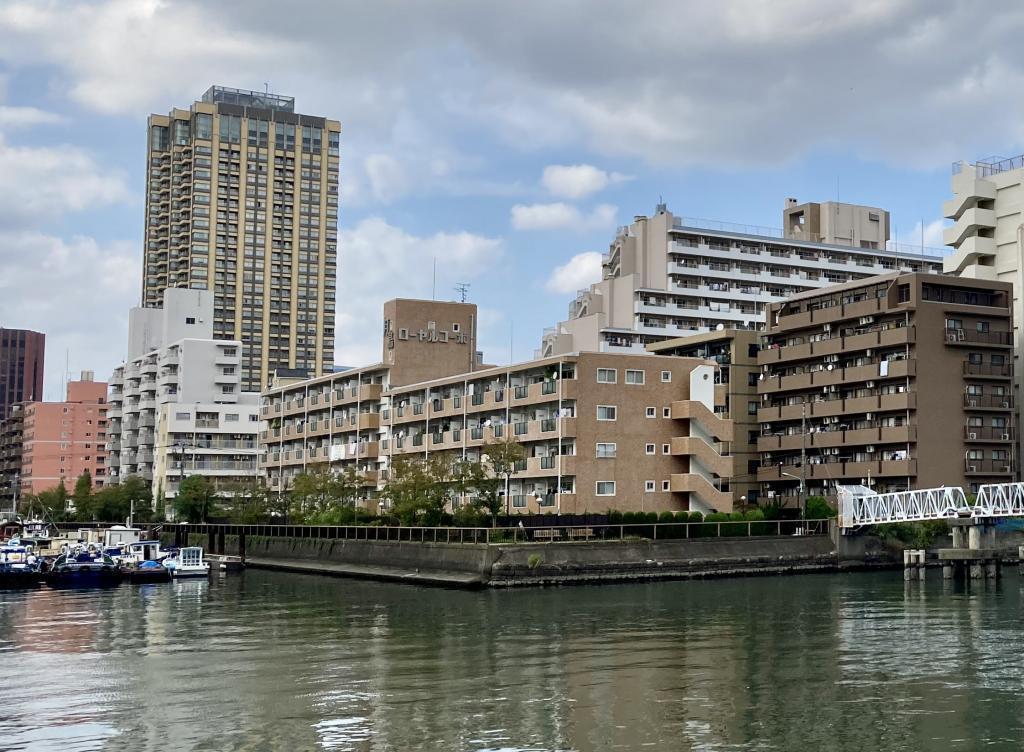
Photographed from Harumi Triton Square side (Photographer on the left side is the Tsukishima River)
The southern corner of Tsukishima 4-chome, which separates space and space.
If you approach here inadvertently, you may slip back in time to Meiji period! Laugh
⑤Tsukishima River - Reimei Bridge
Old stone walls can still be seen between Sakura Kobashi, a pedestrian bridge, and Reimeibashi (Harumi-dori St.).
The completion of Tsukishima No. 2 landfill site (currently Kachidoki 1-chome to 4-chome) located on the Kawaminami side of Tsukishima was completed in 1894, so the stone wall seen from Triton was actually piled up nearly 130 years ago. Thing.
However, at the time of the construction of Sakura Kobashi, a gentle slope is provided on the west bank side, and some of the stone walls are invisible due to the effects.
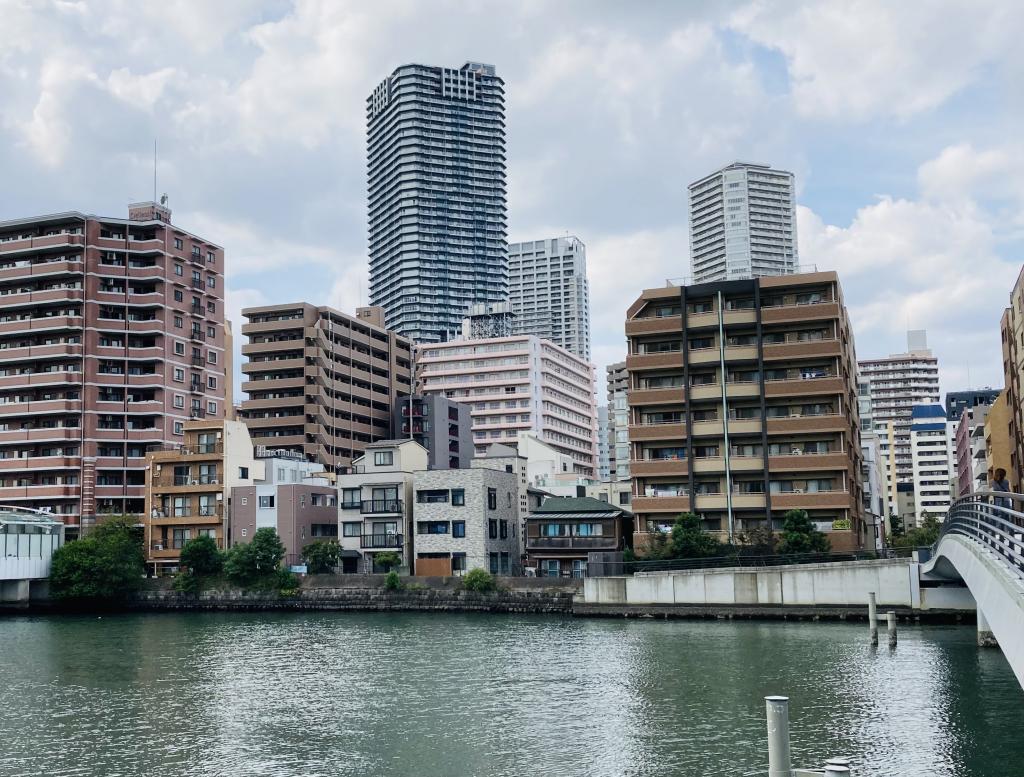
Photographed from Harumi Triton Square side (pictured: Triton Bridge on the left, Sakura Kobashi on the right)
⑥Reimeibashi - Shingetsu Shimakawa
Between Reimeibashi and Shinzuki Shimakawa, which are part of Harumi-dori St., the promenade has been developed along with the development of the Tower Mansion (Park Tower Kachidoki), and the stone walls have almost disappeared.
Only the part where the promenade at the base of Reimeibashi is cut (lower right of the first photo) can see the stone wall of Meiji period.
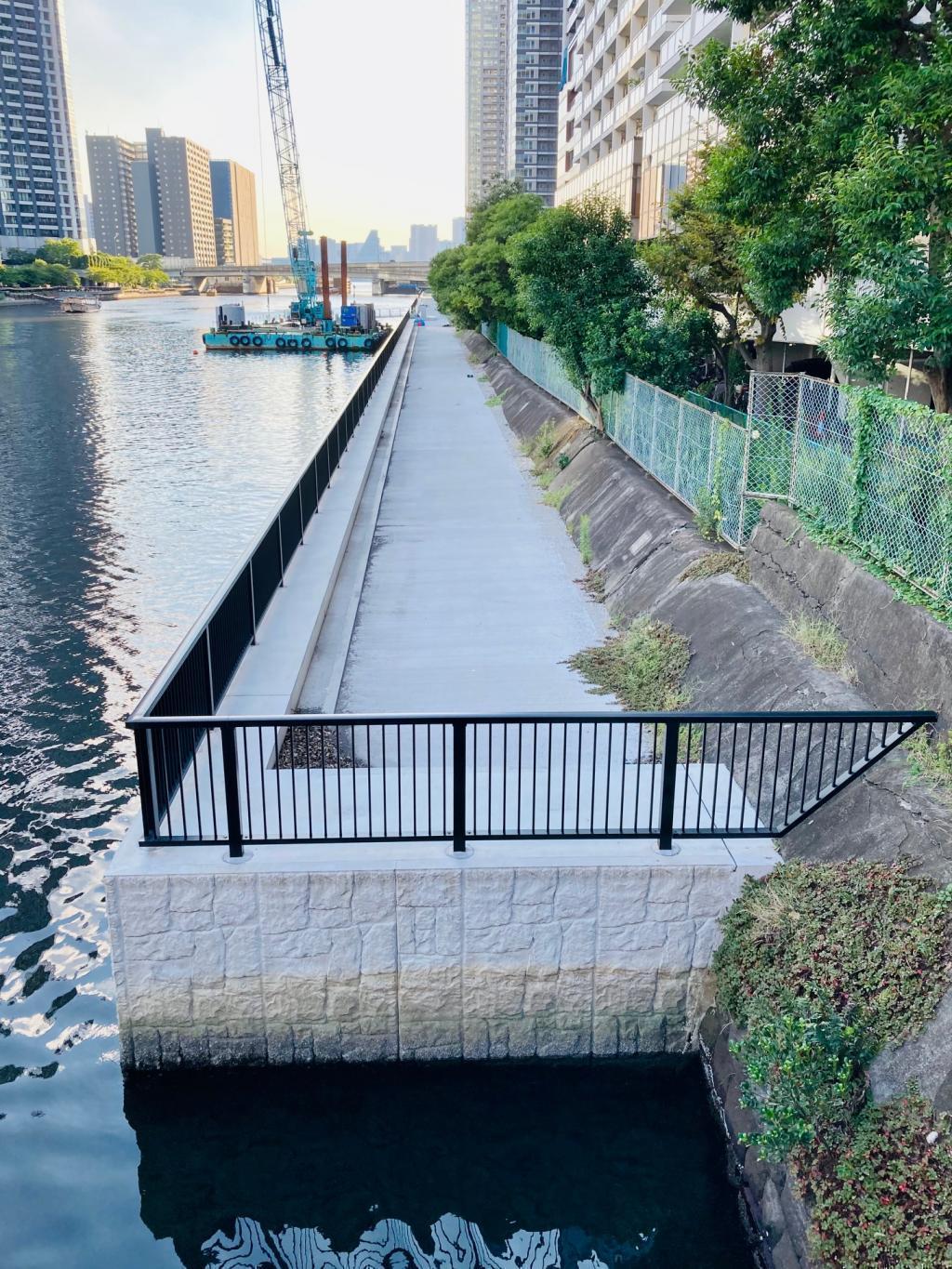
Photographed from Reimei Bridge (north side)
A disaster prevention dock will be set up on the morning tide canal side of Park Tower Kachidoki. In addition, the construction of a humanitarian bridge connecting the Harumi side and Kachidoki side is progressing, and if you start moving into HARUMI FLAG, an apartment used as an athlete village at the Tokyo 2020 Olympic and Paralympic Games, cross this bridge and go to Kachidoki Station It is likely that the flow of people going to Kachidoki Station will be born.
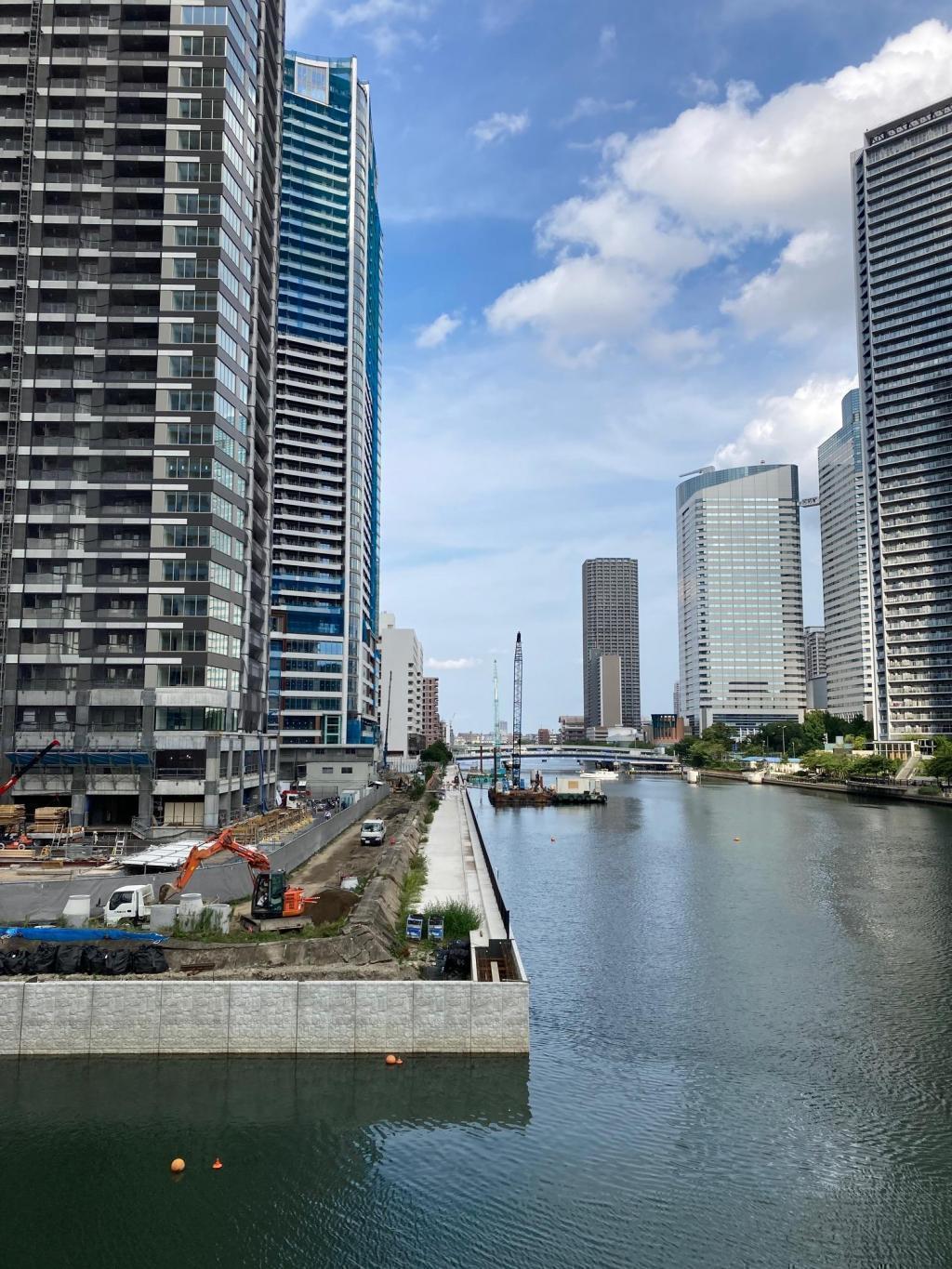
Shooting from Reimei Ohashi (south side)
⑦Shingetsu Shimakawa North Bank
The northern shore of Shinzuki Shimakawa is also in contact with the park tower Kachidoki site, and promenade is being improved.
As with the Asashio Canal side, the soil is piled up to the upper part of the stone wall, so the Meiji period stone wall seems to be completely invisible.
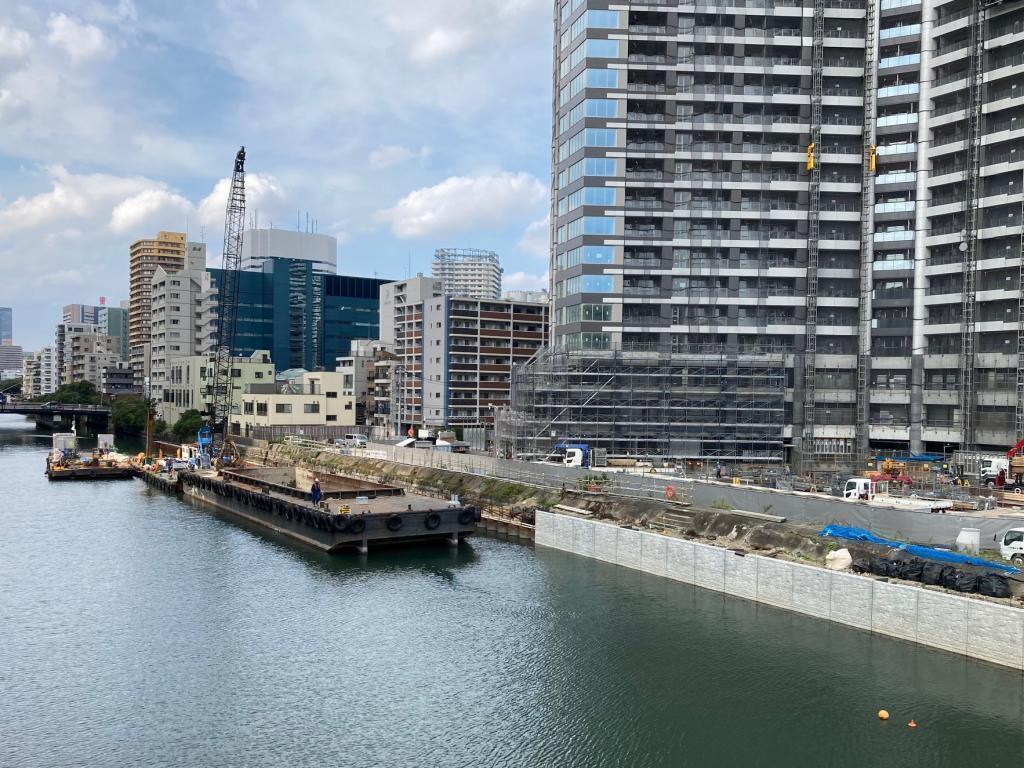
Shooting from Reimei Ohashi (southeast side)
Shingetsu Shimakawa flows from the foreground to the back left
However, if you look at the homepage of Park Tower Kachidoki, the visual of the promenade part is cut in the middle of Shinzuki Shimakawa, so maybe you can enjoy the stone wall near Niijima Island Bridge for a while now.
⑧Dawn Ohashi to Asashio Kobashi
Tsukishima No. 3 landfill site (currently Kachidoki 5-6), located south of Shinzuki Shimakawa, was completed in 1913. As a landfill, it is No. 3 land with a history of nearly 110 years, but no stone walls that make you feel the times canal are found no longer on the revetment of the Asashio Canal.
Because it is close to Tokyo Bay, a high seawall has been built, and new stone walls are piled diagonally at their feet. The beautiful colored stones have been transported during the construction of seawall improvement work conducted from 2017 to 2018.
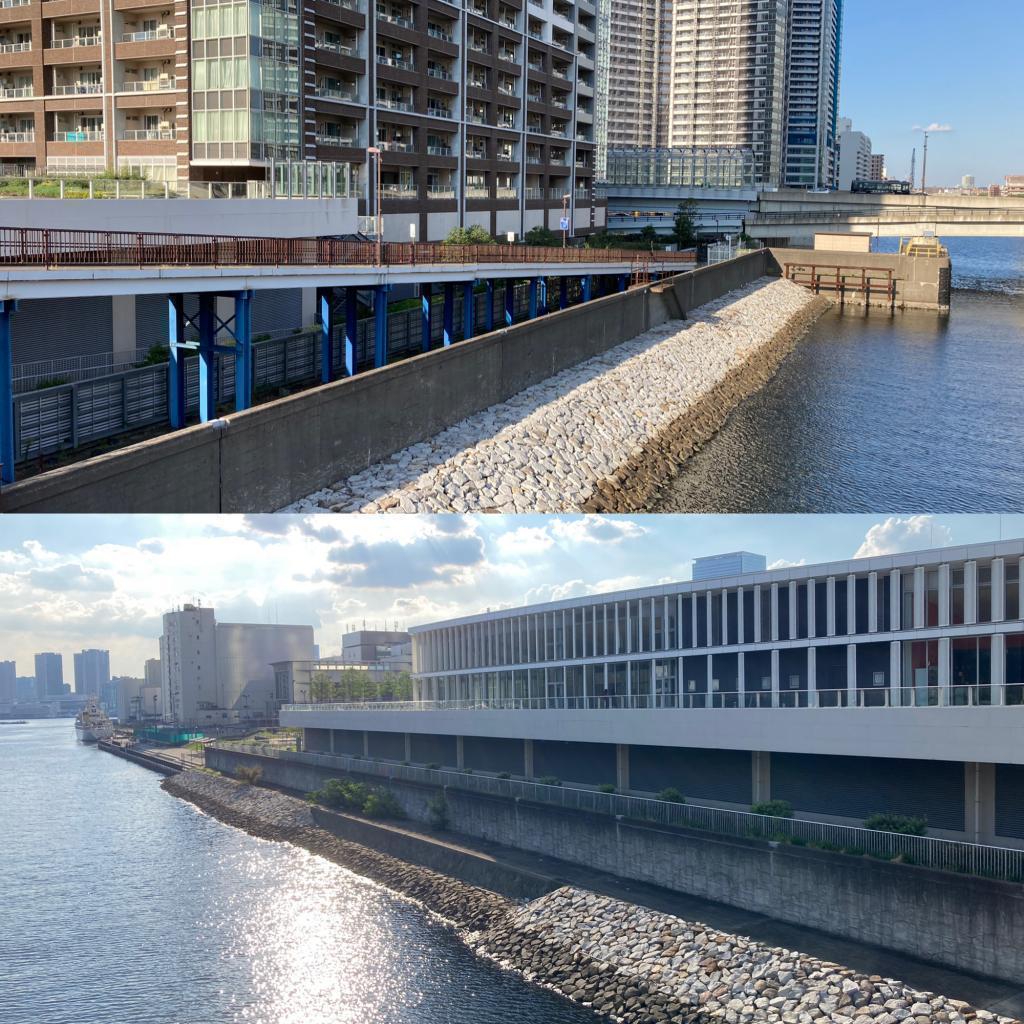
Above: Shooting north from Asashio Kobashi
Below: Shooting south from Asashio Kobashi
Tsukishima No. 1, No. 2, and No. 3, which were reclaimed from the Meiji era to the Taisho era.
Looking for a stone wall where you can feel the history, I walked along the Asashio Canal from north to south.
As the speed of regional redevelopment increases, the scenery around this area is changing every day.
Why don't you come to see the morning tide canal with your own eyes?