 Official
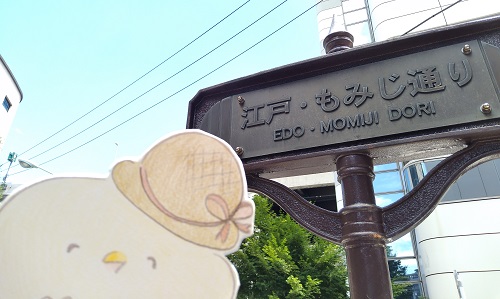
The sidewalk in Chuo-ku is interesting! 34.Momiji-dori Street, Edo
Hello, my name is Minato-chan.
The sidewalk in Chuo-ku is interesting! This is No. 34.
It's been three years since the last No. 33.
It’s been a long time since the series resurrection.
Thank you very much.
In Chuo-ku, a total of 99 routes (as of August 2023) are nicknamed for 43 routes in the Kyobashi area, 46 routes in the Nihonbashi area, and 10 routes in the Tsukishima area.
The nickname of the road tells the history of the town, has the affection of the local people, and gives the people who pass the road an opportunity to have an interest in the town and an attachment.
Minato-ko loves the sidewalks of Chuo-ku.
This time, we will walk along "Edo Momiji-dori".
It is a street from Nihonbashi 1-18, Nihonbashi River to Nihonbashi 3-15 and Yaesu-dori Street.
In 2003, the nickname "Edo Momiji-dori" was given.
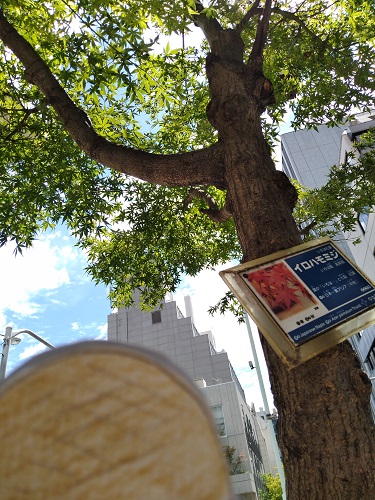
The street tree is the same as the nickname, Japanese maple.
It changes color every season and colors the street.
The green summer is bright now.
By the way, Toshin Beltway runs on the east side in parallel with Momiji Street in Edo.
You drive one more way than the road, cars.
A number of bridges across the car.
Yes, this road was originally a river.
It was called Kaedegawa River.
It is a waterway connecting the Kyobashi River and the Nihonbashi River, hitting the eastern coastline of Edo Maejima. It feels like the part of the Kaede River has been left as a waterway, and the landfill has progressed east.
Therefore, there was also a residence of Mr. Shogen Mukai Tadakatsu. Now, the main pillar of the shipping bridge remains.
Boat transportation, which had been important until then, ended its role with time, and instead increased traffic such as cars and trucks.
As the town changed rapidly toward the 1964 Tokyo Olympics, Kaedegawa changed its appearance to an expressway.
By the way, did you know that in Chuo-ku, the names of rivers include maple (Kaede), cherry blossoms (sakura), and autumn leaves (momiji)?
It's a stylish mix that is typical of Edo Chuo-ku.
The first Kaede River and the second Sakuragawa River are Hatchobori.
Originally, Hatchobori was called Hatchobori Funairi, which was built to protect Edo Castle and the city of Edo against attacks from the sea, and was located inside the embankment.
The name was given because the length was eight (872m).
At the entrance, Shogen Mukai was set up.
Yes, as the coastline moved, the sea gate number also moved.
At this time, there was no gunshot or Tsukiji.
After that, Hatchobori played an important waterway for boat transportation, connecting the Kamejima River and Kaede River.
Then, in the Meiji era, I changed my name to Sakuragawa.
Even now that the landfill of Tokyo Bay has progressed, the fact that the town name Hatchobori, Minato, and Irifune remains is very valuable in knowing the history of Tokyo.
By the way, what is the Miszume Momijigawa?
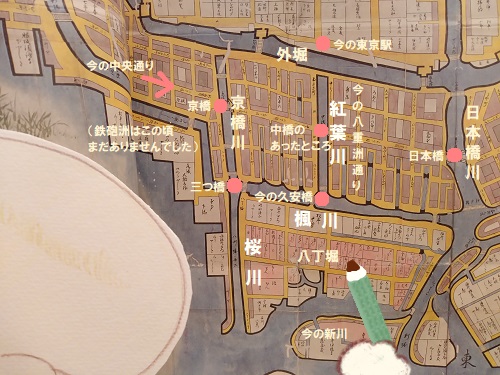
There is still no Hatchobori or Kaede River, dating back to the early days of Edo.
Between the Nihonbashi River in the north and the Kyobashi River in the south, there were nine moats in the direction of outer moat from the coastline (later Kaede River).
From 1-chome to 8-chome, there was one between the town, and the Kyobashi River and the Momiji River as a bypass to outer moat.
This was a "quay" dug for the construction of the retrenchment of Edo Castle.
The Momiji River is just on the current Yaesu Street. It is a line from around Kuyasu Bridge to outer moat.
You can see that in 1632 (1632), the oldest map in Edo, Toshima-gun, Bushu (Kanei era Edo map), which is said to be the oldest map in Edo.
The name Momijigawa is derived from the fact that water was pouring from Momijiyama in Edo Castle.
Right now, just around Kuyasu Bridge was the confluence.
There was a bridge called Nakahashi on the Momiji River. It is just around the intersection of Chuo-dori and Yaesu-dori.
Nakahashi…Speaking of which, the birthplace of Edo Kabuki!
In 1624 (1624), Saruwakaza, later Nakamuraza, raised a tower in the southern part of Nakahashi.
After that, the western half of the Momiji River will be Nakahashi Hirokoji Temple, and its character will be changed to a busy area as a firebreak area and with the birth of Saruwakaza.
Speaking of the Genroku era, it was just 100 years since Ieyasu entered Edo.
The coastline goes further east, and the gunshot and Tsukiji are also appearing.
At that time, these moats were also inland, and their role was completed.
The Kyobashi River, where the radish banks are located, and the Momiji River.
The Kyobashi River continued to help boat transportation and remained until the war, but the Momiji River disappeared around this time of the Genroku era, as if it were other moats.
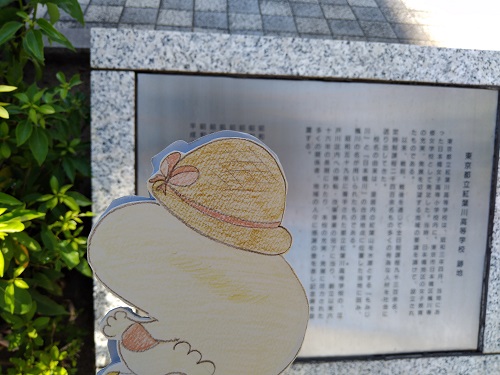
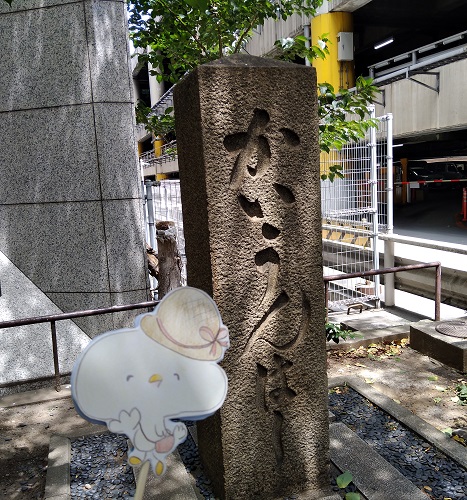
In addition, we found a monument that tells us that the Momiji River really existed.
It was the site of the Tokyo Metropolitan Momijigawa High School.
On the east side of the Kaede River (now Toshin Beltway), there is a stone monument with a height of your feet in the planting facing the sidewalk of the Central Police Station.
Tokyo Metropolitan Momijikawa High School was established in 1928 and was a school located in this area until it was relocated in 1984.
The monument also mentions that the former Momiji River is the origin of the school name.
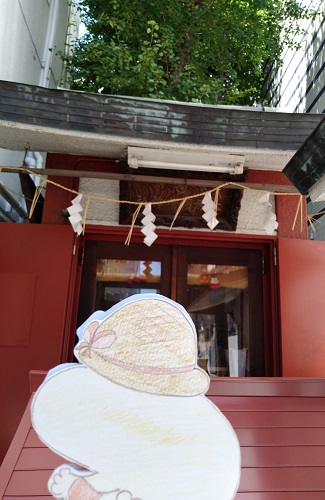
In addition, there is also Ohara Inari Shrine, which is considered to be the guardian angel of Boat Transport.
I'm sitting quietly between the buildings.
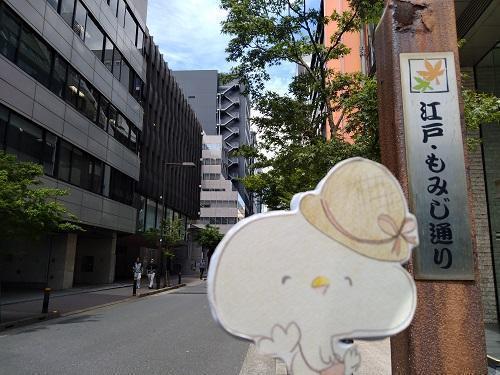
Look for the Momijigawa River in Maboroshi…。
There is no trace now, but it is interesting to think that the remnants of "Edo Momiji Street" remain in the name.
♪Reference "Chuo-ku Monoshiri Encyclopedia" Chuo-ku Tourism Association / "News from Kyobashi Library Local Room No. 57 Port Pier '16-Edo Minato no Natachi-" Masao Suzuki 1987 / "Kyobashi Library Local Room Newsletter No. 152 Edo / Tokyo River = Chuo-ku River" Kenji Sugawara 2015 / "Kyobashi Ward Historical Figure Collection Kyobashi Edition" Chuo Ward Kyobashi Library 1996 / Chuo FM 84.0 "Every week from Sunday to Sunday 14:5:0"

Chuo-ku Tourism Association correspondent Minato-chan
No. 191 August 1, 2023