 Official
Agata-i, Kamono Mabuchi
Kokugaku…
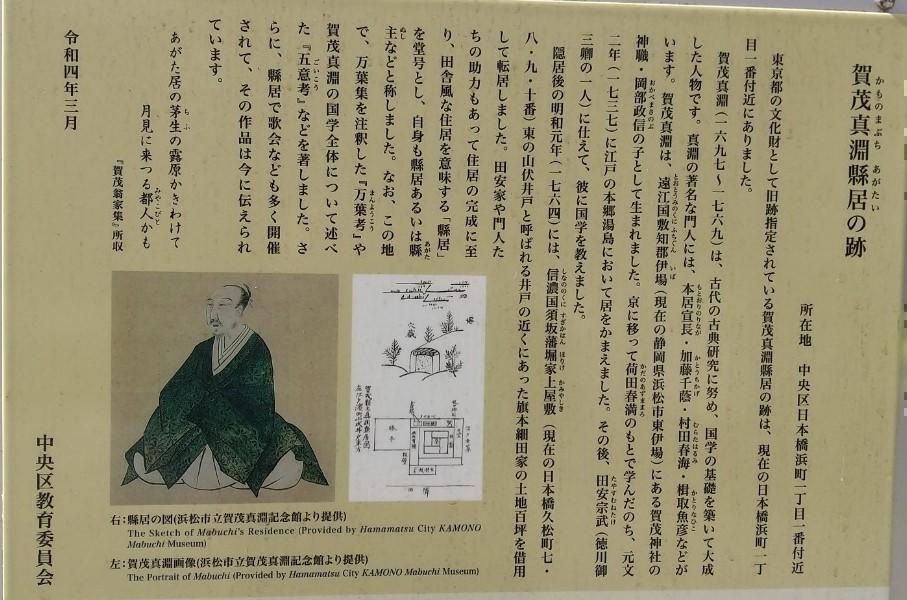
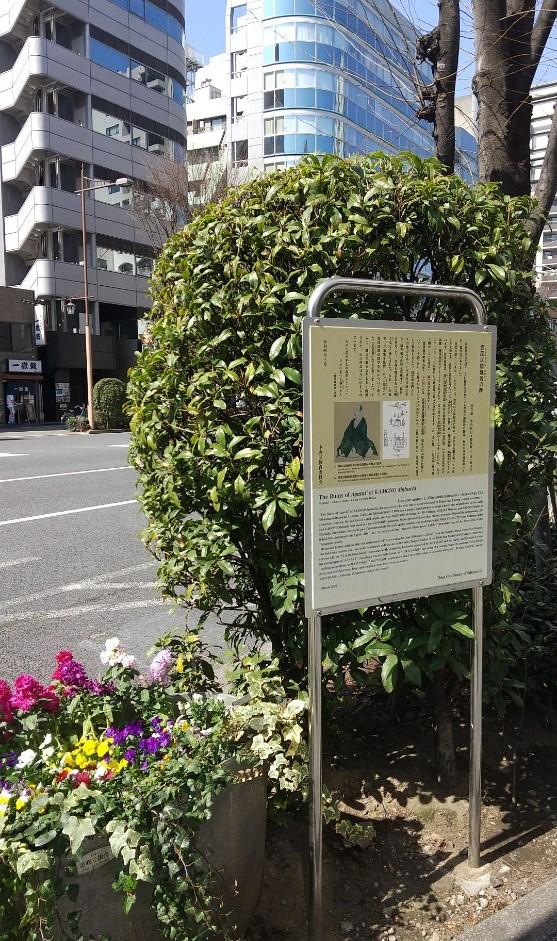
An explanation board of the ruins of Kamo Mabuchi Agatai, located in front of a drugstore on Cheongju Bridge Street near Meijiza. Kamono Mabuchi. You may well know if you are familiar with Shinto. However, I studied with people of national studies in Japanese history, but I don't remember the details.…Kokugaku wasn't the basis of nationalism during World War II. It feels dangerous, but is it okay? There may be people inside who think they pass by. I thought so. What did people in the Edo period think of Kamono Mabuchi and national studies?
Kokugaku which was popular among Edo townspeople
The ukiyo bath of Shikitei Sanma is a humorous book popular with Edo townspeople. (For information on Ukiyo Bath → Please refer to the previous blog "Edo Water of Shikitei Sanma") In Volume 3 of the Ukiyo Bath, there will be a conversation in a public bath between two women who believe in Motoori Norinaga (a disciple of Kamono Mabuchi) and laugh with Ohohoho. Their names are kamoko and Keriko. Maybe it's the end of the song. It is a name given by tearing classic lovers. It is a child who reads "Uto Ho Monogatari" (The Tale of Uto). Keriko, who is writing based on a new translation of Kamono Mabuchi and Motoori Norinaga's "Tama no Kogushi" to read "The Tale of Genji", but has not progressed easily. The names of classic books come out one after another. The appearance of the battle of knowledge, such as "Ukeragahana" by Chiin Kato, a disciple of Kamono Mabuchi. However, it is a story that the child ends with praise without laughing, saying, "Amajimono Abegawa Mochi is a good powder and lunch is good."
The only thing I found interesting when I read this story was that the two of them did not laugh at the last funny waka and thought they were intelligent. However, perhaps the townspeople of Edo were interesting because they had the knowledge of classics that came out one after another while laughing at the fact that there were people who understood national studies and classics. I think it's an episode that shows that national studies were familiar enough to be browned in humorous books.
Kyoka became popular at the same time as Kokugaku. Kyoka is the same verse as waka, 57,777, but while waka emphasizes the atmosphere and emotions, Kyoka is mainly humorous and satirical about the world. In order to make Kyoka, you must have a culture of waka and classics. Then add laughter and satire. Uchitoo Motoori, the son-in-law of Ohira, the adopted son of Motoori Norinaga, is a national scholar, but when he was young, he was also a kyoka artist called Jibiki no Hayami. Masamochi Ishikawa, who wrote the old-fashioned dictionary "Gagonha" and The Tale of Genji's commentary, was also a kyoka artist named Meshimori Yadoyano. It is an interesting kyoka name, but it seems that he was the son of a inn in Kodemmacho. It seems that some people did both national studies and kyoka. The people of Edo may have naturally acquired knowledge of national studies and waka when enjoying funny Kyoka.
And although there is no illustration in "Edo Famous Zoukai" in the late Edo period, there is an explanation as "The Land of Kamono Mabuchi Okina". Some people may have visited this area at that time because it is included in the Edo Famous Zoukai, a guidebook that covers historical sites of Edo.
It was surprising that difficult national studies and waka were familiar to the townspeople of Edo.
Origin of Kokugaku
In order to maintain the shogunate system and order, Edo shogunate chose Confucianism as an appropriate study, especially Shushigaku. In the same way that there is a distinction between the top and bottom in the heavens and the earth, Shushigaku is defined (the principle of the upper and lower statutes), and while keeping self-interest and self-interest and feelings in order to live in an orderly manner. He preached the need to keep in mind (reliable spirit).
Kokugaku is a study that criticizes the Shushigaku and seeks to discover the ancient Japanese nationalities and culture before Buddhism and Confucianism were introduced by learning classics. By learning Manyoshu's waka, Kamono Mabuchi decided to find a simple and straightforward spirit (high straight heart) and an ideal spirit for the masculine expression of the waka, and restore the unique spirit of the Japanese. Kamono Mabuchi's books include the study of "Manyoko" and Manyoshu's commentary "Kanjiko".
While Shushigaku was a discipline that was settled from the top, Kokugaku could be said to be a discipline that originated from the private sector in response to it. That's why I think it was popular with Edo townspeople.
What is Ianakura in Kamo Mabuchi County?
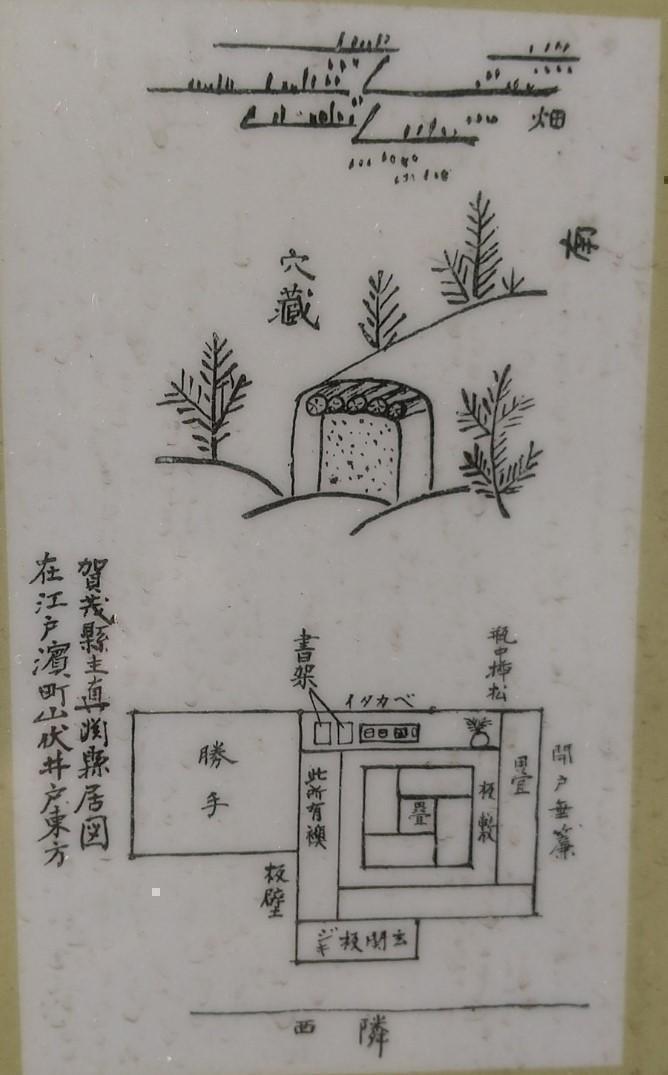
Map of the site description board of Kamo Mabuchi County
Because Kamono Mabuchi was a priest of Okabe Shingu Kamo Shrine in Hamamatsu, his family name was Kamo, and his name was Mabuchi from Fuchigun, where he was located.
Mabuchi studied national studies from a young age and was taught by Azumamaro Kadano in Kyoto. In 1750 (1750), he went to Edo to serve Munetake Tayasu (the second child of Yoshimune Tokugawa). After retirement, in 1764 (1764), he rented a land of 100 tsubo from the Hosoda family and built a simple house called Agatari residence. The eldest son of the Hosoda family was Ukiyo-e artist Eishi Chobunsai, who is said to have divided the popularity of Utamaro Kitagawa and beauty ukiyo-e. Eishi Chobunsai was still small when Kamono Mabuchi arrived, but Kamono Mabuchi's broad national studies may have had some influence on him, as the eldest son of a samurai but became a Ukiyoe artist. Kamono Mabuchi lived here until he died between the ages of 68 and 73.
Agatai is a state of making a garden like a countryside. The picture above is a sketch of Agatai. The main room is four and a half tatami mats. It is too narrow when the pupils gather and perform singing parties, so if you take up the kizashiki widely in the south and east and remove the fittings between them, you can use four and a half tatami mats and the kizashiki as one room. Was.
The garden is tens of tsubo. The west was illuminated by the moonlight, and the west raised a little soil and planted Wakamatsu around to create a hole warehouse. There is also a hole in the garden in the photo above. What is a jakura? Why? This is ready for a big fire. You must have stored important things in the event of a fire and protected them from fire. Did you even have your own writings? It's like an Edo town where there were many fires. The east of Anakura was made like Nobe and fields, and there were green leaves and wild biru were planted. It seems that there were two saplings and small cherry blossoms that had been dug from Mount Hakone.
There is a waka poem written at the moon viewing event on September 13 held in this Agatai.
There is no wild goose on the moon shadow of the sky and the moonlight of the autumn night (the wild goose rings in the clear sky of autumn night)
The inn in Agata was rough and told to who to come to see the moon. (Translation: Nobu blows and my house in the countryside was rough. Come to see the moon, if you tell whom shall I tell?
There are about 340 disciples of Mabuchi. One-third of them were women. I don't know how many people participated in this song, but I imagined a relaxed singing party where I wrote my favorite song regardless of gender.
National Studies during World War II
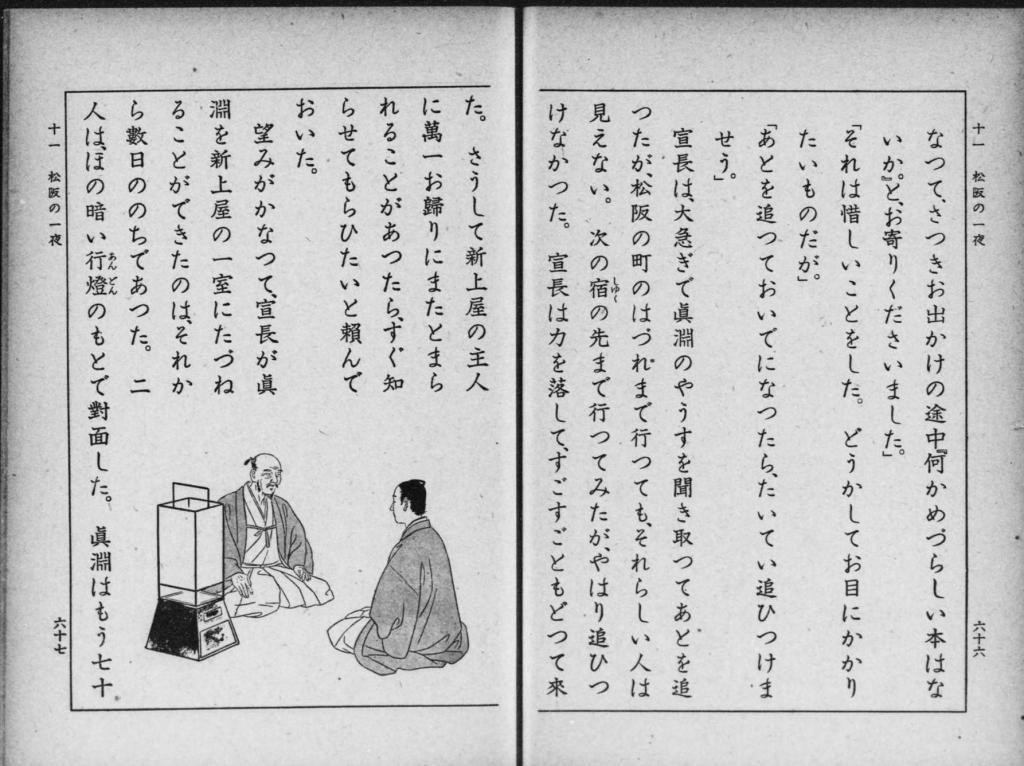
"Elementary School Osamu Osamu Yotsumatsuzaka Night" National Diet Library Digital, 1943
I think the following is the reason why some people like me think that the nationalistic idea of national studies led to World War II.
Song of self-admiration of Kamono Mabuchi's disciple Motoori Norinaga
"When asked about the Yamato heart of Shikishima, the yamazakura flower smells in the morning sun"
This is because when asked about what Yamato-shin is when he learns Chinese books and is absorbed in Chinese culture and culture, Nobunaga knows the beauty of yamazakura flowers shining in the morning sun, and is impressed by its beauty. It's a song that wrote my own heart to answer.
However, during the war, it was distorted as a song that symbolizes the samurai spirit of the entire Japanese people. Name of the Kamikaze Special Attack Corps The Shikishima Corps, Yamato Corps, Asahi Corps, and yamazakura Corps were also named from this song. It was used to beautify the death of war.
Also, the story of "Matsuzaka Night" that everyone who was educated before and during the war knows. (The photo above is Osamu's textbook during the war) Do you know? I didn't know. In summary, "Motoori Norinaga, who lived in Matsuzaka, had long respected Kamono Mabuchi. At one time Nobunaga heard that Mabuchi, who went to Ise, passed through Matsuzaka. I chased him quickly, but couldn't find him. However, I was able to meet Mabuchi on the way back from Ise. Nobunaga taught Mabuchi the idea of Records of ancient matters's commentary to Mabuchi, based on the dark lanterns of the inn where Mabuchi stayed. Mabuchi became old in the study of Manyoshu and couldn't reach Records of ancient matters. I entrusted the research of Records of ancient matters to Motoi if you could. The two formed a teacher-student relationship, and after that, they exchanged letters, but only met once. It was a night in once-in-a-lifetime encounter. Motoi completed the research of Records of ancient matters over the next 35 years."
When this story was adopted in a textbook, it was "once-in-a-lifetime encounter encounter" → "Importance of one class at a time" and "35 years to complete" → It seems that it was a teaching material that taught "the importance of continuing hard work even after school." However, the achievement of laying the foundations of learning was considered to be the achievement of building the Great Japanese Empire, and it was carried out before and during the war. After the war, all education and ideas had been denied. It seems that "One Night in Matsuzaka" was also deleted from textbooks because Japanese education was bad.
[Explanation version of the ruins of Kamo Mabuchigatai] Nihonbashihama-cho 1-chome Cheongju Bridge Street
[The nearest station] Hamacho Station on the Toei Shinjuku Line
[References]
"Kamono Mabuchi" Yasutaka Saigusa Kikkawa Kobunkan
"Mabuchi and Nobunaga: The History and Truth of the Night of Matsuzaka" Koji Tanaka Nakakou
"The History of Japan: 53 People Who Changed Japan" by Naoyoshi Koya Gakken
"Kunigaku to read gently" Nobuhiro Nakazawa Ebisu Mitsusho Published
"Eishi Chobunsai Exhibition Catalog" Chiba City Museum of Art
"Edo Famous Zoukai" (Chikuma Gakugei Bunko)