 Official
Chuo-ku, where children learn, "Jr. Chuo-ku culture and history Zukan"
This is Edamame, a correspondent with children.♪
Continuing from the previous time
"How do children learn about Chuo-ku?"
I would like to introduce a book that can be touched on.
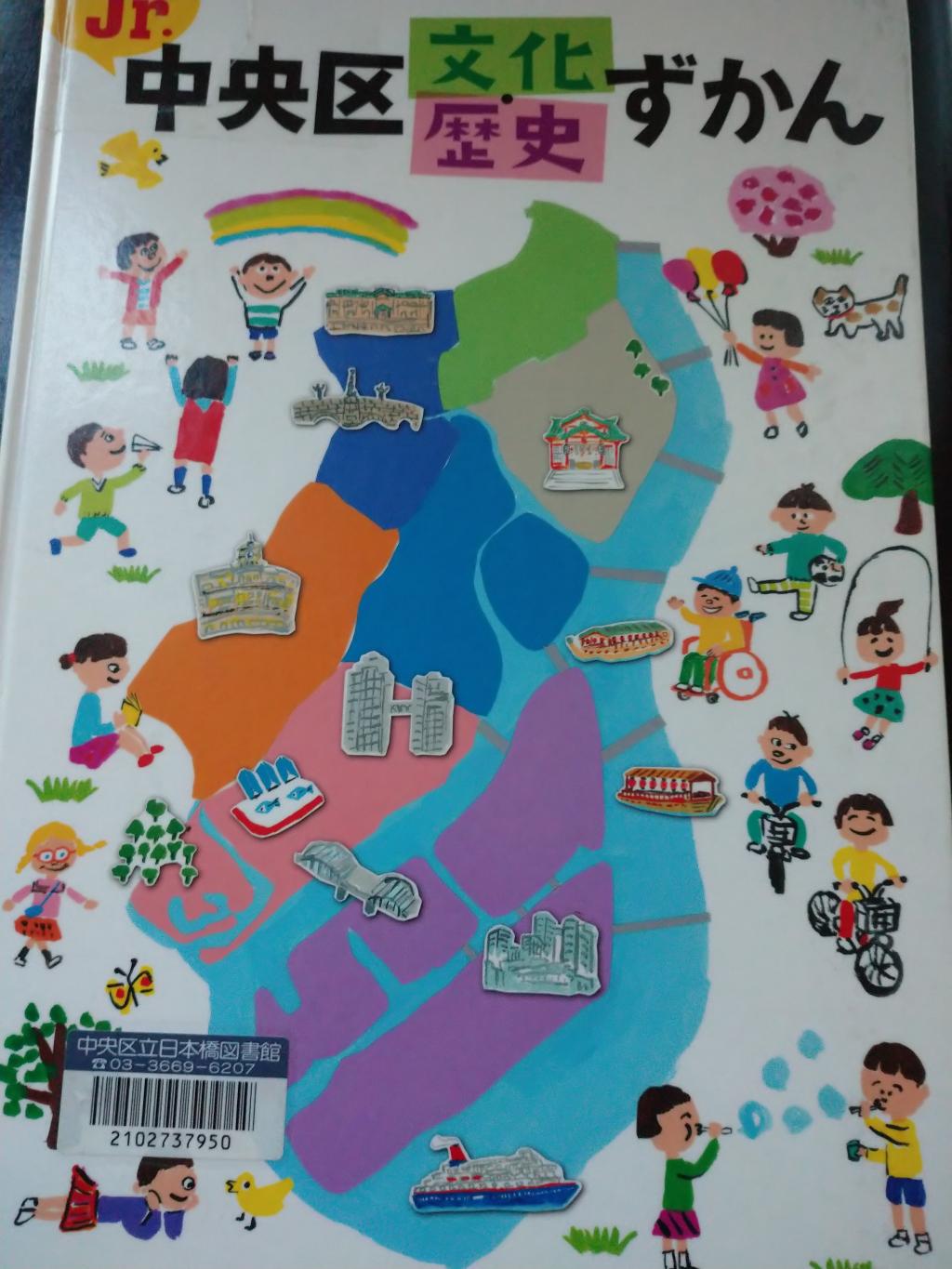
This time, I would like to introduce "Jr. Chuo-ku Culture and History Zukan".
What is "Jr. Chuo-ku Culture and History Zukan"?
This book was issued by the Chuo Ward Kyobashi Library in March 2013.
The history and culture of Chuo-ku are introduced in a very detailed manner so that it can be superimposed with Japanese history.
As an image ... From "Our Chuo-ku" introduced last time,
Isn't it like you delve deeper into the content?
As an editorial policy, the main target seems to be "elementary school upper grades".
https://www.city.chuo.lg.jp/kusei/kohokotyo/press/puresuheisei24/250401press.html
(↑ This is a press release from Chuo-ku government office at the time of publication.)
The content is quite varied!
It's the most important thing.
A total of 264 pages. It is a picture book with a lot of contents of A4 size.
I think you will mainly learn about Japanese history as a sixth grader in elementary school.
Based on that, the first half will appear as a set of the characteristics of each era and things and people related to Chuo-ku.
Of course, it also covers detailed events related to Chuo-ku.
Some things that are not listed in the official text of the tourism certification are also described here.
・・Thanks to you, I learned a lot.
(Theory that correspondents, mainly studying in the official text, are only in the official text (a great sweat))
For example,...
"Let's take a look at the stage of Kabuki" ... A detailed explanation of what the stage mechanism is going on. Plus, it also touches on the history of the Kabukiza building, which is now the fifth generation.
"Let's go to the factory!" ・・ ・ There were seven "Kansen Factory" in the former Kyobashi Ward from the early to mid-Meiji era. It was a place where one building was partitioned into a small room and rented to various merchants and operated, but the situation is explained in a spread manner.
"Hamarikyu that leaves the shape of the Edo period" ... Introduces illustrations as well as events and events (such as stories where elephants were kept here) that were in the Edo period. ・・ ・ I've never heard of a battle ...! ! !
In the second half, the characteristics of the current region and the highlights of the city (many of those that appear in the official text of the tourism certification) are introduced, divided by region. .
It also introduces the state of elementary schools in each region and the history of each school.
It is a very interesting place for a child-raising generation (or a generation with children going to elementary school in the future).
Chuo-ku, which has a specially recognized school system. There is also a pattern of going to school outside of the local elementary school.
(Please refer to the information on the Chuo-ku website for the specially approved school system.)
I found it useful to know the characteristics of schools that I might go to (laughs).
You can check the contents not only at the municipal library but also on the website! !
Okay, I'll have to go to the municipal library.
・・Everyone who thinks.
Actually, what's it?
The content of this book is published on the Internet in a considerable proportion.
http://www.library.city.chuo.tokyo.jp/kidstimes?15
Some pages are closed to the public.
(Mainly introducing schools at municipal elementary schools. There are quite a lot of children's faces ... so it's natural to lie down. )
It can be understood as a whole.
Even so, everyone who says that it is easier to read in the shape of a book.
Please be assured.
All three municipal libraries are in possession.
What's more, not one book per library, but a considerable amount.
So, can you get the loan procedure immediately with a considerable probability? I think so.
I hope you can pick it up in conjunction with "Our Chuo-ku"! !
★Chuo Ward Kyobashi Library★
1-1-1 Tsukiji, Chuo-ku 1-2 basement floor of Chuo-ku government office
03-3543-9025
★Nihonbashi Library, Chuo Ward★
1-1-17 Nihonbashi Ningyocho, Chuo-ku Nihonbashi Elementary School, etc. 6.7F
03-3669-6207
★Chuo-ku Tsukishima Library★
4-1-1 Tsukishima, Chuo-ku, Tsukishima Kumin Center 3F
03-3532-4391
★The website common to the three Central City Librarys★