 Official
Chuo-ku protected from typhoon flood damage
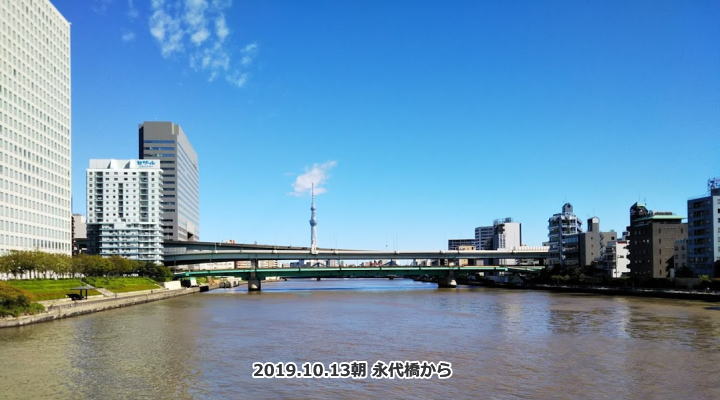
Typhoon No. 19 caused flooding of rivers throughout the country. It is not yet in the past, and it seems that there are many people waiting for rescue even as of the 15th. I would like to express my sincere condolences to all those affected.
The area of Toto, including Chuo-ku, has been suffering from repeated floods, but this time it was almost intact due to the multi-layered flood control facilities and the efforts of people involved in flood control. With great appreciation, I would like to introduce some of the flood control facilities that have protected us.
If Arakawa was flooded
First of all, take a look at the video "Maybe this happened."
This video shows the Kanto Regional Development Bureau of the Ministry of Land, Infrastructure, Transport and Tourism: It is called "Fiction Documentary" Arakawa Flood "H29.3 Revised Edition" produced by Arakawa Lower River Office. Upstream of Arakawa by Typhoon: Due to heavy rain falling around Chichibu, it is a live-action simulation when Arakawa overflows around the railway bridge on the Keihin-Tohoku Line, just slightly upstream of the Iwabuchi sluice (*). It depicts the terrible result that office districts such as Chuo-ku and Chiyoda-ku lose all functions. 。 。
※The current Sumida River branches off from Arakawa at the Iwabuchi Suimon (Kita-ku, Tokyo).
Chuo-ku, which is protected by multiple layers
Arakawa has been suffering from floods throughout the Toto area for a long time, so that the Araburu River is said to be the origin of the name. Conversely, flood control in the eastern capital has a long history beginning with the Tonegawa Togen in the Edo period.
Below, we will introduce some of the facilities that protected the Sumida River. It is a very simple introduction, so if you are interested, please refer to the link.
(1) Arakawa Floodway (current Arakawa)
As you know, in the past, the Sumida River was directly connected to the upstream of Arakawa. The rain that fell upstream of Chichibu was flowing into the Sumida River as it was. Thanks to the Arakawa Floodway completed by a major construction that took 17 years from 1913, and the Iwabuchi Lock that controls it, most of the water flowing through Arakawa is not the Sumida River. It began to flow to the spillway.
Transition of Arakawa Floodway (Arakawa Lower River Office)
(2) Chichibu 4 Dam
The upstream of Arakawa is in the mountains of Chichibu, but there are many dams here. The Urayama Dam, Nise Dam, Takizawa Dam, and Kakkaku Dam are called Chichibu 4 Dams. Above all, the combined water storage capacity of both Urayama and Takizawa dams, which started operation in Heisei, is more than 100m3!
Even in the huge underground of the metropolitan area outer spillway (which also prevented the flooding of small and medium-sized rivers such as Nakagawa), which is famous as an underground temple, the water storage capacity is 670,000 m3 (that is a tremendous amount), so Chichibu's dam The dependability is unlimited!
Arakawa Dam General Administration Office
Full operation of underground temple for the first time in four years (Asahi Shimbun)
(3) Arakawa Daiichi Reservoir, Lake Aya
Lake Aya started operation for the first time in 20 years due to this typhoon. Lake Aya has a storage capacity of 10.6 million m3. There is a total of 39 million m3 in the first reservoir. Currently, the 2nd to 5th regulating ponds are under construction and planning. This is another very reliable ally.
Reservoir (Arakawa Upper River Office)
Facilities of the entire Arakawa River (Arakawa Upper River Office)
(4) Sluice gates along the Sumida River
There are many sluice gates in Chuo-ku and Koto-ku, and the Tokyo Metropolitan Port Bureau and Koto Flood Control Office share and manage them. From the work of the sluice gate, it may be more about "protecting people from the Sumida River" rather than "protecting the Sumida River", but anyway, on the day of the typhoon, these sluice gates were closed one after another and strengthened their protection.
Locks "Closed Information" (from e-mail magazine of Koto Flood Control Office)
As of 14:09 on October 12 due to Typhoon No. 19, the following five locks have been closed.
Shin Onagi River sluice gate, Tate River sluice gate, Oshimakawa sluice gate, Sumiyoshi sluice gate, Tsukishima River sluice gate.
As of 15:00 on October 12 due to Typhoon No. 19, the following five locks have been closed.
Kamihirai sluice gate, Imai sluice gate, Shinkawahigashi sluice gate, MINAMOTO no Morikawa sluice gate, Uchikawa sluice gate
You saved me so much
Chuo-ku was protected by the multi-layered facilities of the Sumida River and Arakawa River and the efforts of the people involved in it. But where did "Rain that fell on the city center, including Chuo-ku" go?
The answer is a sewage treatment plant (currently renamed the Water Reclamation Center).
There are two types of sewage treatment: "merging type" and "split flow type". The combined type is a method in which rainwater and sewage (domestic wastewater including toilets) are treated without distinction, and the diversion type is a method in which rainwater and sewage are treated separately.
Unfortunately, sewage treatment in the city center is a "joining type", so if a typhoon like this or a long rain in July this year exceeds the treatment capacity of the water regeneration center, `` Sewage is almost as it is It will be washed into the Sumida River. " Because it is sewage containing not only rainwater but also sewage containing sewage, it is full of Escherichia coli and smells terrible. This summer, because of that, paratriathlon swimming competition in Tokyo was canceled.
Because it is a city where sewage treatment has been applied from an early stage in history, there seems to be a dilemma that the old-fashioned "merging type" has become a "separate type" in areas where sewage treatment has recently been completed. It is said that it takes more than 50 years of construction and more than 10 trillion yen to make the city center a diverting system from now on.
What a frightening story. 。 。
Current Situation and Issues of Combined Sewerage (Tokyo Metropolitan Sewerage Bureau)
Water quality of Odaiba Swim Cancellation Para Triathlon World Cup (Nikkei Shimbun)
Sewage discharge under Rainbow Bridge (posted by a member of the Diet above)