 Official
Extra Nagasakiya (2)
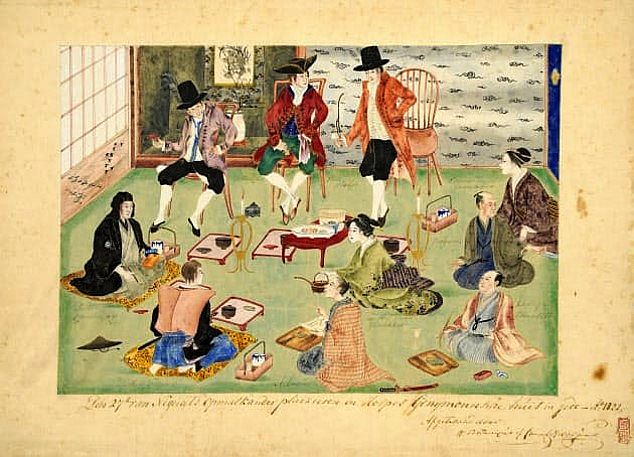
I have introduced this blog several times about Nagasakiya where Choichi Dutch trading post stayed in during the Edo period, but a new picture called Hoken Katsuragawa's "Nagasakiya Banquet Map" (1822, 1822) was discovered in the Netherlands and purchased it by Kanda University of International Studies. Since it was open to the public from November 1st to 14th, it was visited and on November 14th, a lecture titled "Reading Nagasakiya Banquet Map" (Lecturer).: Professor Emeritus Kiyoshi Matsuda, Kyoto University, participated in the event. I've heard an interesting story, so I'll report it briefly.
Known "Nagasakiya 2F Figure (Failke Brush)"
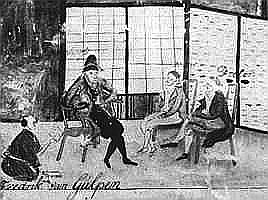
In the past, this drawing is well known as a painting depicting the second floor of Nagasakiya, but it was painted in 1810 by Jan Frederick Failke (1770-1814), a surgeon with a trading house. This exhibition was exhibited by Nagasaki collector Tokutaro Nagami as "Edo Nagasakiya 2F Figure" at the Japanese orchid Cultural Exhibition held at Nihonbashi Shirakiya in 1940. I'm afraid I don't know where this picture went.
Let's consider the second floor hall diagram that Hoken Katsuragawa newly introduced in 1822 while comparing it with the paintings of Failke:
1) According to the Dutch signature, the banquet was held on February 27, 1822 (April 18, 1822 AD). Director Blom Holtz arrived in Edo on February 5 (March 27) and had an audience with the Shogun on February 15 (April 6). After that, the party interacted with Dutch scholars Hoken Katsuragawa, Gentaku Otsuki, Genshin Udagawa, Sakuzaemon Takahashi and others in Nagasakiya.
2) Two shoji door sheets on the left, tokonoma on the front, and Karagami on the right are wallpapers on the floor to the ceiling. The pattern of the wallpaper of Hokenzu and the Karagami of the sliding door in the Failke figure have the same pattern with clouds scattered. It may be a hobby of Genemon Ehara, who credited Nagasakiya. However, the structure of the room is different.
3) In the diary of the director of the trading house on March 21, 1821, the Edo information that "there was a big fire in Edo and our dormitory was damaged again." Since Nagasakiya was rebuilt after this fire, the composition of the second floor may be different.
10 banquet participants
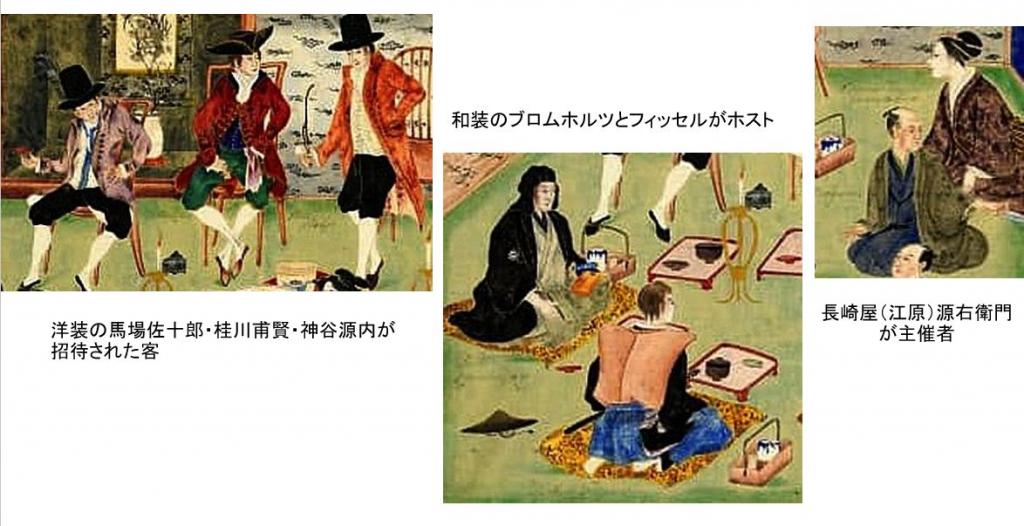
Genemon Ehara, who was 47 years old at the time, was a Japanese sitting directly on a tatami mat. Japanese-style Blom Holtz and Fissel serve as hosts, Western-style Baba sitting in chairs, Hoken and Kamiya are invited guests. It is probable that the main customer fell in a costume banquet was consulted by magistrate's office Nagasaki and Genemon Nagasakiya, and was generously devised to teach Shokan Choichi about Edo's luxurious life and etiquette. Fishel, who was a play-like, seemed to be in good mood.
Fissel looks out the white tabi of both feet from the hakama, a black lacquered hat on the left side, and a hand-held tobacco tray on the right side. Blom Holtz, the director of the trading house, has a smoke tube in his right hand, puts a reddish brown pocket on his left knee, and a hand-held tobacco tray on the left side.
Hoken wears a triangular cap and wears a red rock coat on a embroidered waist. The appearance of Sajuro Baba and Gennai Kamiya is basically the same as Hoken, but the hat is not an outdated triangular hat of Hoken but a trendy mountain high hat.
The play-loving Fissel said about this disguise banquet, "I laughed bitterly at the Western-style Chighag." The Dutch clothes worn by Japanese people have been collected over a long period of time, and it was extremely strange to wear them in combination.
Reference:
Fissel "Remarks of Japanese Customs" Heibonsha, Orient Bunko, Page 242
Kanda Sano Bunko Exhibition Catalog: The second floor of Nagasakiya - Orchid studies before Siebold -