 Official
Chuo-ku, which can be seen from "Edo Famous Spots Zue"
Mitsumata edition of Shinohashi Sanpa
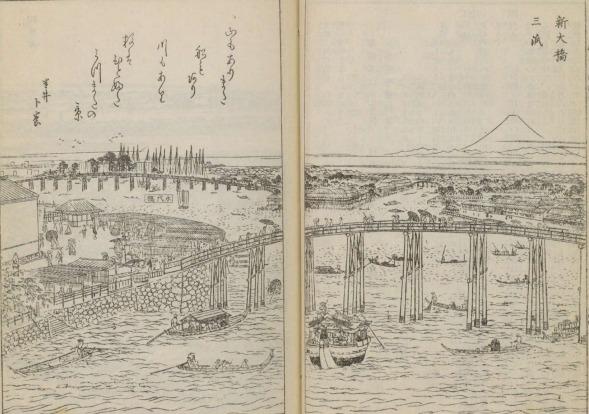
"It is located downstream from Shinohashi Ryogokubashi, and from Hamacho to Fukagawa Rokumabori. It is about 180 square meters long. This bridge is the first time in Genroku 6th year of Kishi Rooster [1693]. The old name of Ryogoku-bashi Bridge is Ohashi. By his name, he was called Shinohashi.' "Shinohashi Three Schools" "Edo Famous Zoukai" from the Digital Collection of the National Diet Library
The present neighborhood of Nakasu
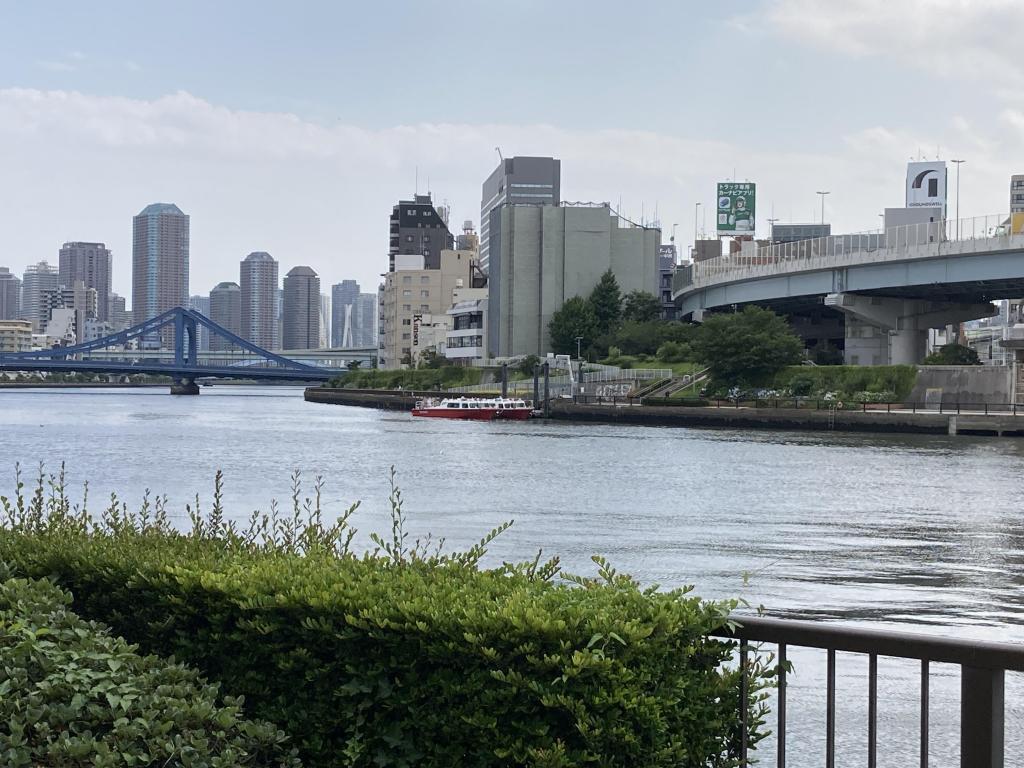
This photo was taken in June 2023 of Nakasu depicted in "Edo Famous Zoukai". First of all, Nakasu Park in Chuo-ku is the green area facing the Sumida River. It is the overpass of the Metropolitan Expressway Mukaijima Line that enters as if it is sucked into the green. Once upon a time, the Hakozaki River flowed under it. Looking at the left side of the photo, you can see Kiyosu Bridge (blue) modeled on suspension bridge in Cologne, Germany, the high-speed part (white) of the two-story Sumida River Ohashi, the Eitai Bridge (light blue) behind it, and the pillars of Chuo-ohashi Bridge (white), and the skyscrapers of River City 21 behind it. Again, let’s try to fix the history.
1693: Shinohashi Bridge (somewhat downstream from the current position)
1698: The Eitai Bridge Bridge (about 150 meters upstream from the current location)
1928: Kiyosu Bridge Bridge
1979: Sumida River Ohashi Bridge
1986 Start of River City 21
1993: Chuo-ohashi Bridge Bridge
What is important here is that the bridge location of Shinohashi and Eitai Bridge is different from the current location. In the picture, two bridges, Shinohashi and Eitai Bridge, are drawn. So this time, I went downstream from the current Shinohashi and took a picture. There are no Kiyosu Bridge, Sumida River Ohashi, and Chuo-ohashi Bridge during the Edo period. Of course, River City 21 has not been built. But the Eitai Bridge is real. If you think that it is 150m upstream from the present, you may be able to achieve consistency between the picture and the photo.
Mitsumata
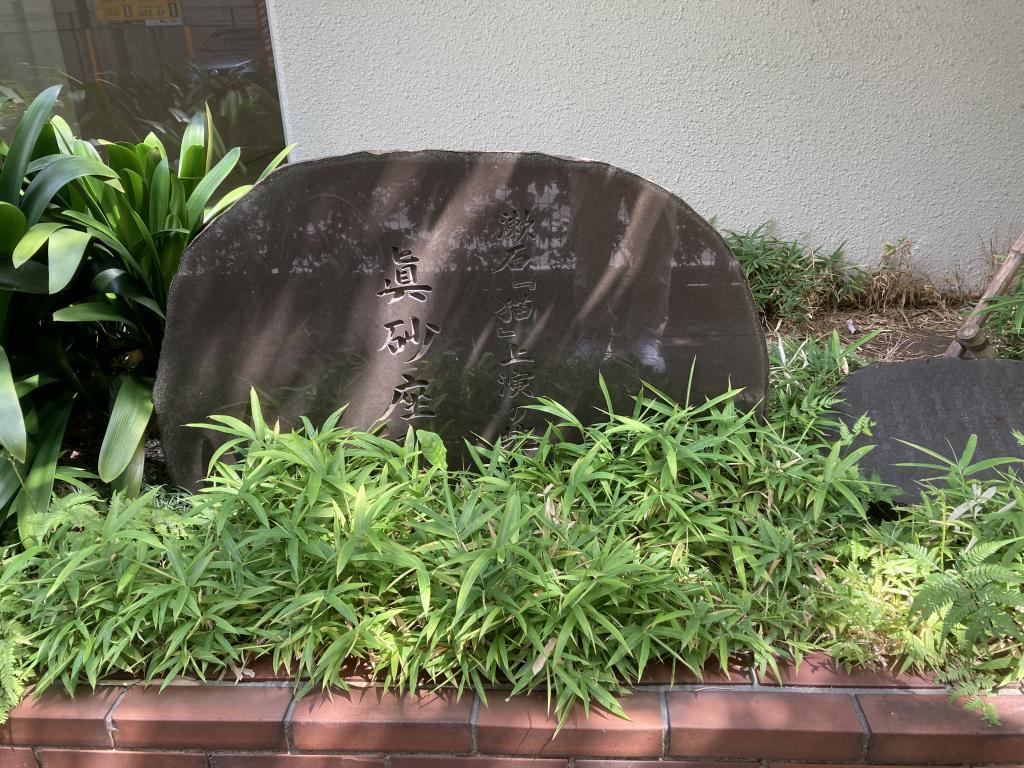
"It's a branch school under Shinohashi. The flow between the Asakusa River and Hakozaki is divided into the flow (this place is the edge of separation, when the tide is divided between the tide and the water, it is Koyuifu). Recently, it has become a famous place of the moon (by the way, Ifu, Meiwa 8th year Shinu [1771], buried the middle school and became a living person, and called Nakasu. However, at the time of the flood, the letter came to the year of the Kansei Moto Rooster [1789], and the moat of the river like the original). " "Three Schools" and "Edo Famous Zoukai" from the Digital Collection of the National Diet Library
And it was written in "Edo Famous Place Map", but was reclaimed in 1886 (1886) and called Nakasucho. Speaking of Nakasu, we must not forget the Masago-za, which opened in 1893 (1893). However, transportation was not good and customers were far away, and in 1917 (1917), it was closed. The prosperity of Nakasu's Hanayanagi-gai did not last long. Then, in 1971 (1971), the Hakozaki River, which flowed at the border between Hamacho and Hakozaki-cho, was reclaimed and connected to land. Today Nakasu is a quiet apartment town.
River City 21 with sailboat support
Finally, I felt it by comparing the picture with the photo, and I would like to write that and finish this blog. I didn't feel as if the sailboat's columns depicted after the Eitai Bridge in the picture were foreseeing the skyscrapers of River City 21 after the Eitai Bridge in the picture.